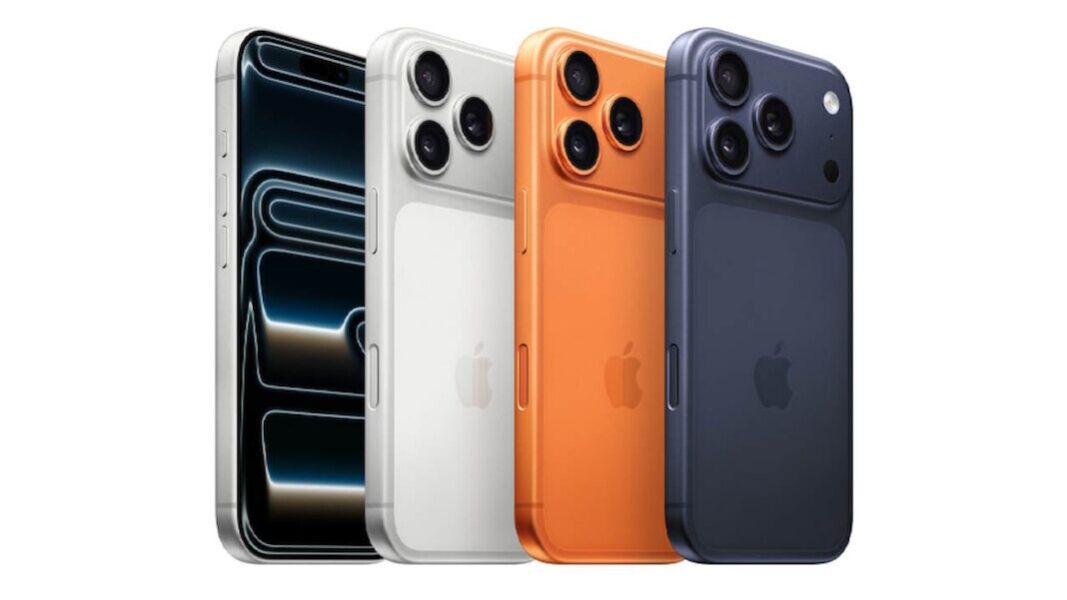
- Apple Talks: Apple is reportedly weighing PrismML’s AI compression technology.
- Phone-Sized Model: PrismML’s one-bit Bonsai 27B stores a 27-billion-parameter model in a 3.9 GB package.
- Quality Tradeoff: Lower-precision weights save memory, but PrismML acknowledges modest accuracy loss, with factual recall weakening first.
- Scale Testing: Millions of queries across many device combinations must test speed, energy use, heat, accuracy, and reliability.
Apple is reportedly considering AI compression startup PrismML’s models for larger on-device AI. The early discussions do not confirm a partnership, acquisition, integration, or product deployment. PrismML released Bonsai 27B in one-bit and three-value variants on July 14, providing a confirmed 3.9 GB package for Apple to test.
Apple reportedly plans to use PrismML compression for larger iPhone AI models. Bonsai 27B belongs to Alibaba’s Qwen model family and is presented as the first 27B-class model on a phone. Its one-bit package occupies 3.9 GB, compared with 5.9 GB for the three-value variant.
Each parameter is a stored value that shapes model behavior. PrismML designed the smaller package to fit within the iPhone 17 Pro’s memory budget, giving Apple a public artifact to test rather than proof that it will adopt the technology. Keeping more AI processing on-device could improve speed and privacy by reducing dependence on external servers.
Apple will reportedly be evaluating speed, energy efficiency, and on-device performance. PrismML CEO Babak Hassibi acknowledges a modest accuracy loss when using the model, with factual recall weakening before reasoning, mathematics, and coding skills. Bonsai 27B reaches up to 163 tokens per second in its one-bit format on an Nvidia GeForce RTX 5090, although desktop throughput will differ from iPhone performance.
How PrismML Shrinks a 27-Billion-Parameter Model
PrismML uses quantization, which stores model weights with fewer bits to save memory. Its method replaces each 16-bit weight with either one bit or one of three values. Low-bit compression lets limited-memory hardware load a package that would otherwise require roughly 54 GB.
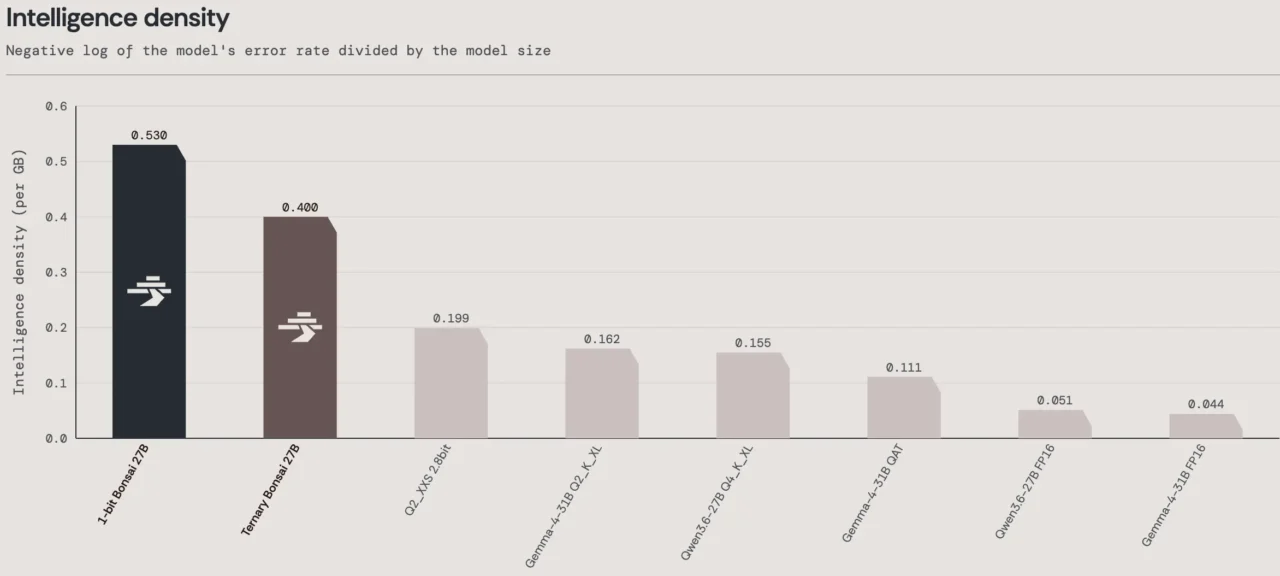
Against PrismML’s chosen baseline, Bonsai 27B uses 14 times less memory, runs up to eight times faster, and consumes five times less energy in the company’s tests. Reducing Bonsai 27B’s weights to one or three values saves memory by discarding some detail from the original model. PrismML CEO Hassibi puts the accuracy cost at a few percentage points of performance, with factual recall weakening before reasoning and coding as the weights lose precision.
Public weights on Hugging Face and a linked whitepaper expose PrismML’s evaluation method to scrutiny, but they do not establish reliable performance across consumer workloads. Sustained iPhone use adds separate limits: battery capacity, heat dissipation, response speed, and output accuracy. Device memory must also accommodate the operating system, applications, and working data, so a model file cannot consume the phone’s entire memory budget.
Scale Testing and a Crowded Mobile AI Field
AI phone deployment requires evidence beyond just one compressed package. PrismML’s technology still requires extensive real-world testing across iPhone workloads and device configurations. Tarun Pathak, research director at Counterpoint Research, defines readiness in query volume and hardware combinations.
“The ultimate test will be millions of queries, thousands of device combinations and robust testing at scale.”
Tarun Pathak, Research Director at Counterpoint Research (via CNBC)
Testing at that scale will need to determine whether performance remains consistent during sustained use, not merely whether the model fits in memory. It will also need to reveal how response speed, energy use, heat, output accuracy, and reliability vary across workloads and hardware combinations. Repeatable results would separate a downloadable compressed model from software dependable enough for routine consumer use.
Apple may route some sensitive AI requests through Private Cloud Compute, its server system for work that cannot stay on the device. More local inference could reduce network dependence and keep more data on the phone. PrismML would supplement rather than automatically replace Apple’s existing hybrid AI architecture.
PrismML also enters an established mobile deployment field. Google’s mobile-oriented Gemma model versions reduce the memory footprint of Gemma 4 E2B to about 1 GB through quantization and cache optimizations. PyTorch’s ExecuTorch edge-inference runtime targets phones and other constrained devices with acceleration across several processor types.
The open-source MLC unified engine spans iOS, Android, web, desktop, and server systems. Its compiler-backed design maintains one model-serving layer across platforms instead of requiring an unrelated runtime for each target. Apple can compare the available tools and formats by measuring repeatable quality, battery life, speed, and reliability rather than parameter count alone.
Independent testers can use PrismML’s released weights to measure those qualities across iPhone configurations. Bonsai 27B is available, but no Apple deployment timetable or deal exists. Apple would have to identify Bonsai 27B in an iPhone product plan and set a release timetable before users could receive it.