- EU Order: The European Commission, the European Union’s competition regulator, has required Meta to restore free WhatsApp access for rival AI assistants.
- Regional Access: OpenAI confirms that users can reach ChatGPT through WhatsApp across the 30-country European Economic Area, not worldwide.
- User Access: Users can message OpenAI’s verified +1-800-242-8478 contact without an account, but eligibility follows the WhatsApp number’s country code.
- Open Case: Meta must preserve free access while the investigation continues, and the final decision will determine whether that obligation remains.
European Commission officials ordered Meta in June 2026 to restore free access for rival AI assistants through the historical WhatsApp channel within five working days. As the European Union’s executive and competition regulator, the Commission imposed temporary requirements while its antitrust investigation continues. Regulatory intervention changes access during the case without resolving whether Meta’s underlying policy was unlawful.
OpenAI now confirms that users can reach ChatGPT through WhatsApp across the European Economic Area (EEA). Its 30 countries comprise the European Union’s 27 member states plus Iceland, Liechtenstein, and Norway. Access has returned only within this region, not worldwide, and its availability elsewhere remains unresolved.
European users can again interact with ChatGPT inside WhatsApp, but eligibility follows the WhatsApp number’s country code. A traveler in the EEA whose number is registered elsewhere may remain ineligible. OpenAI also warns that access may arrive gradually and remains subject to usage limits.
How ChatGPT Access Works
Users can start by saving OpenAI’s verified +1-800-242-8478 contact, branded 1-800-CHATGPT, and sending it a WhatsApp message. Basic use does not require a separate ChatGPT account. OpenAI introduced the original phone-and-WhatsApp service in 2024, making the current change a restoration of an established access route.
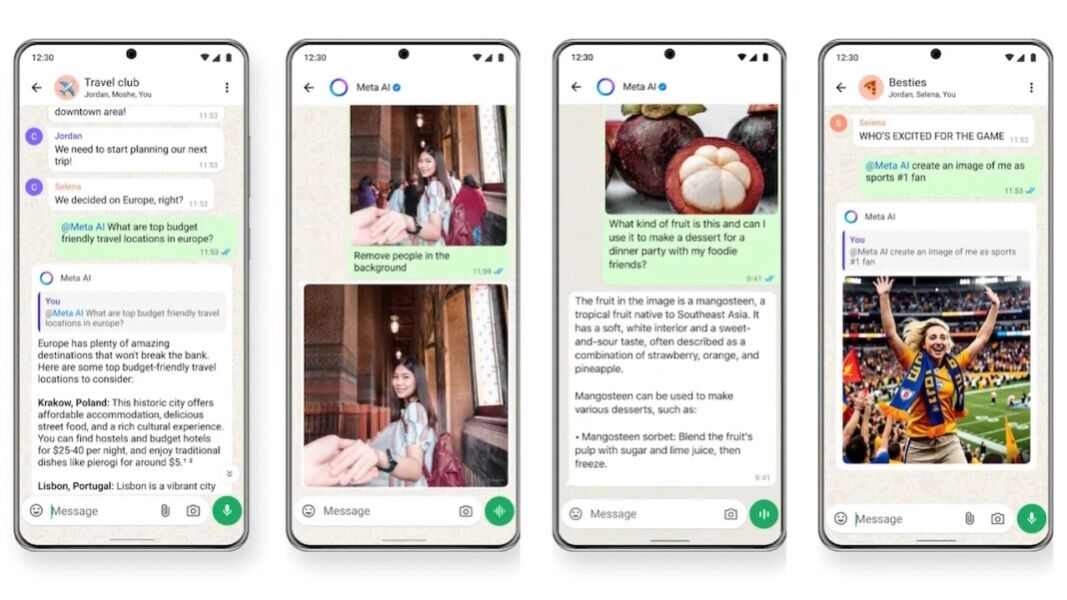
Image and voice support later broadened the service beyond text. Users may receive text, image, and voice-message support, including generated pictures. Those interaction formats remain separate from the legal question of whether competing assistants can reach users through WhatsApp.
No new model accompanies the access change. For European users, the practical development is restored WhatsApp distribution rather than a separate model release. OpenAI continues to describe 1-800-CHATGPT as experimental, so gradual access and usage limits remain part of the service conditions.
An experimental contact differs from a full ChatGPT app experience. The messaging channel controls how users enter and continue a conversation, while eligibility, rollout pace, and usage caps can affect access even when the same user can open ChatGPT elsewhere. WhatsApp remains a distribution route with its own operational limits, not a replacement for every other ChatGPT interface.
Users may link a ChatGPT account to use existing account information and synchronize message history. Account-free use avoids that setup, while account linking provides continuity with prior ChatGPT activity. Both routes remain subject to the country-code gate, gradual availability, and usage limits.
How Meta’s Ban Became an EU Competition Case
Meta had changed its WhatsApp Business rules in October 2025 to restrict general-purpose AI chatbots. Under the changed WhatsApp policy, providers can not use the business platform when a general-purpose assistant was their primary service. Companies could still deploy AI for ancillary tasks such as customer support.
Meta’s rule turned on what a provider offered through WhatsApp rather than prohibiting every automated tool. A retailer could still use AI to answer support questions, but a company selling a general-purpose assistant could not use the same channel. Meta’s product-based division separated assistants competing with Meta AI from AI embedded in other business services.
On December 4, 2025, the European Commission opened a formal antitrust investigation into whether the policy breached EU competition rules. Meta removed ChatGPT, Microsoft’s Copilot assistant, and Perplexity’s AI assistant on January 15, 2026, while keeping its own Meta AI chatbot accessible. Rival assistants lost a messaging channel that Meta’s own service retained.
Meta proposed fees of €0.049 to €0.13 per message in March as a solution. These costs would grow with conversation volume, and the Commission assessed that such pricing could reproduce the ban’s exclusionary effect for high-volume services. Requiring the earlier free terms removes that per-message cost while the investigation continues, although Meta still controls WhatsApp’s infrastructure.
Under the interim measures, Meta must preserve access on the free terms that applied before it changed the rules in October 2025. The Commission had previously warned that such requirements could follow while the investigation continued. Rival providers now receive immediate distribution relief without a final liability finding, and Meta retains responsibility for operating the platform during that period.
Free access under the interim order changes the immediate outcome without deciding the investigation. Meta could still face fines of up to 10% of global annual turnover, plus daily penalties of up to 5% of average daily turnover, for non-compliance. A final European Commission decision will determine whether Meta must continue providing free WhatsApp access to competing AI assistants.