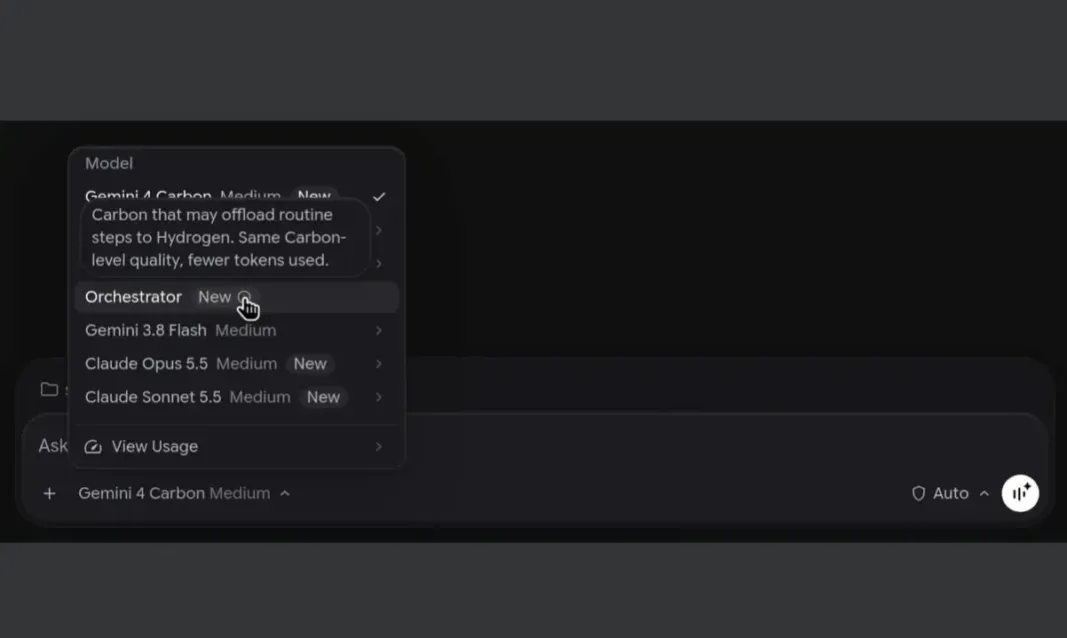
- Automatic Coding: Google’s Antigravity coding tools gain Orchestrator, a mode that splits a task between two Gemini 4 models.
- Quota Use: On average in Google’s tests, Orchestrator consumed 24% less quota (usage allowance) and finished 19% faster than its Carbon planning model.
- Reasoning Control: Hydrogen, the implementation model, lets users choose thinking depth when run alone; Orchestrator users cannot choose reasoning effort.
- Paid Access: The launch covers Hydrogen for Google AI Pro and Ultra subscribers, with Orchestrator reserved for Ultra in the model documentation.
Google is rolling out a coding mode that lets Antigravity, its AI development environment, hand a task between two Gemini 4 models automatically. Called Orchestrator, it assigns Carbon to planning and review and Hydrogen to implementation, letting developers keep one conversation running as the work changes.
The November 12 release also adds Gemini 4 Hydrogen as a standalone choice. Developers can select its reasoning effort directly, or use the combined mode to have the software manage the division of work.
Carbon Plans, Hydrogen Implements
With Orchestrator, each user message starts with Carbon examining the task and preparing a plan. Hydrogen then changes files, writes code, runs builds and tests, and checks the result against that plan. Carbon can answer a question or review request directly when implementation is unnecessary.
The exchange works in both directions. If verification fails twice, an interface behaves unexpectedly or a design decision remains unsettled, Hydrogen returns the conversation state to Carbon. Carbon examines what happened, revises the plan and hands implementation back. On longer tasks, Hydrogen also reports progress for Carbon to review. Those documented handoffs happen inside a response, so the developer need not switch models at each stage.
Antigravity’s May 2026 expansion into a multi-agent development suite already provided a command center for concurrent agents. Google’s November 10 Carbon release added a /swarm preview for coordinated parallel work. Orchestrator instead keeps one conversation agent and changes which model handles planning or execution within it.
Google’s rationale is that a long coding task changes character as it progresses: difficult planning can give way to routine implementation, then require deeper reasoning again when something breaks. Orchestrator puts Carbon at those planning and review stages while Hydrogen carries out the settled work.
Hydrogen’s Speed and Coding Results
Google claims Hydrogen completes tasks 2.5 times faster at its default High reasoning level than Gemini 3.8 Flash, the prior fast-model baseline.
The SWE-sweep benchmark credits parts of software-engineering work through a subtask-weighted reward. Google reports 13.5% for Hydrogen versus 3.1% for Claude Sonnet 5.5, another model available inside Antigravity.
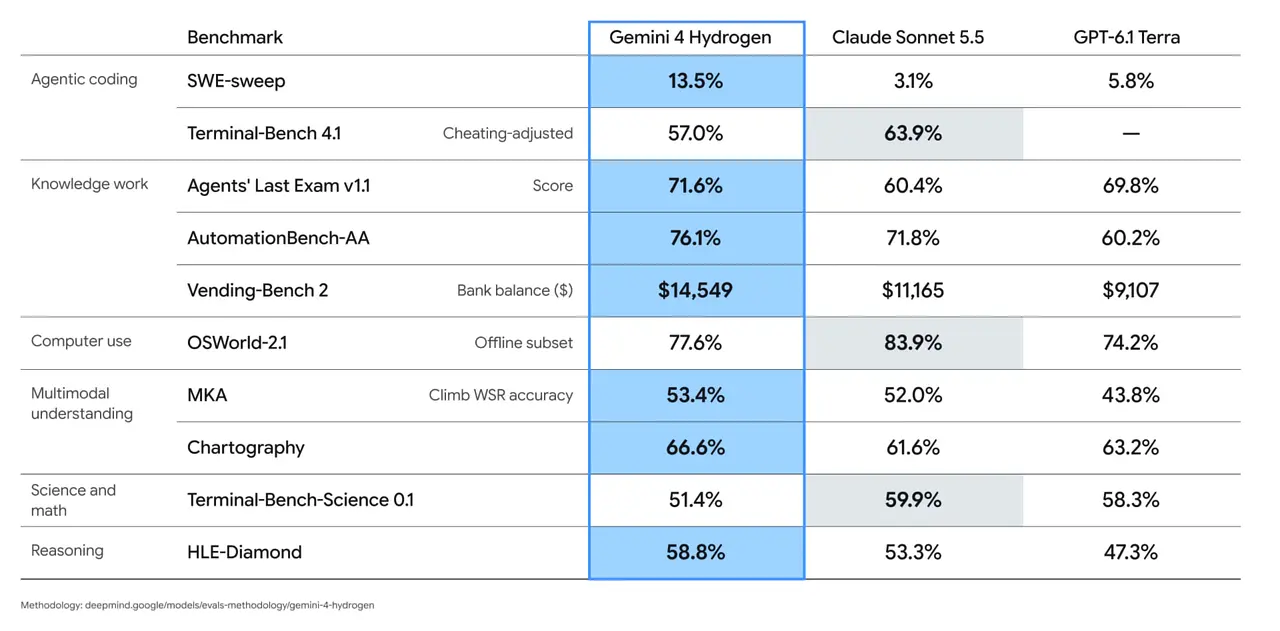
For Hydrogen, Google used Antigravity CLI 1.4.8 with safety filters enabled; Sonnet’s result comes from the public leaderboard.
For Orchestrator itself, Google claims task success close to Carbon alone while using an average of 24% less quota and completing 19% faster. Terminal-Bench tests whether agents can complete computer tasks through text commands. The Antigravity post identifies that test as Terminal-Bench 4.1; the broader Hydrogen launch identifies it as 4.0.
More Reasoning Changes the Trade-Off
Standalone Hydrogen offers Low, Medium, High and Extra effort. The Extra option corresponds to xhigh in the command-line tool and gives the model more reasoning effort. Orchestrator uses a fixed configuration; choosing Carbon or Hydrogen directly restores control over the effort level.
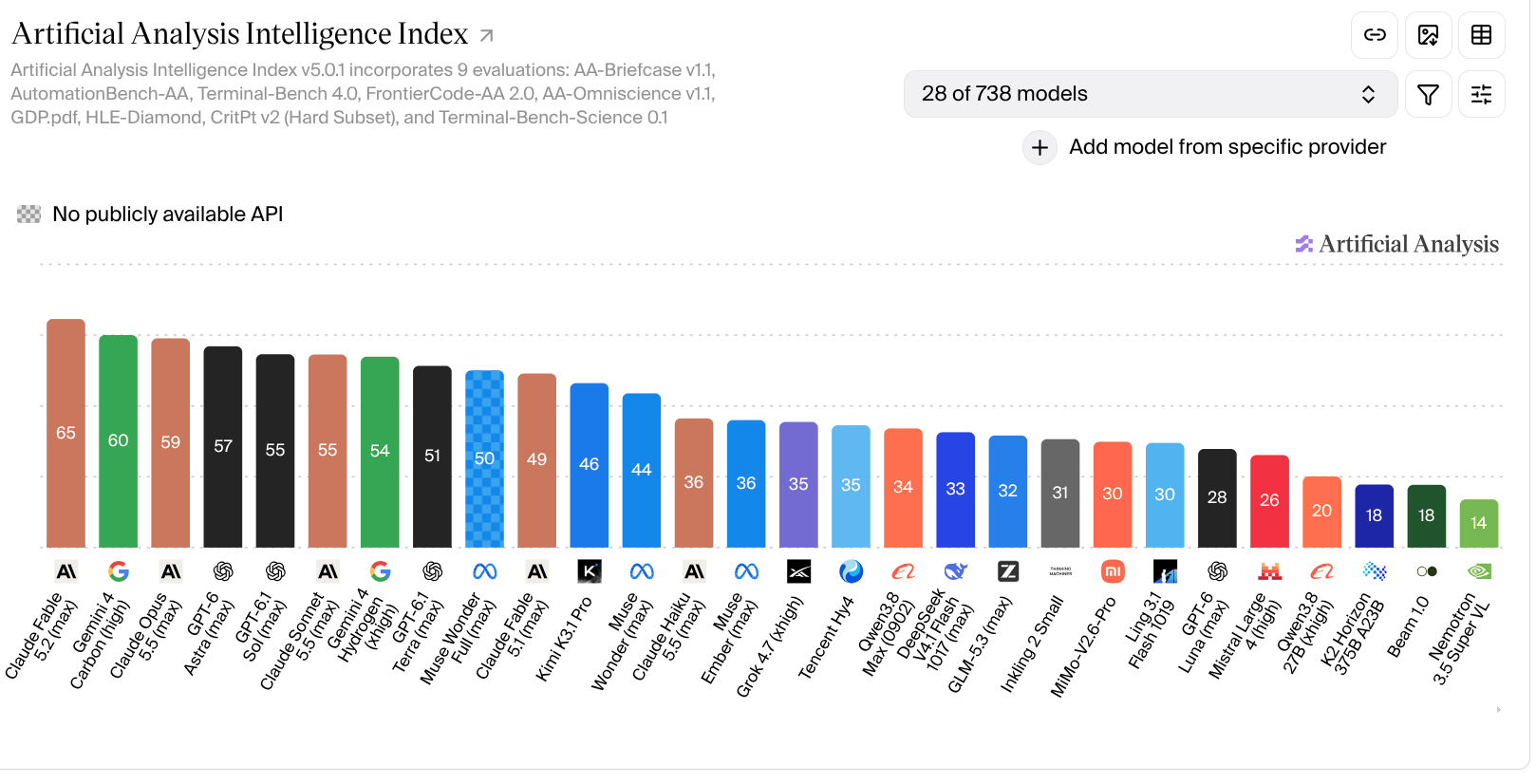
Higher effort can also consume more tokens, the units used to count a model’s text processing and generation. Developers can use Hydrogen through an API, an interface that lets software send requests to the model and receive its output. In its independent Hydrogen xhigh evaluation, Artificial Analysis recorded 304 million output tokens across its nine-evaluation Intelligence Index, against a 72.8 million median for its comparable-price group. Its estimated time per task was 13.0 minutes, close to that group’s 12.9-minute median. That estimate combines token volume and measured serving speed for this API evaluation workload.
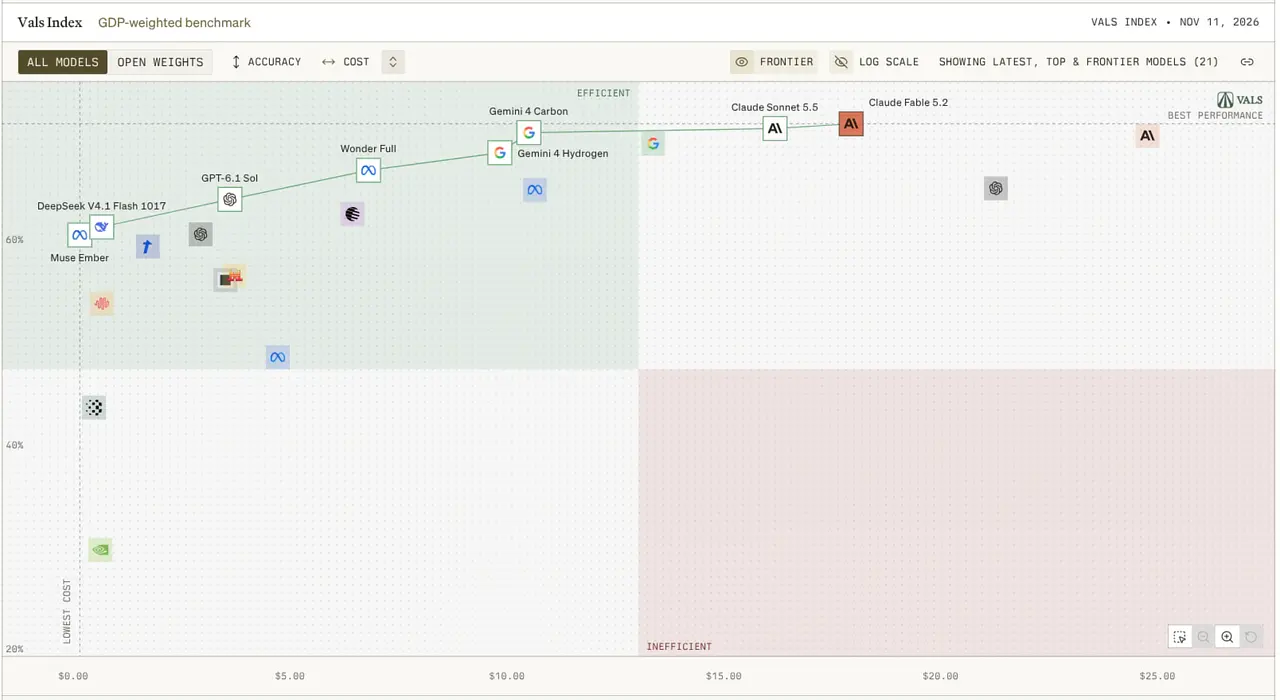
Vals AI separately measured 54.04% for standalone Hydrogen at xHigh on Terminal-Bench 4.0. Its method averages three runs across 66 tasks, awarding success only when a task passes its full verification tests.
Access and Usage Follow Different Rules
The launch specifies Hydrogen’s rollout to Google AI Pro and Ultra subscribers, and Orchestrator to Ultra. Google’s operational model and plan pages also list Hydrogen for free accounts, leaving launch-day free-account reach unclear. The product’s changelog warns that releases can take a few days to reach all users.
For business customers, the enterprise model table supports standalone Hydrogen and excludes Orchestrator. The launch post uses broader wording, saying enterprises can access both.
Hydrogen’s listed API rates are $1.50 per million input tokens and $7.50 per million output tokens. Artificial Analysis calculates $3.16 per task for its own weighted xhigh benchmark workload. Antigravity instead meters included plan quota by the work performed, so the claimed 24% quota reduction supplies no fixed dollar saving for a developer’s project.
Pro and Ultra subscribers can spend AI credits after exhausting their included quota. Under the AI Credit Overages setting, Never makes the user wait for a quota reset; Always automatically spends credits until the included allowance refreshes.