- New Model: Google released Gemini 4 Hydrogen for coding and tool-driven work, with free and paid developer access.
- Reasoning Cost: Its xhigh setting scored better in independent testing, with greater estimated task time and measured cost than the default high setting.
- Coding Workflow: In Google’s Antigravity coding environment, Ultra subscribers can use Orchestrator to switch between planning and execution models.
- Reliability: Google’s internal tests found more harmless requests rejected than with Gemini 3.8 Flash, its previous fast model.
Google released Gemini 4 Hydrogen on November 12 for developers building coding assistants and other software that carries out tasks with tools. The new AI model offers adjustable reasoning: independent evaluator Artificial Analysis found that moving above its default setting raised the test score while more than doubling estimated task time.
Hydrogen accepts text, images, audio and video and produces text. Google positions it for rapid execution alongside Gemini 4 Carbon and Argon, which handle deeper, longer reasoning. In one Google demonstration, Hydrogen used a keynote video and a design template to create a Slides presentation, then checked the slides and repaired overlapping text and layout problems.
Faster Coding, with Uneven Results
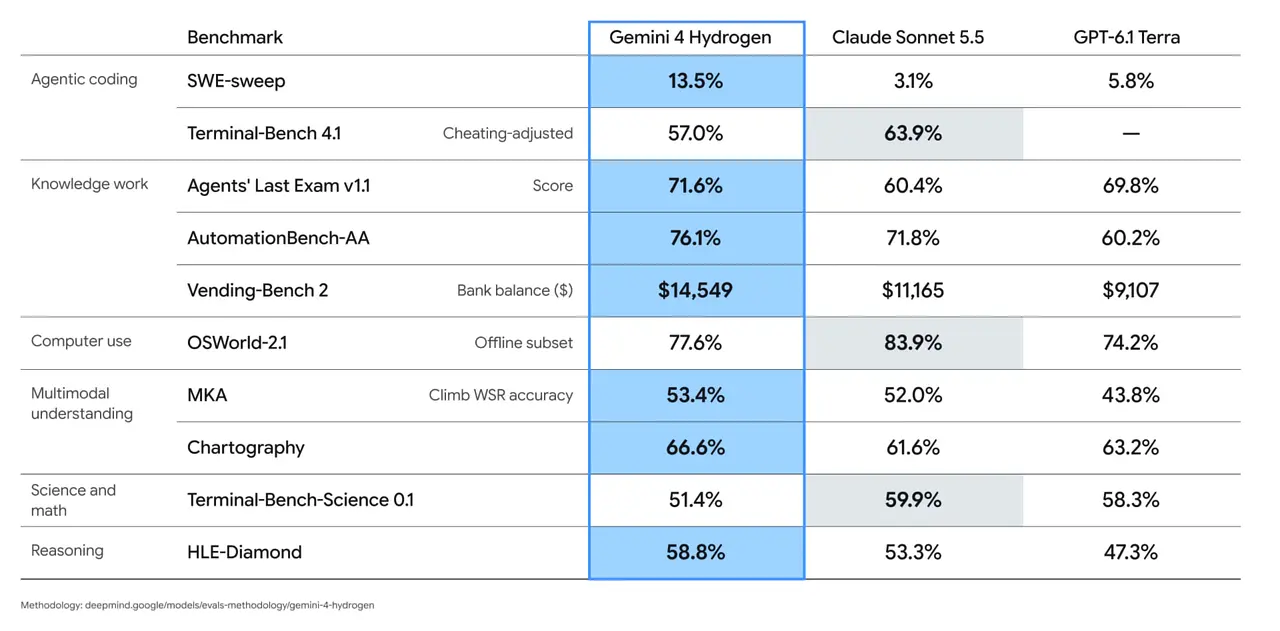
Google reports that Hydrogen finishes tasks 2.5 times faster than Gemini 3.8 Flash at its default high reasoning setting. On Terminal-Bench 4.1, which tests software agents working through a computer terminal, its cheating-adjusted score rose from Flash’s 18.2% to 57%. Google averaged five attempts per task at high reasoning. The benchmark’s automated graders check completed work and resist attempts to manipulate scoring.
Anthropic’s Claude Sonnet 5.5 retains an advantage over Hydrogen on terminal work and computer use in Google’s selected comparisons. The model card puts Sonnet at 83.9% against Hydrogen’s 77.6% on the 82-task offline subset of OSWorld-2.1, a computer-use evaluation. Google tested both models on that subset and reported the best of three runs.
In Artificial Analysis’s test results, Hydrogen at medium reasoning tied for the highest score on GDP.pdf, which tests visual reasoning over long, complex documents. In AA-Briefcase, which evaluates tool-using knowledge work, graders rated Hydrogen’s presentation above those of other Gemini models, including Carbon.
Independent evaluator Vals AI tested Hydrogen at xHigh and ranked it first of 85 models on Tax Agent Bench, at 52.30%. The benchmark asks agents to research 193 private US tax questions, mostly about corporate tax, and produce cited answers.
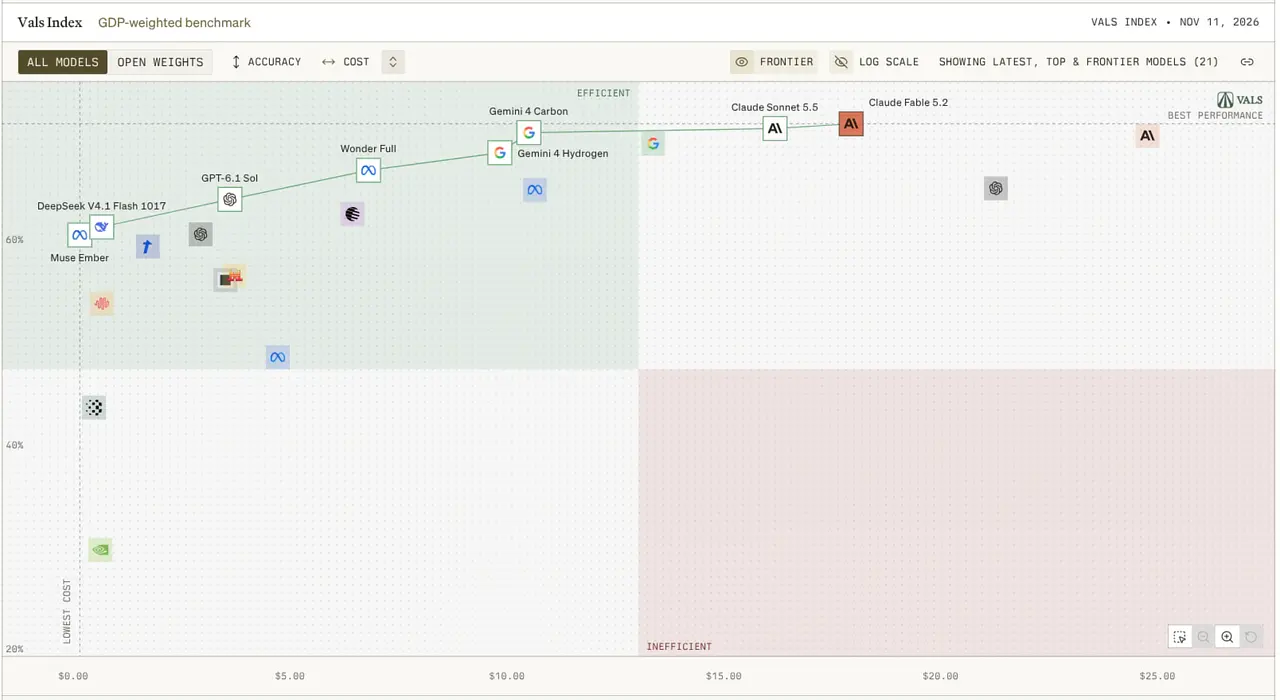
Its score averages question results with citation adjustments: an answer failing any required check gets zero, while credit for correct answers also depends on valid citations. A language model performs the grading. Hydrogen’s separate Terminal-Bench 4.0 coding result ranked 11th of 64.
More Reasoning Raises the Bill
Hydrogen defaults to high reasoning rather than Flash’s medium and adds an xhigh option for harder problems. Thinking consumes output tokens, so raising effort can increase both the wait and the charge. Google warns that xhigh can overthink simpler prompts.
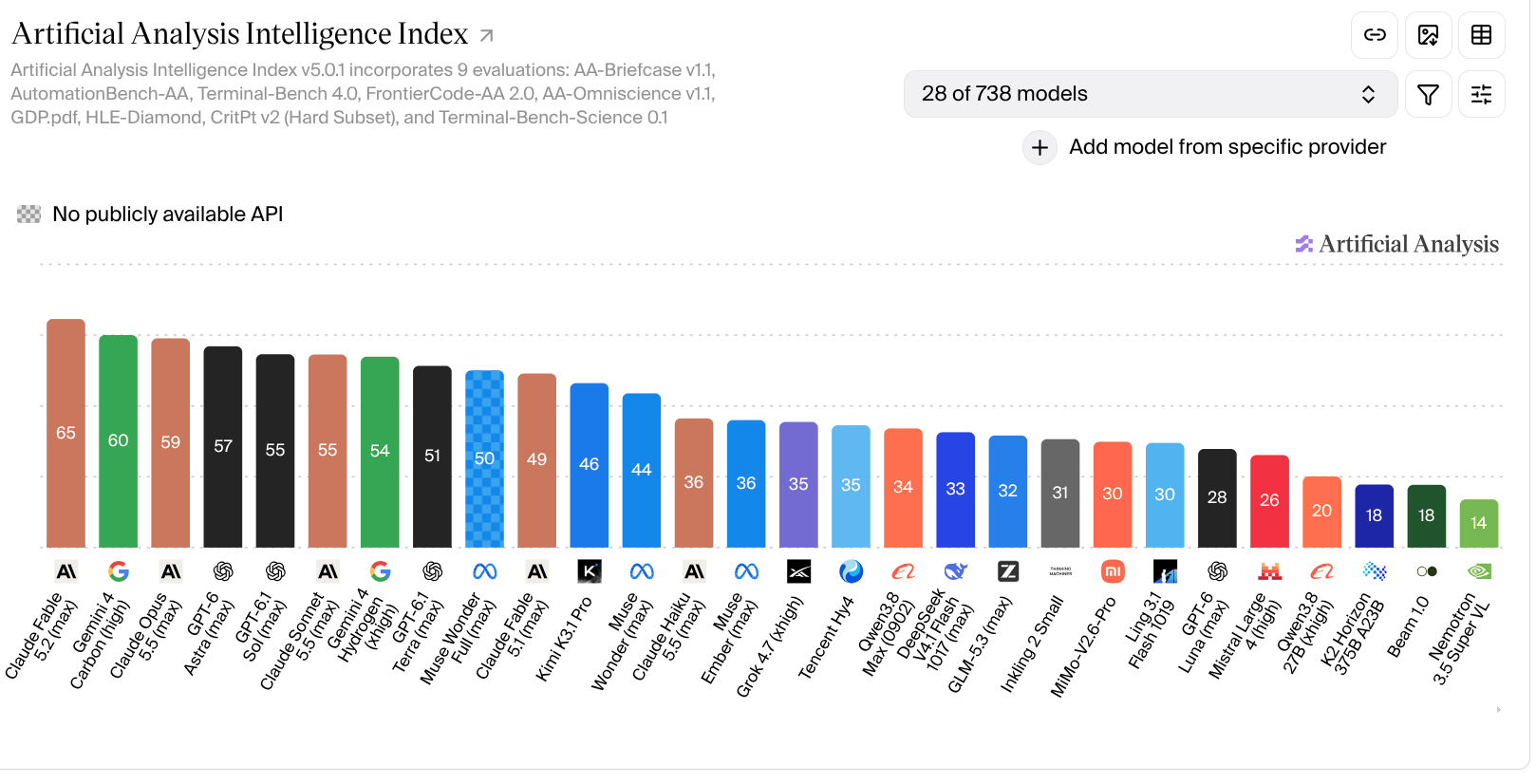
Artificial Analysis’s Intelligence Index v5.0.1 combines nine evaluations. Its time measure divides output-token volume by output speed and weights the results across tests; its task costs similarly combine token usage and prices.
Artificial Analysis Intelligence Index v5.0.1 results as of November 12, 2026
| Model and Reasoning Setting | Index Score | Estimated Minutes per Test Task | USD per Test Task |
|---|---|---|---|
| Gemini 4 Hydrogen, high | 51 | 6.0 | $1.87 |
| Gemini 4 Hydrogen, xhigh | 54 | 13.0 | $3.16 |
| GPT-6.1 Terra, max | 51 | 14.2 | $0.96 |
Hydrogen at high offered a shorter estimated task time than OpenAI’s GPT-6.1 Terra, but Terra cost less per test task. Moving Hydrogen to xhigh bought three additional index points while raising measured cost from $1.87 to $3.16 and estimated time from six to 13 minutes.
Terminal-Bench 4.0 stayed at 54% at both high and xhigh. On the science-task test Terminal-Bench-Science 0.1, raising effort from high to xhigh lifted the score from 41% to 50%.
Carbon Plans While Hydrogen Executes
Google’s Antigravity coding environment also gains Orchestrator, which switches between Carbon and Hydrogen during one task. Carbon can inspect dependencies and build a plan, then Hydrogen edits code, updates packages and runs tests. If execution runs into difficulty, Carbon can inspect the changed state and revise the plan before handing work back to Hydrogen.
Hydrogen is rolling out in Antigravity to paid Google AI Pro and Ultra subscribers. Orchestrator’s rollout is limited to Ultra subscribers.
Developer Capacity and Access
Hydrogen is available through the Gemini API, which lets developers connect applications to the model, and Google AI Studio, its development interface, on free and paid tiers. The free tier has rate limits. The enterprise API model is a short-term generally available release, subject to at least 45 days’ notice before retirement.
The API shares 1,048,576 tokens across input, thinking and output. Tokens are the units used to process text and other inputs, so long documents and extensive reasoning draw on the same capacity available for an answer. Flash instead had separate one-million-token input and 64K output budgets. A single foreground response, produced directly for a request, is limited to 65,536 tokens; generating more requires continuation or background processing.
Google includes the Gemini app in its rollout. For personal accounts, the app’s capacity limits are 32K tokens without an AI plan, 128K with Plus and one million with Pro or Ultra.
Hydrogen is also available globally in Google Search. Google says it can search more subtopics simultaneously when answering a question, draw on more sites and provide more visual, structured responses.
Rates Depend on Usage
Standard API access costs US$1.50 per million input tokens and $7.50 per million output tokens, including thinking. Flash’s corresponding rates remain $0.75 and $3.75 through December 31, 2026, then rise to Hydrogen’s rates on January 1, 2027.
Hydrogen also changes how repeated input is discounted. It removes explicitly created context caches and uses automatic, implicit caching for prompts of at least 4,096 tokens. Cache hits cost $0.075 per million input tokens, a 95% discount from standard input. Google Search grounding, which supplies web-search information to an answer, is charged per generated search query after the allowance; one user request can generate several queries.
Google may use free-tier data to improve its products; standard paid-tier data is excluded.
Where Reliability Still Falls Short
Google DeepMind’s model card reports more unjustified refusals than with Flash, particularly on multimodal prompts involving non-text input, such as images. Its internal automated evaluation found a 5.57-percentage-point increase in rejections of benign or borderline requests that could safely be fulfilled. The card lists hallucinations, occasional timeouts and excess token use among the remaining limitations.
Google says the full Safety & Security Report will be available in the coming days.