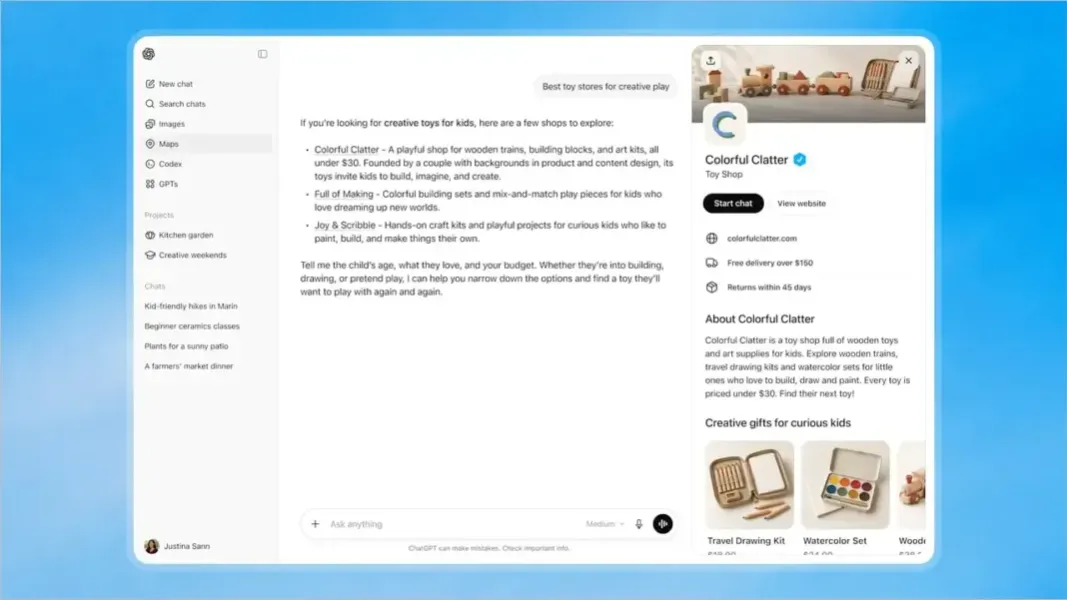
- Free Brand Chats: OpenAI’s ChatGPT now lets eligible U.S. online businesses publish free AI agents that answer shoppers’ questions.
- Paid Promotion: Businesses can also buy sponsored placement for their agents.
- Customer Privacy: Merchants receive aggregated visibility statistics and conversation themes, while individual prompts and chat transcripts are not shared with them.
OpenAI has opened a free route for eligible U.S. ecommerce and online-service businesses to answer shoppers’ product questions inside its ChatGPT AI assistant. The November 10 beta lets companies supply information to an OpenAI-run Business Agent, while shoppers go to the merchant’s own website to pay.
Called Businesses in ChatGPT, the beta combines public business profiles with Business Hub, where companies verify their profiles, update business information and see engagement statistics. The agents add a separate branded conversation to that business presence.
Now in beta: Businesses in ChatGPT.
Claim your business, manage your information, and get insights on how people engage with you.
Eligible businesses can also build a Business Agent to answer customers’ questions and help them explore what you offer.https://t.co/N2GEZX0mFT pic.twitter.com/lYj2Z48fhQ
— OpenAI (@OpenAI) November 10, 2026
Business Information Shapes the Conversation
A shopper can open company details from a ChatGPT response and enter an available Business Agent. That puts questions about a seller’s products inside the assistant, with the brand conversation identified separately from ChatGPT’s own response.
Businesses supply instructions and product feeds, but OpenAI provides the agent. “We aren’t allowing folks to bring their own agents,” OpenAI monetization vice president Benji Shomair said at a briefing covered by Digiday. He said shoppers leave for the business’s site when ready to pay, leaving the merchant to decide how to complete the transaction.
For sellers using Shopify, the ecommerce platform, OpenAI’s ChatGPT app connects a store’s product catalog to Business Hub. Merchants can publish an agent that uses store details and their guidelines to answer questions and suggest products. The same app offers separate ad-account and campaign controls within Shopify.
Agent publishing initially covers eligible U.S. ecommerce and online-service businesses. Broader expansion has no announced timetable.
A Free Route Beyond Sponsored Chats
The new organic option extends a format previously reached through an ad. In September, a Sponsored Agent pilot let users click an advertisement to open a branded conversation within ChatGPT.
Shomair said the agent behind the free and sponsored routes should be the same. Business Hub and organic agents are free at launch. Claiming a profile should leave recommendation frequency unchanged, he said; better business information could help ChatGPT match a seller to more relevant conversations.
ChatGPT already had shopper-facing commerce functions. Its November 2025 Shopping Research experience assembled buyer guides and comparisons. The 2025 Instacart integration went further, building grocery carts and supporting payment inside ChatGPT after account connection. The new agents’ merchant-site payment flow differs from that earlier in-chat checkout.
Google Offers a Similar Product Conversation
Google’s Business Agent on Search also answers shoppers’ questions in a brand’s voice. It uses Gemini models with information from the company’s website and Merchant Center, Google’s product-data management service. A shopper searching for the brand can ask about an item’s material or fit rather than leave immediately for a product page.
Google’s customization requirements include a U.S. ecommerce store, a verified Merchant Center account, at least 50 approved free product listings and a claimed brand profile. As of November 11, Google still lists further training with business data, agent-specific analytics and checkout through the agent as coming soon. OpenAI’s Shopify integration already offers merchant-supplied store guidelines.
What Business Hub Measures
ChatGPT Business Hub reports mentions, views, website clicks and discovery topics. A local mention counts a displayed location result; an online mention requires a reference to the business’s website. Discovery topics summarize conversations in which ChatGPT cites the site.
Businesses receive aggregate information, while individual ChatGPT and agent conversations are not shared with them. Low activity can leave figures withheld under privacy thresholds.
The beta lacks a competitive share-of-voice measure. Google’s separate Merchant Center AI performance report, made available to U.S. merchants and four other markets in September, compares brand visibility with competitors across AI Mode and AI Overviews, its AI search experiences.
Why Outside Visibility Tools Still Matter
Accuracast group CEO Farhad Divecha said his team wants to compare outside visibility estimates with OpenAI’s own figures because the estimators lack original ChatGPT data. Their accuracy could affect whether his agency keeps paying for them.
Sonata Insights founder and chief analyst Debra Aho Williamson expects first-party reporting to reduce those vendors’ informational advantage. She also sees continuing demand: OpenAI discloses limited data, and businesses need visibility across several AI platforms, beyond ChatGPT.