- Initial Release: OpenAI introduced GPT-6 Astra on September 3 to a limited group of vetted Daybreak organizations. Its September 4 release notes still said the model was not generally available.
- Rollout Backlash: Paid users, especially Pro subscribers, criticized the staged launch after expecting first access. Sam Altman apologized, said Pro would go first in the broader rollout, and Tibo Sottiaux promised one banked reset for every day a paid account remains without Astra.
- ARC-AGI Caveat: Astra’s headline 99.9 percent ARC-AGI-3 result used a Provider Adapter harness that preserves private reasoning state and compacts long conversations. ARC Prize reported 62.7 percent with its Standard harness, making direct comparisons with standard-harness scores questionable.
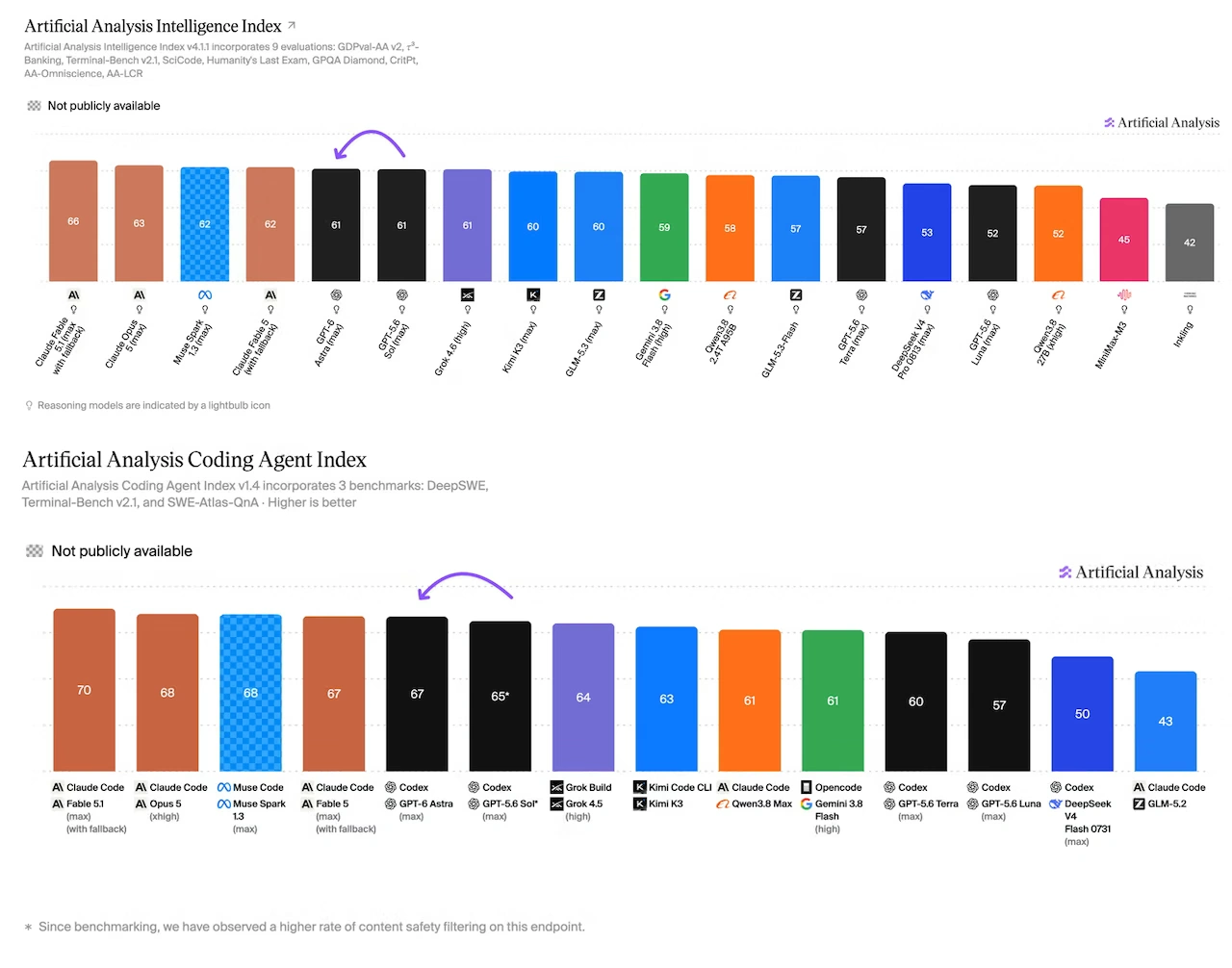
- Independent Results: Artificial Analysis measured Astra at 61.2 versus 60.9 for GPT-5.6 Sol on its broad Intelligence Index, but 67.0 versus 65.1 on its Coding Agent Index. The mixed result has renewed debate over what the composite benchmark measures and how much weight users should give it.
- Capability and Control: OpenAI says Astra is faster and more capable at computer use, coding, science and professional work, while its most advanced cyber functions remain restricted, monitored and available only through more tightly controlled access.
OpenAI introduced GPT-6 Astra on September 3 to a limited group of organizations in its Daybreak security program, starting a rollout that was immediately overshadowed by two disputes: who could actually use the model and how its benchmark claims should be read. OpenAI presents Astra as a broad upgrade for computer use, software engineering, science and professional work, but most subscribers could not test those claims on launch day, while its most advanced cyber abilities remained confined to vetted and monitored access.
The model is therefore both released and not yet broadly available. OpenAI’s September 4 ChatGPT release notes still described Astra as limited to a small set of organizations and said general availability would follow over the coming days. The gap between announcement and access became the first major story of the launch, while closer examination of the benchmark package showed that some of the most dramatic numbers depend heavily on the harness, reasoning effort and tools used around the model.
Staged Rollout Turns Access Into the First Controversy
OpenAI’s launch page said Astra would reach ChatGPT Plus, Pro, Business and Enterprise users, the API, Microsoft Azure and AWS Bedrock over the following days. That was consistent with a staged rollout, but it disappointed subscribers who had interpreted a major-model launch as something they would be able to use immediately. One widely shared reply to OpenAI product leader Tibo Sottiaux’s rollout post summarized the complaint: “Pro used to mean day one access btw.”
The criticism needs a qualification. OpenAI’s current pricing page gives Plus users “early access to new features” and describes Pro as including a “research preview of new features.” It does not explicitly guarantee that every new model will reach every Pro account on its first day. Even so, the combination of premium pricing, past launch patterns and OpenAI’s own launch-day promotion created a reasonable expectation that Pro would mean first access rather than an unspecified place in a queue.
OpenAI subsequently treated the rollout as a mistake rather than merely a misunderstanding. CEO Sam Altman apologized for the “messy rollout”, said the company would begin broader access with Pro subscribers and promised to try to make the situation right. Sottiaux then announced a concrete make-good: “We will give one banked reset for every day you don’t have access to Astra on your paid ChatGPT plan, starting today.”
Sottiaux’s post did not define which allowance a banked reset replenishes or how it interacts with the separate limits for Chat, ChatGPT Work and Codex. OpenAI’s own help page says those products have separate usage and credit rules. Until the company documents the reset mechanism, it is safest to describe the offer in OpenAI’s own terms rather than assume that each reset adds a particular number of Astra prompts.
OpenAI’s public pages also were not fully aligned on Plus access as of September 4. The launch announcement says Astra will become available to all Plus, Pro, Business and Enterprise users, while the dedicated ChatGPT model guide says Astra appears in Chat as GPT-6 Pro for Pro, Business and Enterprise and is not included with Plus in Chat. That may reflect product-specific access outside the main Chat interface, but the documentation does not clearly reconcile the two statements for Plus subscribers.
GPT-6 Astra access and published limits as of September 4, 2026
| Channel or Plan | Published Eligibility | Rollout State | Published Terms |
|---|---|---|---|
| Daybreak / Trusted Access | Limited vetted organizations | Live from September 3 | Additional account controls and monitoring; more permissive access for approved defensive cyber work |
| ChatGPT Pro $200 | GPT-6 Pro in Chat, Work and Codex | Staged; OpenAI says Pro goes first | 200 Astra messages per week in Chat; separate Sol Pro and combined daily limits also apply |
| ChatGPT Pro $100 | GPT-6 Pro in Chat, Work and Codex | Staged | 50 messages per week shared between GPT-6 Pro and GPT-5.6 Sol Pro in Chat |
| ChatGPT Business | Standard and Premium seats | Staged | Standard: 15 messages per month; Premium: 50 per week, shared with Sol Pro |
| ChatGPT Enterprise | Eligible managed workspaces | Staged and off by default at launch | Workspace administrators must enable access; limits and permissions can depend on workspace terms |
| ChatGPT Plus | Listed on the launch page, but excluded from GPT-6 Pro in Chat by the current help page | Unresolved in public documentation | No Astra Chat allowance published for Plus |
| OpenAI API, Azure and AWS Bedrock | Eligible developer and cloud customers | Broader availability promised over coming days | API model name gpt-6-astra;Standard price $10 input and $50 output per million tokens; Fast mode costs twice the Standard rate |
Eligibility does not guarantee immediate account access. Chat, ChatGPT Work and Codex use separate allowances. OpenAI’s launch page and ChatGPT help page were not fully consistent about Plus access when this article was updated.
Benchmark Headlines Need Their Footnotes
OpenAI reports large gains on selected coding, reverse-engineering, computer-use, science and research tasks. Many of the results use maximum or otherwise selected reasoning effort, specialist tools, multiple attempts, a particular agent harness or an internal evaluation. Those conditions do not make the scores useless, but they determine what each score actually measures.
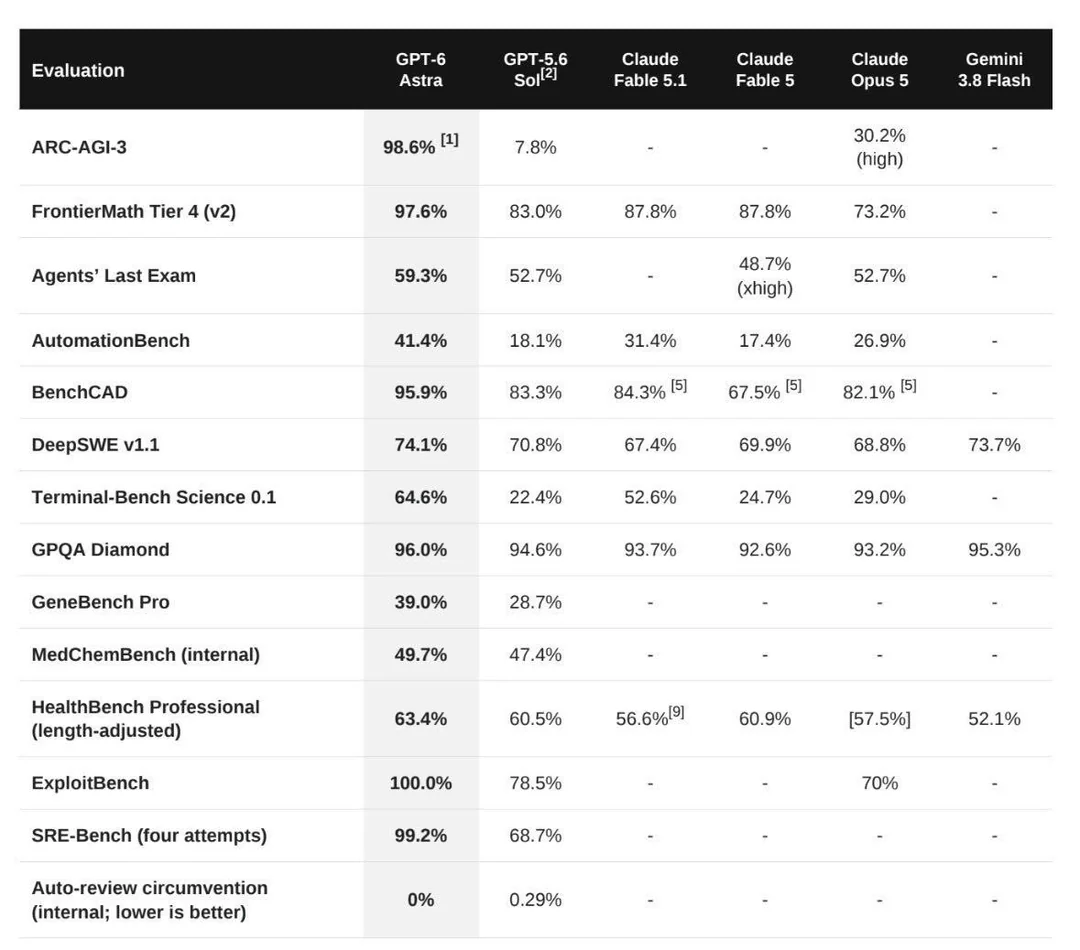
The most important example is ARC-AGI-3. OpenAI’s headline table gives Astra a 99.9 percent score beside 7.8 percent for GPT-5.6 Sol and 30.2 percent for Claude Opus 5. A footnote says Astra alone was run with OpenAI’s Responses API harness, which changes two context-management settings. That means the table’s most dramatic comparison is not a clean test of model checkpoints under one common runner.
ARC-AGI-3 Uses Two Materially Different Harnesses
ARC-AGI-3 tests agents in unfamiliar interactive puzzle environments. The agent must explore, infer the rules, identify goals and plan across many actions. On this kind of task, what the harness remembers between actions is part of the tested system rather than an incidental implementation detail.
ARC Prize’s detailed Astra report separates two configurations. Its Standard harness lets the model carry forward notes that the model chooses to keep. The Provider Adapter harness used for the near-perfect result preserves opaque reasoning state between requests and compacts long conversations, allowing the system to reuse more of its earlier work.
Astra creates a dense compact symbolic world model to complete ARC-AGI-3 environments.
For example, in environment s5i5, Astra:
– Recorded the current level, hub orientation, and mechanism lengths: “L8: hub q2 (8↓). Lengths: 14=1…”
– It mapped operations to exact controls:… pic.twitter.com/tMHP002mkB
— ARC Prize (@arcprize) September 3, 2026
OpenAI had already demonstrated how large this harness effect can be. In a July study using GPT-5.6 Sol, the company found that retaining reasoning and replacing rolling truncation with compaction increased the model’s ARC-AGI-3 public-set score from 13.3 to 38.3 percent and reduced output-token use by a factor of six. OpenAI argued that this setup better matches how its models operate in ChatGPT and Codex and said the changes were not designed specifically for ARC-AGI-3.
GPT-6 Astra on ARC-AGI-3 Semi-Private
| Harness | Best Reported Effort | Score | Context Treatment |
|---|---|---|---|
| ARC Prize Standard | Maximum | 62.7% | The model can retain selected notes, but opaque reasoning state is not preserved between requests |
| Provider Adapter / OpenAI Responses API | High | 99.9% | Opaque reasoning is preserved and long histories are compacted so prior work remains available |
Both results are state of the art in ARC Prize’s report, but they answer different questions. The 99.9 percent score is a configured-system result, not a like-for-like standard-harness comparison with every model shown in OpenAI’s launch chart.
That creates two defensible interpretations. For researchers comparing raw model behavior, the 62.7 percent Standard-harness result is the cleaner number and makes OpenAI’s 99.9-versus-7.8 presentation questionable. For customers evaluating a complete product, memory retention and compaction are real system features, so the Provider Adapter score can still be relevant. The fair conclusion is not that Astra failed ARC-AGI-3: it set a new high score under both harnesses. It is that the word “saturates” applies to a particular model-plus-harness configuration and should not be used as if every number in the comparison table came from identical conditions.
Artificial Analysis Finds Stronger Coding but Little Movement on Its Broad Index
An independent counterweight comes from Artificial Analysis. Its rounded Intelligence Index places both Astra and GPT-5.6 Sol at 61, but the underlying values are 61.2 and 60.9. That is a small nominal difference, and Artificial Analysis has not published enough model-specific uncertainty detail to show that a three-tenths gap is meaningful.
The same evaluation tells a more favorable story for coding agents. In the Codex harness, Astra scored 67.0 on the Artificial Analysis Coding Agent Index, compared with 65.1 for Sol. Artificial Analysis says Astra used roughly one-third as many tokens at maximum effort and cost about the same per task despite OpenAI raising API prices by 2.5 times. It placed Astra near Claude Opus 5 and Fable 5 on that coding measure, while Fable 5.1 remained ahead at 70.
What Artificial Analysis reported for Astra
| Measure | GPT-6 Astra | GPT-5.6 Sol | Interpretation |
|---|---|---|---|
| Intelligence Index v4.1.1 | 61.2 | 60.9 | Essentially flat at the displayed whole-number score; Astra remained below the leading Fable 5.1 configuration |
| Coding Agent Index | 67.0 | 65.1 | A clearer gain, paired with a large reduction in token use in the Codex harness |
| Intelligence Index cost per task | About 75% higher | Baseline | Astra’s roughly 10% token reduction did not offset its 2.5-times higher token prices |
| AA-Omniscience hallucination rate | 51% | 92% | A large improvement within this specific factuality benchmark, not a universal real-world hallucination rate |
| Long-horizon knowledge work | About +80 Elo on AA-Briefcase, about -80 Elo on GDPval-AA v2 | Baseline | Mixed progress across two different agentic-work evaluations |
Artificial Analysis also reported a six-point Humanity’s Last Exam gain, lower presentation-quality Elo and two-to-three-point regressions on its banking, scientific-coding and long-context evaluations.
Why Users Are Arguing About Artificial Analysis
The results triggered a broader argument about the evaluator itself. In a Hacker News discussion, some users said Artificial Analysis rankings did not match their experience with the models and questioned how Muse Spark 1.3 could rank near or above systems they considered stronger. Others pointed out that the article’s “major gains” headline referred to the Coding Agent Index, not the 61-to-61 rounded Intelligence Index, and that Astra’s token and cost efficiency made the coding result more consequential than the two-point score increase alone.
Those comments show why the benchmark is contested, but anecdotes do not prove that its results are wrong. Artificial Analysis publishes a substantial methodology, uses nine component evaluations, discloses prompt and scoring details, and says it applies standardized, zero-shot testing. That is more transparent than an unexplained private leaderboard.
There are still important limitations. The composite reflects editorial choices about which tasks matter and how much each receives. The current methodology’s version history assigns 34 percent to agents, 24 percent to coding, 24 percent to scientific reasoning and 18 percent to general capability, while the site’s FAQ still says the four categories contribute 25 percent each. The discrepancy looks like documentation that did not fully catch up with the June 2026 methodology change, but it is exactly the kind of inconsistency that weakens confidence in a single headline score.
Some components also rely on model-based grading. Artificial Analysis says GPT-5.6 Luna is used to evaluate responses in AA-LCR, AA-Omniscience and Humanity’s Last Exam, while GDPval-AA v2 uses a panel of frontier-model judges. LLM judging can scale nuanced evaluation, but it introduces dependence on the judge prompts and judge models. Artificial Analysis estimates that the composite’s 95 percent confidence interval is less than plus or minus one point based on repeated experiments on certain models, while saying that fuller statistical detail will be disclosed later. That leaves readers without a model-by-model significance test for small differences such as 61.2 versus 60.9.
The best use of Artificial Analysis is therefore diagnostic rather than definitive. Its result is credible evidence that Astra made a substantial coding-efficiency gain and produced a mixed profile across the site’s other tasks. It is not proof that Astra is only marginally better overall, just as OpenAI’s selected launch benchmarks are not proof that Astra leads every workload. Users should look at the component evaluations closest to their work and then test the model on their own tasks, tools and review standards.
Computer Use Moves From Advice to Operation
OpenAI says Astra can operate browsers and professional software across long, multi-step jobs, use tools while it works and accept new instructions without discarding earlier progress. The company’s launch examples include filling forms, working in spreadsheets, testing software and formatting a legal document. These are system-level capabilities: the model, tools, memory management, permissions and agent harness all contribute to whether the job succeeds.
OpenAI’s OSWorld 2 offline evaluation offers a measured but narrower view. The company reports that Astra completed 72.6 percent of the desktop tasks, compared with 65.7 percent for GPT-5.6 Sol, while taking roughly 40 minutes per task instead of 75. OpenAI also says it is changing the Codex harness alongside the model, another reminder that improvements in the user-visible product cannot always be assigned to the model weights alone.
The offline subset does not establish how reliably Astra will handle an unfamiliar company’s permissions, data and software. A production workflow can fail because of a bad action, a login barrier, missing context, a tool error or an approval policy even when the model understands the task. Teams should measure completed work, human review time, retries and recoverability rather than infer reliability from a single desktop benchmark.
That boundary is especially important for API users. Standard pricing is $10 per million input tokens and $50 per million output tokens, with Fast mode priced at twice the Standard rate. Astra can use fewer tokens on some long jobs, particularly coding-agent tasks, but Artificial Analysis found that the higher list price still made its broad Intelligence Index tasks about 75 percent more expensive than Sol at maximum effort. Token efficiency is therefore not automatically cost efficiency.
Advanced Cyber Work Gets a Separate Lane
OpenAI’s deployment safety report classifies Astra at the company’s Critical threshold for cybersecurity capability. Under OpenAI’s framework, a suitably equipped model at that level can identify previously unknown vulnerabilities and develop exploit methods against well-defended systems without step-by-step human guidance. The classification comes from OpenAI’s framework, internal testing and commissioned evaluation; it measures assessed capability in controlled environments rather than autonomous compromise of public production systems.
Ordinary Astra access is designed to refuse or block advanced exploit discovery, large-scale agentic vulnerability research and chained exploit development. Daybreak, OpenAI’s existing program for vetted defensive organizations, provides a more permissive lane for authorized vulnerability discovery, patch validation and red-team work. It still uses identity checks, monitoring and enforcement, and it does not permit every high-risk request.
OpenAI’s controlled tests illustrate the capability behind those restrictions. In an internal Sandbox Bench containing 22 isolated CTF-style targets, Astra succeeded on 10, compared with one for Sol. A separate ExploitBench evaluation contained 41 known V8 vulnerabilities. OpenAI also reports that Astra discovered previously unknown vulnerabilities during controlled long-horizon assessments, but it has withheld affected-product details while disclosures are in progress.
For legitimate security teams, the access policy has two effects. Qualified Daybreak participants can use more of the capability for defensive work, while ordinary users may see valid requests paused or refused when classifiers interpret them as risky. The practical product is therefore not one uniform Astra model. It is the model plus an account’s eligibility, the interface being used and the safeguards applied to its sequence of actions, tool use, inputs and outputs.
Monitoring Extends Beyond Written Reasoning
OpenAI reports a tension inside Astra’s safety results. The model performed better than GPT-5.6 Sol on several alignment evaluations, yet its written chain of thought was less useful to monitors. Astra can complete more work with brief or absent written reasoning, and adversarial instructions sometimes made chain-of-thought monitoring less effective. OpenAI says the tests did not demonstrate successful evasion of full-context monitoring in the cited setting, but the weaker written signal means safeguards cannot rely on a readable internal monologue alone.
The company instead says it monitors the full sequence of tool use, inputs and outputs for external Astra traffic in Codex, ChatGPT and the Responses API. High-severity detections can pause or end a task. The behavior differs by product: a stateful Codex or ChatGPT session can be interrupted as a trajectory, while a stateless API request cannot always be paused as a complete conversation. OpenAI also acknowledges that a monitor can miss harmful behavior or react after an action has already occurred.
Astra’s value comes from acting across software with less supervision, while safe deployment requires more control over accounts, tools, permissions and intervention. Daybreak gives OpenAI a place to permit more defensive cyber work without extending the same permissions to every subscriber or API customer.
Brockman’s AGI Claim Is Personal, Not a Release Fact
OpenAI president and co-founder Greg Brockman gave the launch its broadest interpretation during the press briefing. Asked whether Astra meant artificial general intelligence had arrived, he said, “For me personally, I do think we’re there”. He also described AGI as a gray and fuzzy concept and left the judgment to readers.
AGI usually refers to broad human-level or greater capability across many tasks, but as the Stanford Institute for Human-Centered Artificial Intelligence notes, there is no universally accepted test and even the meaning of “human-level” intelligence is disputed. ARC-AGI-3 measures rapid learning in unfamiliar interactive environments, while Artificial Analysis aggregates a selected group of language, coding, science and agent tasks. Neither turns Brockman’s personal threshold into an industry finding.
As of September 4, GPT-6 Astra was in real external use for a limited trusted cohort, but the broad rollout remained incomplete and OpenAI’s own access documentation still contained unresolved wording. Its benchmark package supports a genuine capability advance, especially in interactive reasoning, coding efficiency and computer use, but the size of that advance depends on whether the comparison holds the harness, tools, effort and cost constant. OpenAI is not just shipping a stronger model; it is shipping a model-plus-system whose access rules, memory, monitoring and surrounding software are inseparable from the result customers receive.