- Coding Upgrade: Grok 4.7 gives developers better coding results in independent tests, while generating more tokens than its predecessor.
- Task Costs: Artificial Analysis measured $3.74 per benchmark task at maximum reasoning effort, versus $1.99 for GPT-5.6 Sol.
- Uneven Gains: Professional-work analysis improved, but presentation quality and long-document reasoning did not improve across the board.
- DeepSeek Alternative: DeepSeek V4.1 Flash costs less in the same benchmark suite, while Grok 4.7 scores higher overall.
SpaceXAI has released Grok 4.7, which is scoring better at coding and professional work than its predecessor but also generates more than twice the output at the same reasoning setting. Developers can use it through the xAI API, Cursor and Grok Build, with unchanged starting token rates.
The clearest gains are in writing code and producing professional documents. Independent evaluator Artificial Analysis found more modest movement in its broader Intelligence Index, which rose from 44 for Grok 4.6 at high reasoning effort to 46 for Grok 4.7 at xhigh. Those effort settings control how much reasoning the model does before answering.
For paying developers, the extra work has a measurable cost. Grok 4.7’s lower price per token than GPT-5.6 Sol did not translate into a lower bill per task in Artificial Analysis’ tests.
Better Coding, Stronger Analysis
SpaceXAI says Grok 4.7 uses a larger base model and longer reinforcement learning, trained on harder tasks weighted toward work that takes many hours. The company attributes better self-checking and management of long conversations to that training. It also trained the model to work with Grok Bot’s surrounding software and tools.
Artificial Analysis’ September evaluation provides a more specific picture of the coding improvement. Running inside Grok Build, SpaceXAI’s coding agent, Grok 4.7 scored 56 on its Coding Agent Index, up from 47 for Grok 4.6. Both used xhigh reasoning effort.
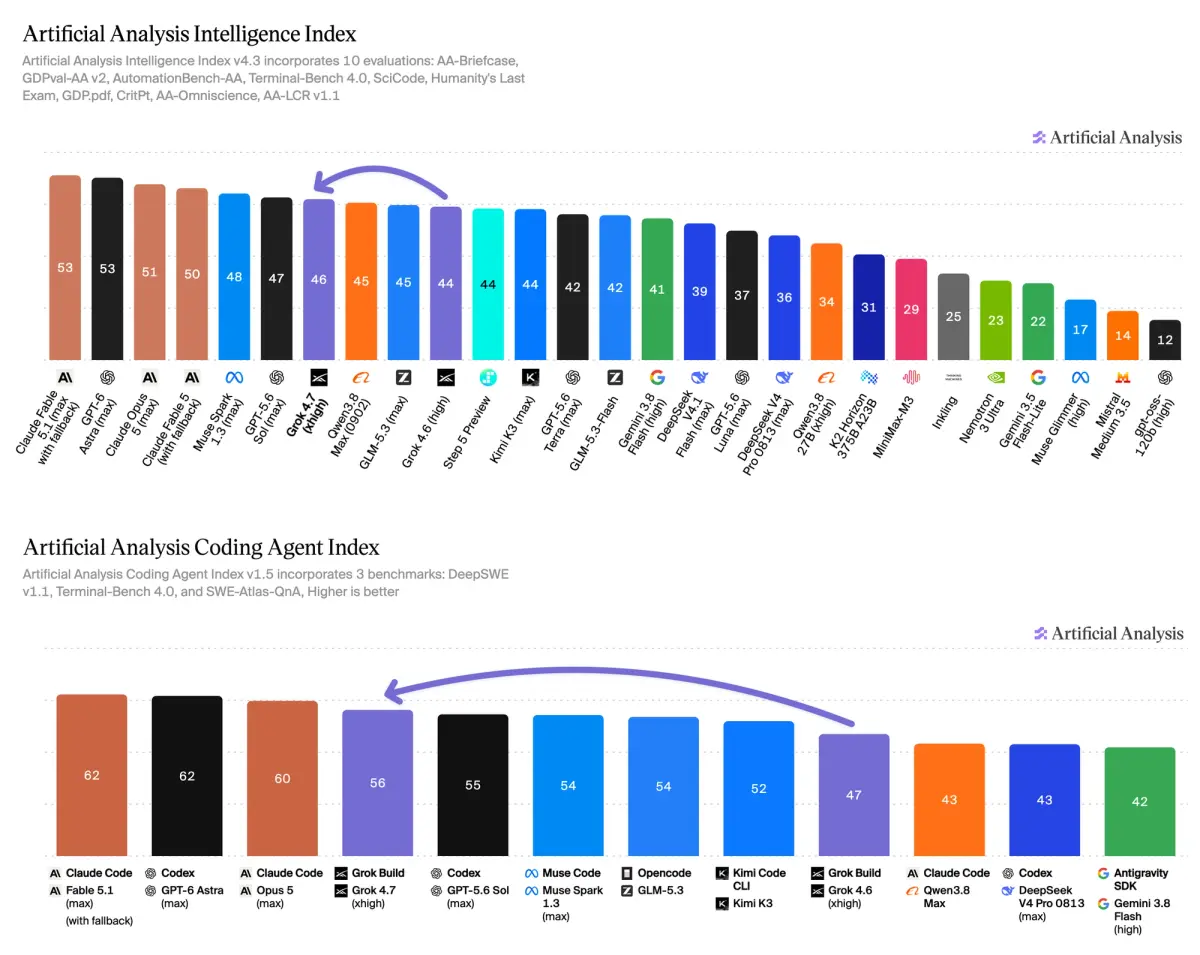
The gains appeared across all three components. DeepSWE software-engineering results rose from 65% to 73%, Terminal-Bench 4.0 results from 18% to 33%, and SWE-Atlas-QnA technical question-answering from 58% to 63%. The coding index gives those three tests equal weight and averages first-attempt success across three runs per task.
That measures the model working with its coding agent. The separate Intelligence Index uses standardized software around models, so its Terminal-Bench result answers a different comparison question. In the September 21 native-agent comparison, Grok Build with Grok 4.7 ranked fourth, behind Claude Fable 5.1, GPT-6 Astra and Claude Opus 5.
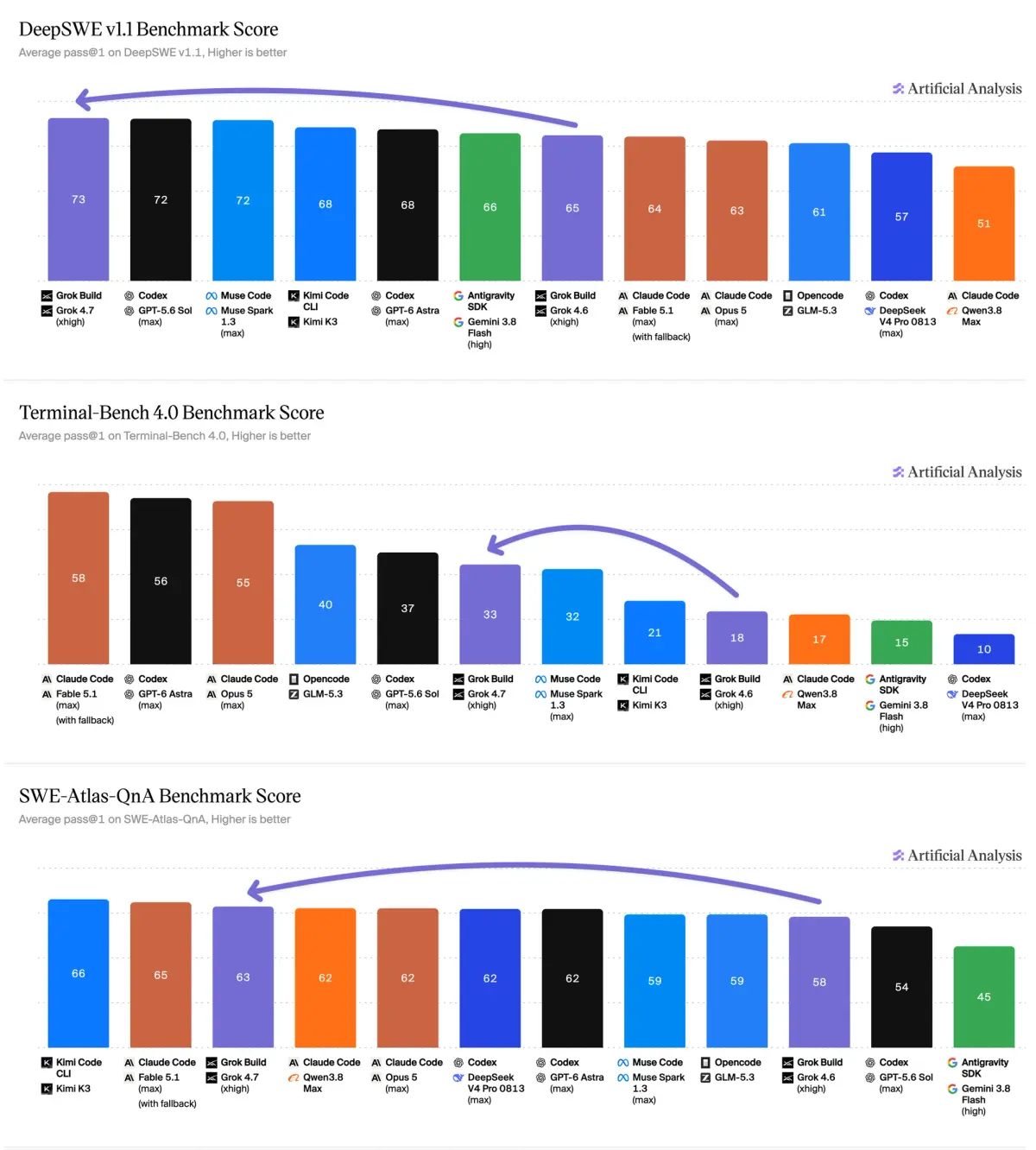
Professional-work gains were concentrated in analysis. On AA-Briefcase, which asks models to produce work such as spreadsheets and presentations, Grok 4.7 reached 1,657 Elo, 111 points above Grok 4.6 at high effort. Elo expresses relative performance in comparisons between submissions. Its analytical-quality rating rose from 1,690 to 1,994, while presentation quality slipped from 1,519 to 1,499.
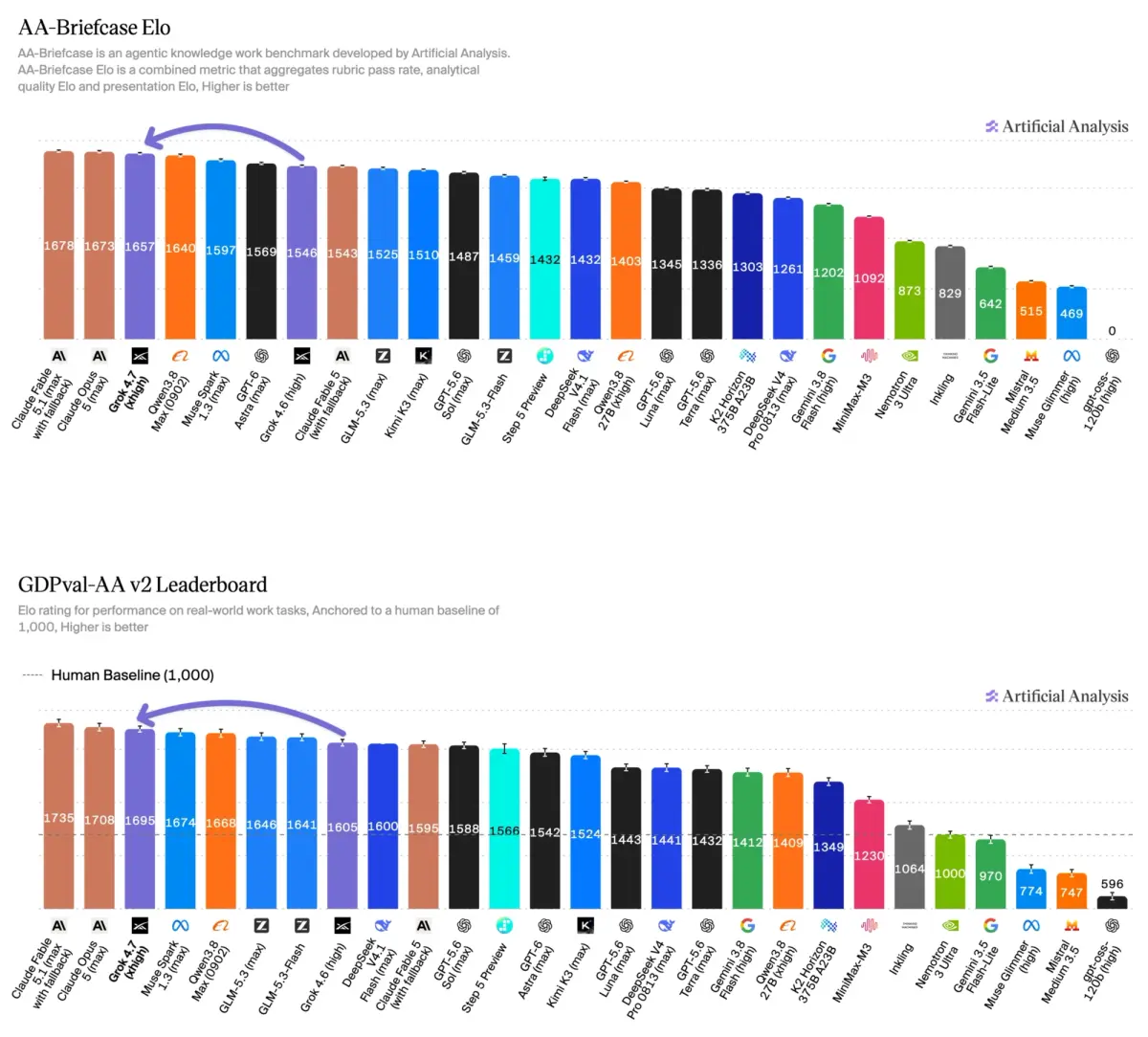
The Briefcase methodology uses simulated multi-week business scenarios, but each task runs independently with supplied files. Models do not carry their own earlier submissions into later tasks.
Long-document reasoning also weakened: Grok 4.7 fell 3.7 percentage points on AA-LCR, which tests reasoning across multiple lengthy documents. Its context window, the amount of material it can handle in a request, remains 500,000 tokens.
Why the Same Token Price Can Cost More
The standard global API rates remain $2 per million input tokens and $6 per million output tokens, matching Grok 4.6. Tokens are the units of text the service processes and generates; output includes the model’s reasoning as well as its answer. Cached input, reused rather than processed afresh, costs $0.50 per million tokens.
The pricing applies higher rates when a prompt reaches 200,000 tokens: $4 for input, $1 for cached input and $12 for output, per million. Those rates apply to all tokens in the request. Requests using the US regional endpoint carry a further 10% premium.
Artificial Analysis measured about 81,000 output tokens per Intelligence Index task for Grok 4.7 at xhigh, against 38,000 for Grok 4.6 at xhigh. Its comparison with Grok 4.6 at high uses a lower baseline of 36,000. At unchanged rates, producing more output increases the output portion of the bill.
The evaluator’s cost-per-task comparison also includes input and caching costs. The September 22 figures show how the choice of reasoning setting changes the expense.
Artificial Analysis Intelligence Index results and reported task costs
| Model and Reasoning Setting | Intelligence Index | Output Tokens per Task | Cost per Task |
|---|---|---|---|
| Grok 4.7, xhigh | 46 | 81,000 | $3.74 |
| Grok 4.7, high | 46 | 66,000 | $2.73 |
| GPT-5.6 Sol, max | 47 | 29,000 | $1.99 |
| DeepSeek V4.1 Flash, max | 39 | 89,000 | $0.27 |
USD per benchmark task. These are evaluated configurations, not forecasts for a customer’s workload.
Grok 4.7’s high setting costs less than xhigh while reaching the same rounded overall score. Meanwhile, GPT-5.6 Sol’s $4 input and $20 output rates are higher than Grok’s starting rates, yet its measured task cost is lower. Token consumption can reverse the apparent advantage on a price sheet.
Artificial Analysis combines provider-reported token counts with measured typical cache-hit rates. Its broader index covers ten mostly text-based, English-language evaluations; a production workload can have different tasks, retries and tool charges.
The competing rate cards have also changed since Grok’s launch. GPT-6 Sol is available through OpenAI’s API at $2 per million input tokens and $10 per million output tokens. The table’s measured GPT-5.6 Sol costs belong to that older model.
Access and the DeepSeek Alternative
Grok 4.7 is available on all Cursor plans and is the default model in Grok Build. Its public API defaults to high effort, with low, medium and xhigh also available. Grok 4.7 Fast serves the same model on faster infrastructure through Cursor and Grok Build; it is excluded from Build’s free tier and unavailable through the public xAI API. Its published short-context rates start at $4 per million input tokens and $12 per million output tokens, with Cursor billing through its own plans.
The Information reports about a two-trillion-parameter DeepSeek model in training and plans for an eight-trillion-parameter model afterward. Both sizes remain unconfirmed; the report supplies no confirmed active-parameter count or release date.
DeepSeek V4.1 Flash provides a measurable alternative. Parameters are learned values inside a model, and only a subset may be active while it generates a token. Artificial Analysis lists Flash at 552 billion total parameters and 16 billion active, illustrating why total size alone cannot describe the computing work for each token.
Artificial Analysis’ matched comparison with Grok 4.7 gives DeepSeek V4.1 Flash a lower overall Intelligence Index score, 39 versus 46. Grok leads on the professional-work evaluations, while Flash is ahead on long-document reasoning, 84% versus 77%. Terminal-Bench results are close at 27% for Flash and 26% for Grok under the standardized setup. That one-point difference supplies little basis for declaring an overall coding winner, particularly when the Grok Build results use different surrounding software.
Flash also shows why token counts need to be read alongside rates. It generated even more output than Grok 4.7, about 89,000 tokens per task against 81,000. Yet the lower rates in the comparison kept Flash’s measured task cost at $0.27, against $3.74 for Grok.