- Violence Alert: OpenAI will alert parents linked to a teen’s ChatGPT account after violence-policy enforcement deactivates it.
- Privacy Boundary: Parents receive policy-category information but cannot read prompts, responses, conversation history or real-time activity.
- Linked Profiles: Unlinked teen accounts generate no family notification, even when other safeguards for users under 18 apply.
- Different Models: Meta’s AI assistant uses human-reviewed alerts for suicide or self-harm signals before account deactivation.
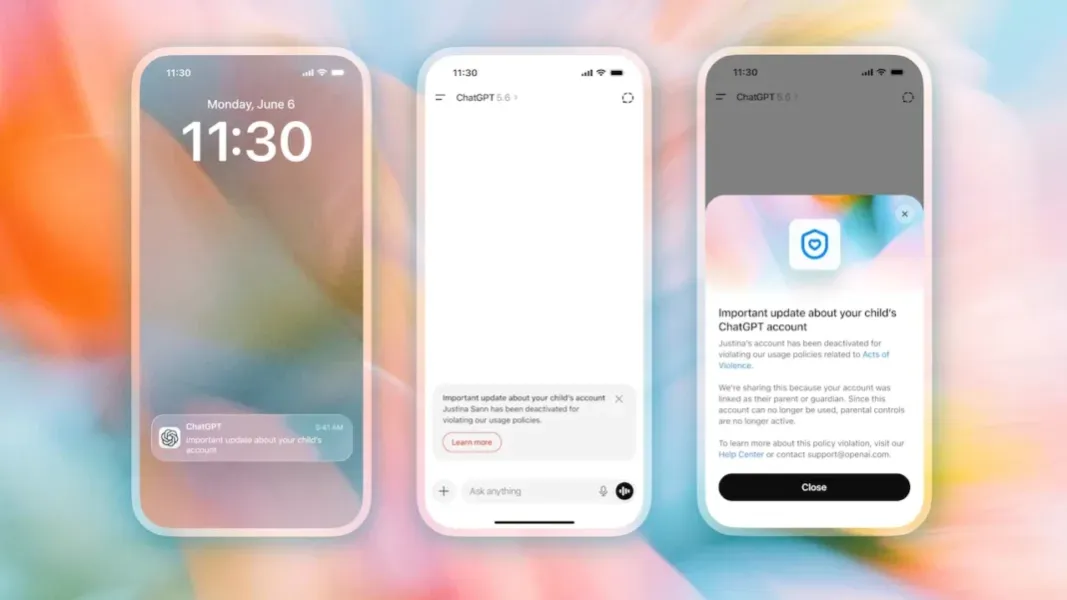
OpenAI will alert linked parents or guardians after violence-policy enforcement deactivates a teen’s ChatGPT account. OpenAI announced the parental-control expansion on July 18 but did not specify a delivery date or geography.
Parents and guardians must connect their profile to a teen’s profile before they can receive an alert. An unlinked teen profile generates no family notification, even when other safeguards for users under 18 apply. Under the conversation privacy boundary, adults cannot read the teen’s prompts, responses, conversation history or real-time activity.
OpenAI is widening the linked-parent notification scope rather than creating continuous conversation monitoring. A Learn More option identifies the violence-policy category behind the deactivation, giving families limited information for deciding whether to intervene or seek help. Because the notice follows enforcement, it cannot prevent the conduct behind the account deactivation or serve as an advance warning.
How the Alert Works and Where It Stops
OpenAI developed the alert with Moonshot, an organization focused on monitoring and countering online violence. Vidhya Ramalingam, Moonshot’s founder, framed notification and added policy information as an initial opportunity for families to respond.
“Notifying a parent when a serious concern arises, with a route to more context, is a critical first step in giving families the chance to step in early and seek help.”
Vidhya Ramalingam, Moonshot founder
Ramalingam’s phrase “first step” also captures the feature’s limit. A teen’s access has already ended when the adult receives the policy category, which cannot identify who was involved or reproduce what was said. Families still need to determine whether a threat remains active before choosing a direct conversation, professional support or emergency assistance, and the category alone cannot prescribe that choice.
OpenAI has not disclosed how many profiles will qualify, how quickly alerts will arrive or what recipients do afterward. Delivery speed will affect an adult’s opportunity to respond to an ongoing concern. Notification and recipient-response rates would indicate how often violence-policy enforcement reaches linked families, how often adults open the message and whether the category supplies enough information for action rather than merely documenting completed enforcement.
Nearly nine in ten teen ChatGPT users use the service for learning, information, skill-building or productivity during a week. Ordinary educational use does not activate the alert, and parents do not gain routine access to those conversations. Only a completed deactivation for violent threats or acts of violence produces the notice for a linked family, keeping the intervention tied to a narrow enforcement outcome rather than general use.
Parents can also activate Study Mode and more frequent break reminders while a profile remains active. Study Mode steers ChatGPT toward hints before answers, while longer sessions prompt breaks. Both measures address ordinary use before enforcement and remain separate from the later violence-policy notice.
In 2025, OpenAI launched ChatGPT parental controls with linked profiles, usage-hour limits, reduced sensitive content and notifications tied to self-harm concerns. Violence-policy alerts inherit the linked-profile requirement while adding a different post-enforcement message. Families must configure the connection in advance because an account without a linked adult has no recipient for the alert.
AI Chatbots Take Different Paths on Teen Safety
In comparision, Meta’s AI assistant uses human-reviewed parent alerts after a teen references suicide or self-harm. In July, Meta’s alerts operated in the United States, United Kingdom, Australia and Canada, with a global rollout planned by year-end. Its model detects a distress signal and sends it for manual review rather than waiting for an account deactivation, creating a different intervention point from OpenAI’s post-enforcement notice.
OpenAI’s approach leaves teen conversations private while giving linked families a narrow intervention route after serious enforcement. Its practical value will depend on alert speed and whether guardians receive enough information to make informed decisions.