- June Availability: Microsoft released Copilot Cowork worldwide on June 16 for eligible Microsoft 365 Copilot customers.
- Completed Work: Cowork handles long-running tasks across tools and returns completed results rather than only drafts.
- Usage Billing: Copilot Credits vary with model use, retrieved context, tool calls, and runtime.
- Admin Controls: Administrators can keep Cowork off, restrict access, set budgets and alerts, and review usage.
- Benchmark Limits: Microsoft’s adoption and savings figures remain first-party claims published when it released Cowork in June.
Microsoft released Copilot Cowork worldwide on June 16 for eligible Microsoft 365 customers after Copilot Cowork’s preview period, putting delegated Office work behind a usage meter.
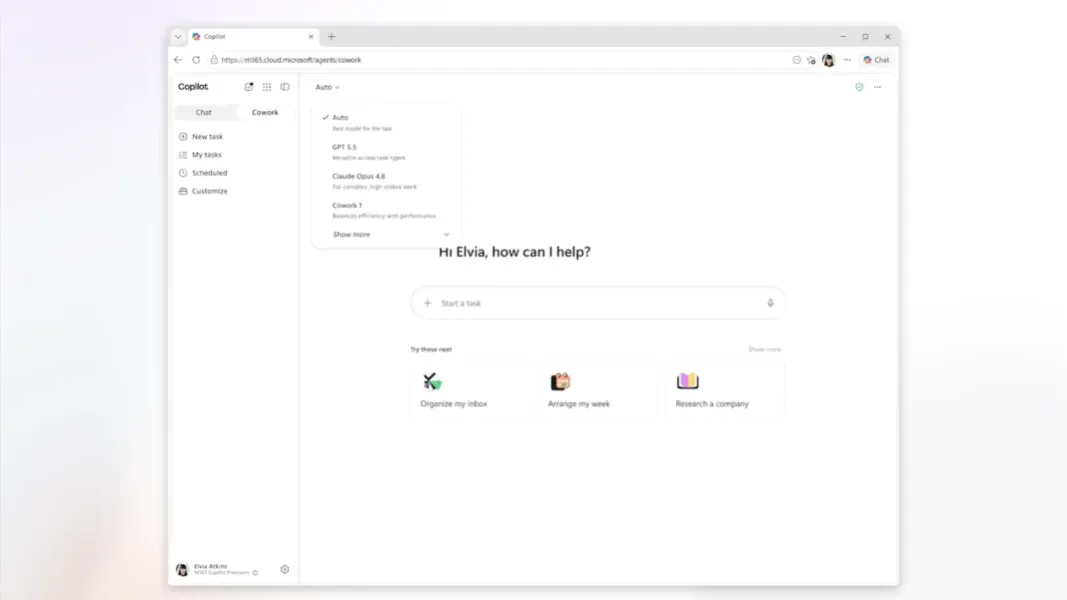
Cowork’s worldwide rollout carried forward its multi-model design. Copilot Cowork’s scheduled tasks run in the cloud regardless of whether a laptop is open, and its Microsoft Graph connection keeps Microsoft 365 governance controls in the task flow.
Its cloud-based architecture enables long-running work across several tools. Customers can assign that work and receive a completed result instead of only a draft.
Each task consumes Copilot Credits, Microsoft’s usage unit for agent work, based on model use, retrieved context, tool calls, and runtime. Billing began with general availability, while qualifying customers in Microsoft’s Frontier early-access program received a grace period before full charges applied. Delegating more work can save time, but it also creates a variable charge that administrators must govern.
Microsoft puts preview adoption at more than half of the Fortune 500, a figure that is not independently corroborated. Administrators retain the deployment decision: Cowork is off by default, with controls for access and spending, budgets, alerts, and usage reports at tenant, group, and user levels. Deployment remains a policy choice rather than an automatic consequence of buying Microsoft 365 Copilot.
Autonomy Comes With a Meter
When Microsoft released Cowork on June 16, customers needed an eligible Microsoft 365 Copilot user license. Each Copilot Credit cost $0.01 under the pay-as-you-go option, and Microsoft also offered a prepaid P3 volume plan. Microsoft’s terms applied at release; current terms may differ.
Model choice, retrieved context, tool use, and runtime can each raise consumption, so the unit price alone cannot predict the bill for a completed task. Administrators can limit who runs Cowork, set budgets and alerts, and inspect usage before expanding deployment.
Microsoft says internal comparison covered 125 runs across 12 prompts where Copilot Cowork produced 30% to 40% lower average cost per prompt than Claude Cowork with the Microsoft 365 connector when both used Opus 4.8. Microsoft cautioned that actual costs vary with usage, configuration, and time, and no independent test corroborates its result.
Under Daniel Anderson’s test conditions, GPT 5.5 would have cost 2.7 times as much as Sonnet for equivalent work, while Opus would have cost roughly $0.80 more than Sonnet. Different configurations prevent that test from validating Microsoft’s comparison.
A Cowork approval-control test examined a separate permission boundary before general availability. Spending limits helpt to constrain cost, while access and approval controls constrain what Cowork may do with organizational data across tools. Staged deployment lets administrators measure consumption without granting broad access immediately.
Cloud Agents Compete on Where Work Runs
Copilot Cowork runs in Microsoft’s cloud and works with Microsoft 365 data. Anthropic’s Claude Cowork web and mobile rollout added cross-device task access, while local file access and computer control still depend on the desktop app.
Claude also offers broader Model Context Protocol connectivity, a standard for connecting AI systems to external tools and data, plus local server access. Deployment location determines which data an agent can reach, which controls apply, and whether unattended work depends on a local machine.
OpenAI introduced ChatGPT Work across apps on July 9. Powered by GPT-5.6 and Codex technology across web, mobile, and desktop, it can gather information, create finished documents and applications, and continue projects for hours. Execution location, data access, and cost controls are part of the product choice, not secondary configuration details.
Since Microsoft ended the Frontier grace period on July 1, customers have borne the full usage charge under their own data and permission rules. Customers will have to measure the Copilot Credit cost of each completed task under live budget and permission controls.