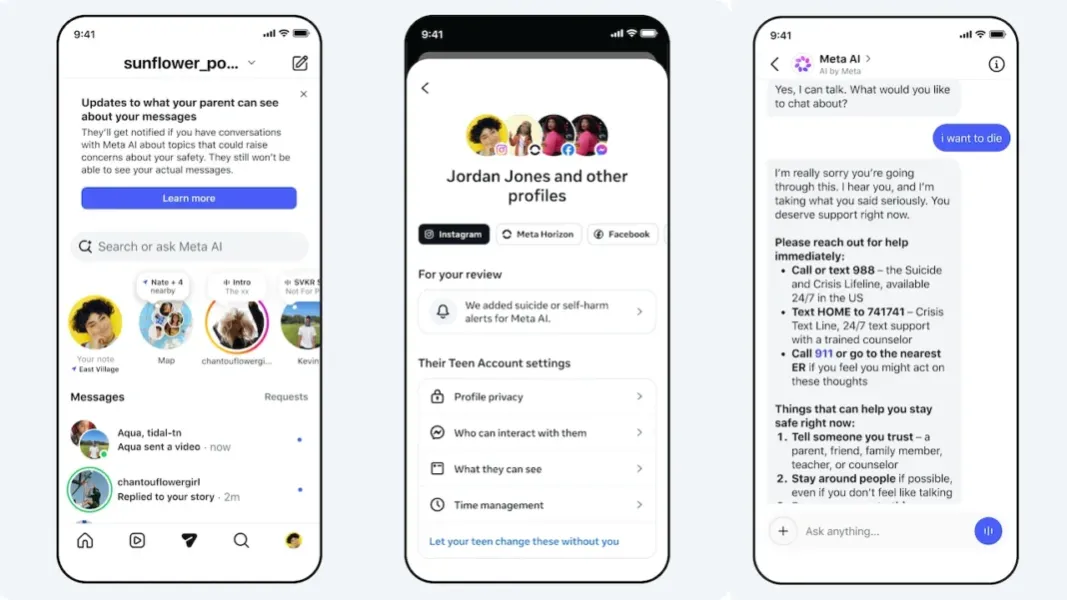
- Parent Alerts: Meta now alerts supervising parents when teen chats with its AI assistant contain possible suicide or self-harm signals.
- Human Review: Artificial intelligence flags risky language, and a person checks every alert before Meta notifies a parent.
- Privacy and Errors: Parents do not receive exact messages, while ambiguous chats can still trigger precautionary alerts.
- Emergency Limits: Emergency-service contact remains unavailable, and adults must opt into supervision before receiving parental alerts.
Meta has introduced parent notifications for supervised teen conversations about suicide and self-harm with Meta’s AI assistant. Parent notifications expand existing crisis-helpline guidance. The controls cover Instagram supervision users in the United States, United Kingdom, Australia and Canada, with global availability targeted for the end of 2026.
Meta AI already directs at-risk teens to crisis helplines and encourages them to contact a trusted adult. Under the new system, AI identifies language associated with danger, but a person checks every flagged conversation before Meta sends a notification. Ambiguous intent can trigger a precautionary warning even without a real cause for concern, while the teen’s exact message remains private.
Participation is not automatic. An adult must opt into account controls that link a parent to a teen account and choose which accounts to supervise. Emergency-service contact for adult or teen conversations involving imminent suicide risk remains under development, with no stated launch date.
How Human Review and Parent Notifications Work
Once supervision is active, Meta can notify the linked adult by text, email or an in-app message. More than 75 teen mental-health clinicians reviewed the assistant’s responses to hundreds of prompts about suicide and self-harm. Supervising adults can also enable Limited Content, a stricter setting that makes Meta AI refuse more prompts before a risky exchange reaches the notification process.
Limited Content addresses prompt access rather than the later alert decision. Human review puts a person between the automated classifier and a sensitive family notification. A reviewer can interpret conversational nuance that the software misses, but the control does not establish that the detection system is accurate.
Independent false-positive and false-negative data remain unavailable, leaving families without measured estimates of missed distress or unnecessary notifications.
Larry Magid, CEO and co-founder of online-safety nonprofit ConnectSafely, framed the intervention as a choice between teen privacy and a parent’s need to know about possible danger. His comment appeared in Meta’s announcement, so it does not independently validate the system’s performance.
“While I believe that teens have a right to privacy, I also believe parents need to be informed if their teen may be at risk of hurting themselves.”
Larry Magid, CEO and Co-Founder of ConnectSafely (via Meta)
A supervising adult can act on the notification without receiving a transcript. Human approval reduces dependence on the classifier alone, yet the lack of performance data prevents parents from knowing whether the safeguard catches the right conversations.
Current Support, Future Escalation and Safety Pressure
Parent notification extends Meta AI’s crisis resources from the chat to a supervising adult. Contact with emergency services remains a development project rather than a live response option. Meta’s earlier AI safeguards provide historical context for the new parent alerts.
Meta attributes more than 19,000 referrals to its Facebook and Instagram systems during 2025, while youth-harm litigation later led it to pull addiction-lawsuit ads from both platforms. Wellness-check referrals send first responders to assess people believed to be in danger. Referral volume indicates the scale of the older systems, not the accuracy of the new chat classifier.
On March 24, 2026, New Mexico jurors returned a liability verdict against Meta over consumer deception and harms including child sexual exploitation. Civil penalties were a $375 million.
A March 25, 2026, Los Angeles jury verdict held Meta and YouTube liable over design choices that harmed a young user and inadequate warnings. Neither verdict assessed the parent-notification system; the cases concerned platform safety, product design, consumer warnings and harms to young users.
Meta targets global availability by the end of 2026. Before that expansion, the decisive test will be whether Meta publishes measured rates for missed notifications and precautionary alerts, allowing families to judge how reliably the system identifies distress.