- US Rollout: Google has expanded Search’s AI Mode to US users with connections to Canva, YouTube Music, and Instacart.
- Connected Tasks: AI Mode can pass prompts to the services for design options, saved playlists, or prepared grocery carts.
- User Control: Users still authorize Instacart purchases, and Google has not named future app partners or provided an expansion timetable.
- App Competition: OpenAI’s ChatGPT and Anthropic’s Claude already support integrations that connect their assistants with external apps.
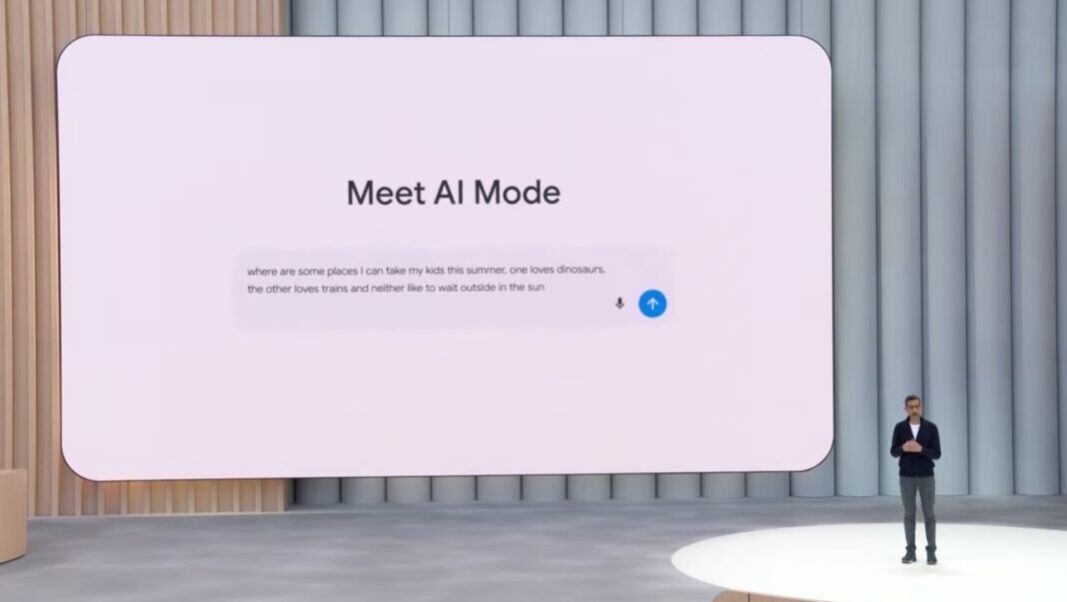
Google expanded Search’s AI Mode this week with connected-app support for users in the United States. The initial lineup connects Google Search’s AI Mode to design platform Canva, music-streaming service YouTube Music, and grocery-delivery service Instacart. AI Mode passes a prompt to the relevant service and receives or prepares the result instead of returning only an AI response.
Google controls the prompt handoff inside Search, while each connected service produces the output or hosts the final action. A party-planning request, for example, can generate an invitation, assemble music, and prepare groceries without being rebuilt in three apps. Canva retains its design workflow, YouTube Music stores the playlist, and Instacart controls checkout; AI Mode coordinates bounded steps rather than taking unrestricted control of the services.
How the Three App Connections Work
Canva handles the creative output. A user can describe a project in Search, send the request to Canva, and receive design-template options without opening Canva first and re-entering the instructions. AI Mode supplies the starting point, while Canva generates the choices and remains the workspace for further editing, preserving the service’s role after Search returns the initial result.
YouTube Music covers both creation and a library action. AI Mode can turn a prompt into a playlist, display songs in an inline card, save the selection to the user’s library, and open YouTube Music for playback. Users can keep the saved playlist, but playback still occurs in YouTube Music rather than becoming a general Search function.
Instacart preserves the clearest user-approval step. The grocery connection can populate a cart from a prompt, but users retain checkout control in the service even after Search assembles the shopping list. Google’s earlier AP2 payment protocol implementation used a similar division by recording user approval in a signed Cart Mandate before an agent-driven payment.
Service-specific actions do not give AI Mode arbitrary app access or payment authority. Google has added a prompt-routing layer for three defined workflows, not one assistant with general control over the connected services. Each partner receives a bounded request and retains the task portion that depends on its interface, account, or approval process.
Google Enters a Broader App-Integration Race
Google is joining rival products from OpenAI and Anthropic as AI Mode interacts with select apps. OpenAI’s ChatGPT and Anthropic’s Claude already support external-app integrations, making the competitive test how much work an assistant can hand off before users must restart elsewhere or approve an action. Google introduced third-party app connections in its Gemini app earlier in 2026 before extending the approach to Search.
Google previously tested adjacent capabilities inside AI Mode, including Canvas creation tools. Earlier in 2026, eligible subscribers gained opt-in Gmail and Google Photos connections, allowing personal information to inform a Search answer. Those account connections bring information into Search, whereas the latest integrations send instructions outward for another service to act on.
In April, Google expanded restaurant booking to eight countries, providing an earlier task-execution example. Named third-party services now go further by receiving instructions and producing or preparing outputs outside Search. Designs, playlists, and carts also remain inside the partner’s workflow, preserving a clear handoff between request preparation and the service-specific result.
Connected accounts and app handoffs solve different parts of a request. Gmail and Google Photos can supply information to an answer, while the three new services can act on instructions. Canva produces a creative output, YouTube Music stores a usable media object, and Instacart prepares a transaction that the customer must approve.
Google Search remains the request hub without absorbing every part of the task into Google’s interface. Google says it plans to support more connected apps and is working with additional partners, but it has not named them or provided a timetable. Until Google identifies the next partner and its approval controls, AI Mode remains confined to the three initial workflows.