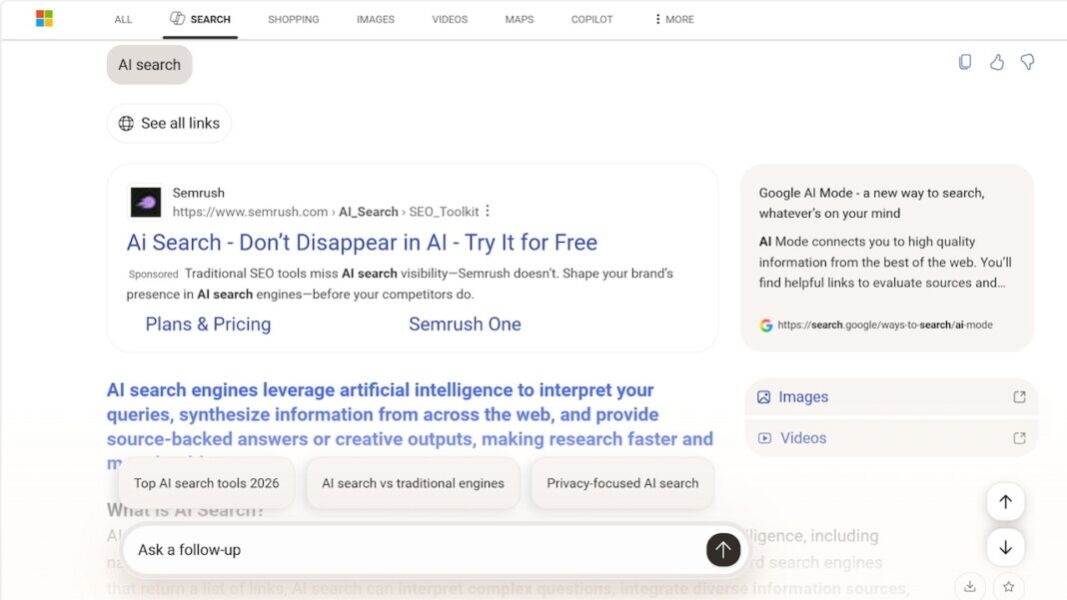
- Bing Control: Bing AI Search Choice lets users turn off Copilot-style AI-generated search summaries.
- Browser Trade-Off: The extension suppresses AI answers but also sets Bing as the default search engine.
- Query Option: Users can add -ai to individual Bing queries when they want fewer AI answers without installing software.
- Market Signal: The preview follows broader search pushback as Google expands AI search and DuckDuckGo gains lower-AI demand.
Microsoft has released Bing AI Search Choice, a preview browser extension for its search engine Bing that lets users turn off Copilot-style AI-generated search summaries. The tool gives Bing a one-click control for toggling AI chat-like features on or off.
Bing AI Search Choice gives users a lower-AI search lane, but it also supports Microsoft’s search-distribution goals. Users can suppress AI-written answers so familiar search results and links remain the focus, while installation also changes the browser’s default search behavior. Jordi Ribas, Microsoft President and Head of Search, said Microsoft research found that “not everyone wants to use AI for everything all the time”.
How Bing’s AI Off Switch Works
Users can choose whether to see AI-generated answers on Bing and switch them off to focus on familiar search results and links. Compared with a built-in Bing setting, the extension is more limited but easier to understand than a buried preferences option.
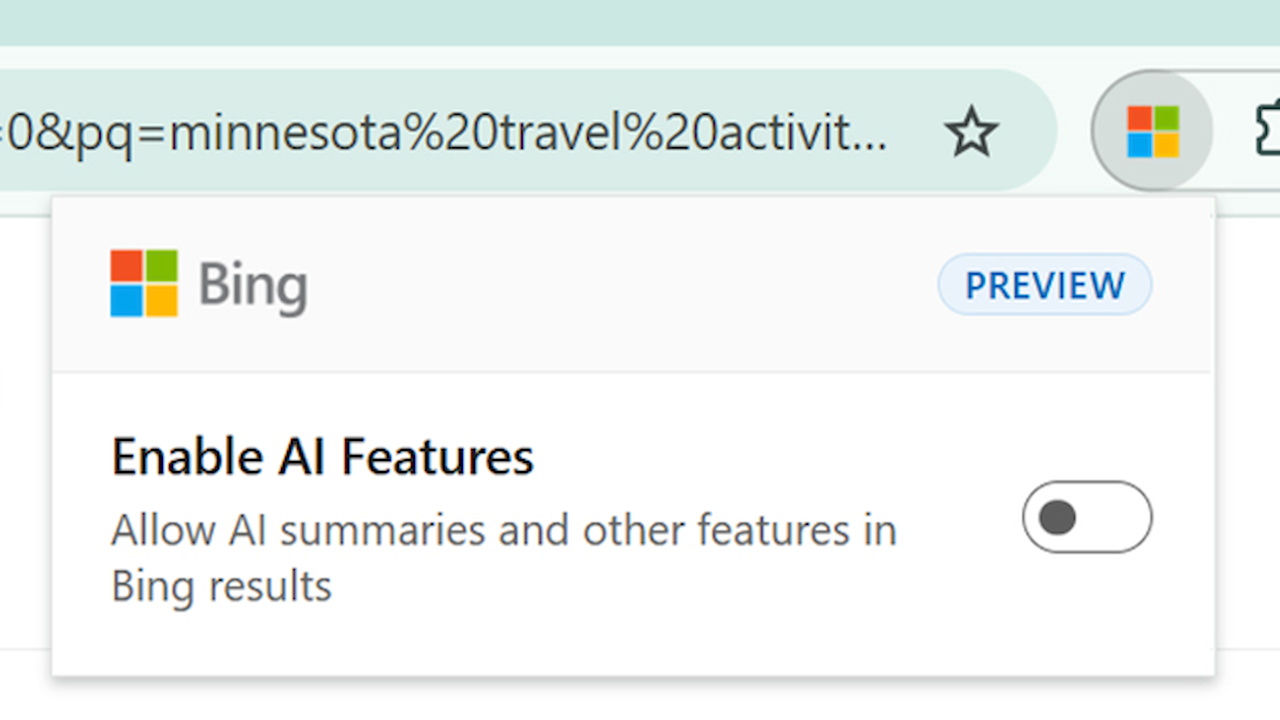
Installation appears to carry a second job. Microsoft’s extension sets Bing as the default search engine and open Bing on every new tab. With that Microsoft offers a browser search placement tool alongside the user-facing off switch.
Users get a useful control, not a neutral one. Anyone who wants fewer AI-written answers must also accept a browser-level search change. For Microsoft, the preview converts a user-control request into a way to keep Bing in front of people who might otherwise try a lower-AI search provider.
At least the software will not collect or use user data, a key constraint for tools that change search behavior inside a browser. While data restraint does not remove the default-search trade-off, it addresses a separate concern for users evaluating add-ons.
Bing users who do not want another extension have a lighter option can also append the parameter -ai to a search query to suppress AI answers for that search. Michael Schechter, a Microsoft search executive, cast the preview as a way to learn whether interested users want this kind of control integrated more broadly.
Jordi Ribas’ preview framing presents the add-on as a demand test before Bing absorbs the control directly. The test keeps the feature small while still measuring demand for a visible AI-answer switch. If enough users take up the preview, Microsoft will have a stronger case for moving the control from add-on software into the search product itself.
Why Search Choice Became a Competitive Signal
Microsoft spent years making AI a central part of Bing before offering this opt-out. In 2023, the company pitched the first AI-powered Bing and Edge preview around search, browsing, chat, answers, and Edge integration. Bing’s new off switch does not reverse that strategy, but it acknowledges that generated summaries need a user-visible exit ramp when they become part of the default search experience.
Microsoft has already tested similar pressure around Copilot. Edge 144 gave users a Copilot removal option after backlash, making the Bing extension part of a wider pattern of AI controls arriving after user resistance. Edge controls affected the browser interface, while Bing AI Search Choice affects search-result pages and the browser’s default search behavior.
Google’s AI Overviews and AI Mode search features in contrast push search aggressively toward generated answers and agent-like tasks. Just recently, Google basically turned Search into an AI agent entry point with longer prompts, uploads, guided suggestions, and recurring tasks. As a result, privacy-focused search engine DuckDuckGo has seen traffic and install gains as some users look for lower-AI search lanes.
AI-answer search service Perplexity has been a front-runner in AI search, building a product around answers rather than link lists. Microsoft now appears to be trying to occupy the middle ground, keeping Copilot answers available, but considering to give users an easy switch when they want ordinary results.
It remains unclear however whether the preview becomes a durable Bing setting rather than an extension for motivated users. If the option stays tied to extension-installation, most users won´t simply know about it. At least the -ai operator offers a simple way users can apply directly from the search bar.