- Model Launch: Anthropic has launched Claude Fable 5 as a public Mythos-class Claude model with safeguards.
- Routing Controls: Sensitive cyber, biology, chemistry, and model-distillation prompts route to Claude Opus 4.8 instead.
- Access Window: Paid Claude subscribers can use Fable 5 at no extra cost through June 22 before usage-credit pricing begins.
- Enterprise Caveat: Customers must weigh 30-day traffic retention, AWS deployment options, and vendor-backed capability examples before adoption.
Anthropic has widened access to its previously restricted Mythos-class capability tier by launching Claude Fable 5, a public Claude model with built-in safety routing. Regular Claude users can try Fable 5, while Claude Mythos 5 remains the less-restricted version for approved cyberdefenders and infrastructure providers.
Pro, Max, Team, and seat-based Enterprise subscribers can use Fable 5 at no additional cost through June 22. After that window, Fable 5 and Mythos 5 move to $10 per million input tokens and $50 per million output tokens, turning the launch into both an access story and a cost decision for paid Claude customers.
How Anthropic Is Limiting Fable 5 Access
Fable 5 is basically a restricted Mythos release. Its safeguards mean queries on some topics, including cybersecurity, biology, chemistry, and attempts to copy or imitate another model’s behavior, receive a response from Claude Opus 4.8 rather than Fable 5.
Anthropic says the fallback path triggers, on average, in less than 5% of sessions. Riskier capability areas move through a controlled route instead of every prompt receiving the same model response.
Enterprise customers also face a data-handling caveat. For Fable 5 and Mythos 5, model traffic would carry 30-day traffic retention, including for customers that previously had zero-retention agreements. Security-sensitive customers have to weigh stronger model access against a retention rule that may require legal, compliance, or procurement review.
Claude Mythos 5 runs on the same underlying model as Fable 5 but lifts some safeguards in areas where Anthropic limits access through Project Glasswing, its restricted-access program for selected partners and defense-oriented users. Anthropic can widen public availability without treating every use case the same way.
Claude Opus 4.8 now serves as the fallback model for some sensitive Fable 5 requests after Anthropic added Dynamic Workflows to that model in May. This routing keeps the public launch connected to Anthropic’s existing Claude model line rather than replacing it with one unrestricted path.
Fable 5 is also available through Anthropic’s Claude application programming interface and consumption-based Enterprise plans. Procurement teams now have a concrete cost threshold for deciding whether larger context and agentic-workflow gains justify a premium model.
What Fable 5 Can Do and Where It Runs
Capability benchmarks remain mostly vendor- or operator-tested, but they give customers concrete tasks to evaluate. In its own testing, Fable 5 outperformed Opus 4.8, OpenAI’s competing GPT-5.5 model line, and Google’s Gemini 3.1 Pro, and the model can extract precise numbers from scientific figures and rebuild source code from screenshots.
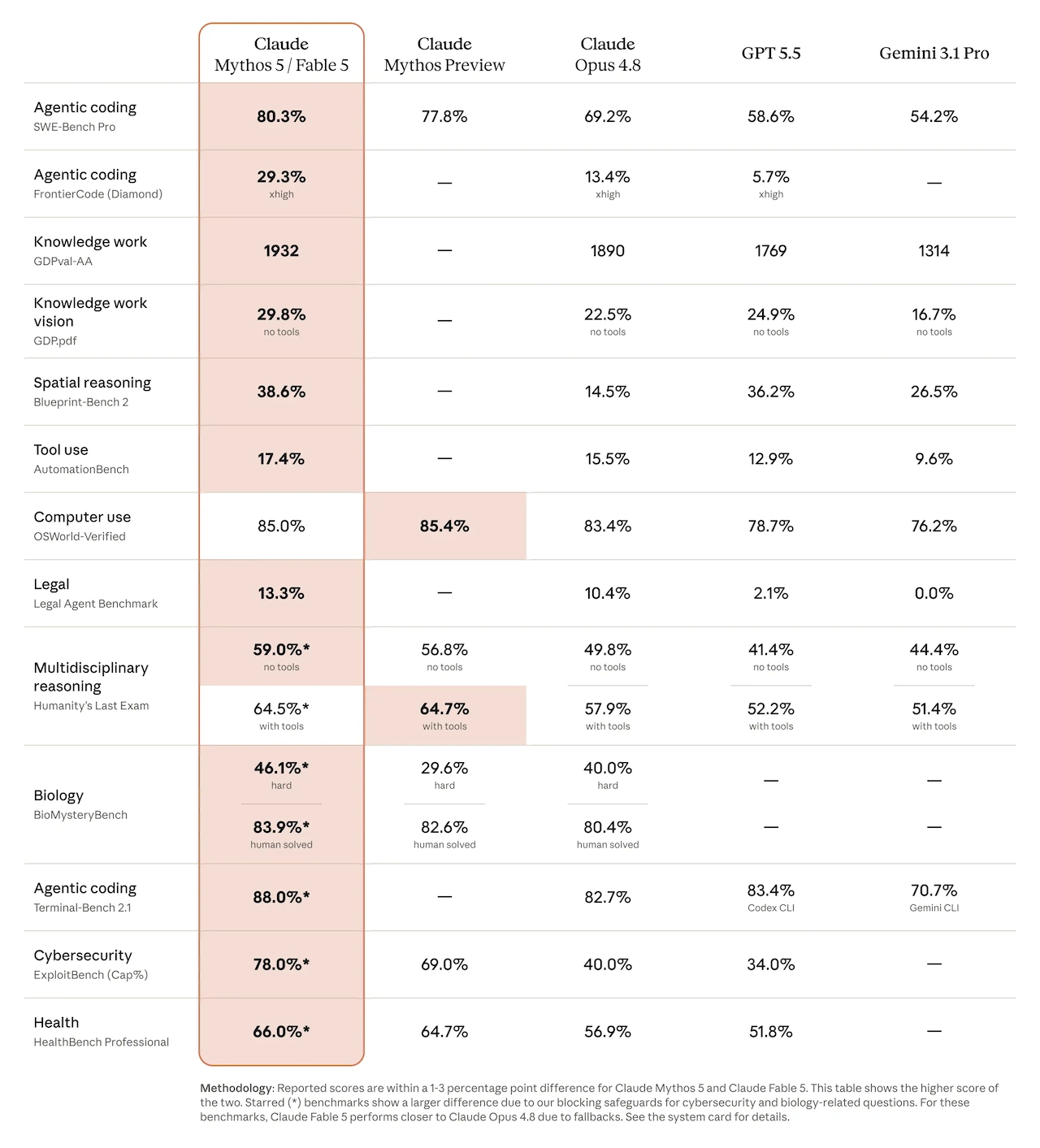
These examples move the claim beyond chat quality and into work where accuracy, visual interpretation, and code reconstruction can be checked directly. Anthropic’s comparison still belongs in the vendor-claim category, not in the same bucket as independent benchmark verification.
Payments company Stripe reported that Fable 5 completed a migration across a 50-million-line Ruby codebase in roughly one day, compared with more than two months for an engineering team. Stripe’s workload gives customers a concrete migration size, timeline, and comparison point rather than only a benchmark rank.
AWS availability turns the launch into an enterprise deployment option rather than only a Claude chat feature. Fable 5 is available through Amazon Bedrock and Claude Platform on AWS, where customers can use it for long-running agent workflows in a managed AI model platform.
An agent harness such as Claude Code lets the model plan work, check progress, and refine an approach over extended sessions. That deployment detail matters because multi-step work creates different oversight and cost questions than a single chat response.
Analytics platform Hex adds an operator-side test case. Hex is rolling out Fable after measuring difficult data-analysis workloads, including scores of 93 percent on Analytical Hard, 93.5 percent on Semantically Modeled, and 65 percent on Semantically Unmodeled.
Hex said: “On the hardest questions, it shows strong judgement and attention to nuance,” tying Fable to analytics work where a wrong interpretation can be more costly than a slow answer.
The Competitive and Prior-Access Context
Project Glasswing had kept Mythos access limited to selected partners and defense-oriented users before the Fable launch. Fable 5 changes that distribution model by making a safeguarded version available to regular Claude users, while Mythos 5 keeps a narrower path for approved users who need fewer restrictions.
Anthropic’s own comparison names GPT-5.5 and Gemini 3.1 Pro, while Mythos cyber-range tests had already placed the family against GPT-5.5 in cyber-range work. DeepSeek V4, a rival frontier-model preview from April, adds another pressure point around how quickly frontier vendors can move stronger models into public or semi-public hands.
After the temporary access window, Anthropic’s token price becomes the next practical test for Fable 5 adoption. Customers will have to decide whether the model’s longer-running work, safeguard routing, retention rule, and vendor-backed capability examples justify moving from a subscriber trial into paid usage-credit consumption.