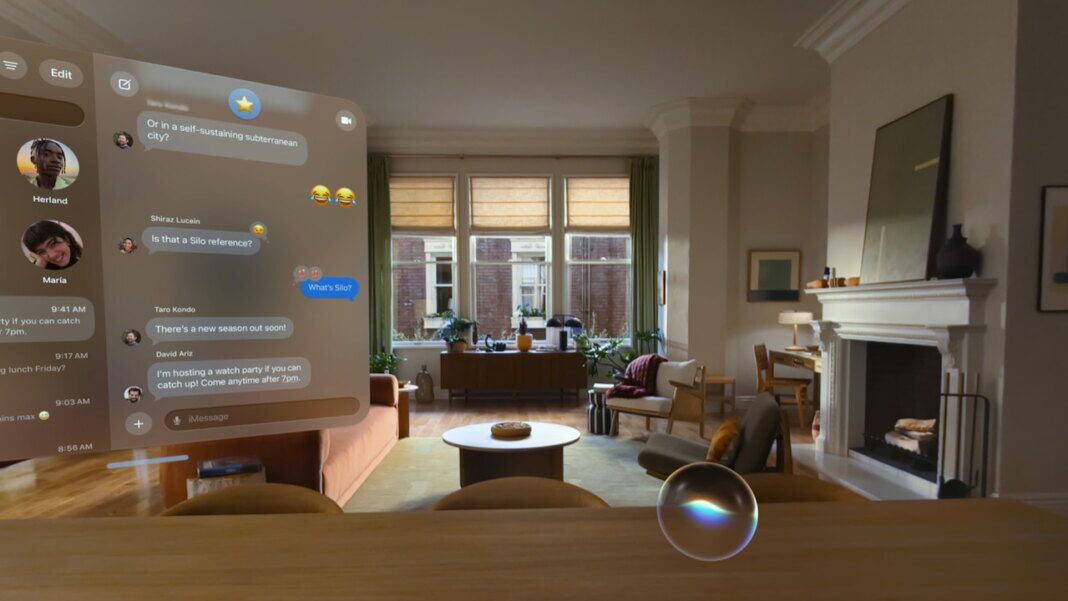
- Vision Pro Update: Apple has announced Siri AI, Visual Intelligence, spatial media tools, and Mac-linked workflows for visionOS 27.
- Feature Mechanics: Users can place a 3D Siri presence, ask about visible objects, and turn panoramas into spatial scenes.
- Availability: Developer testing began June 8, the software update is planned for fall, and Siri AI follows later in 2026.
- Market Test: Vision Pro still has to prove whether AI-assisted spatial workflows reduce everyday friction for owners and developers.
Apple has announced visionOS 27, its operating-system update for Vision Pro, and said it will add the new Siri AI, object-aware visual tools, spatial media controls, and Mac-linked 3D workflows to its spatial-computing headset. Vision Pro now becomes a current test case for assistant and spatial tools inside a headset view where digital content sits around the user.
Developer testing for visionOS 27 began on June 8, with a public beta planned for July and a fall software release planned for Vision Pro. Apple’s 2026 cross-device Siri AI rollout also puts the headset version inside a wider assistant push. On Vision Pro, Siri AI is available as a beta later in 2026 for supported English-language setups, while EU access depends on supported languages.
For Vision Pro owners, the staged rollout leaves a practical test: whether AI can make the headset’s camera-fed view of the user’s surroundings, windows, media, and 3D workspaces easier to use. Apple is not presenting only another maintenance release for a device that still has to expand beyond early adopters.
AI and Spatial Features Move to the Foreground
Siri AI gives Vision Pro a spatial assistant rather than only a voice layer. In visionOS 27, users can pin a 3D Siri visualization in the headset environment and invoke it by looking at it and speaking. Visual Intelligence adds the more headset-specific mechanism: Siri can answer questions about physical or digital objects the user is viewing through passthrough, the camera-fed view inside the headset.
Here’s a first look at Siri AI on Apple Vision Pro. You can now visually look at something and it will tell you what it sees and provide additional context. Could this be the foundation for Apple glasses? pic.twitter.com/80cl5qmHWU
— Nathie 🔜 AWE (@NathieVR) June 8, 2026
VisionOS 27 also gives users more personal media and workspace controls. Panoramas can become spatial scenes or personal environments, while curved windows are coming to Safari, Freeform, and Apple TV Multiview.

Apple’s 3D preview tool Quick Look gains Mac-based model previewing and editing, including wireframes, UV maps, and annotations that let collaborators inspect texture-coordinate maps and model notes inside the headset workflow.
Apple is also pushing more of the headset’s value inside the user’s space instead of in a flat app list. A panorama can become a surrounding scene, a Safari window can bend around the view, and a Mac-connected model can move into a shared review flow. Designers, training teams, and developers will judge whether those controls reduce the steps needed to inspect or adjust 3D content.
Craig Federighi, Apple’s senior vice president of Software Engineering, tied the AI work to user context and privacy rather than only to feature breadth.
“Truly helpful AI must be centered on our users’ needs, deeply integrated into the products they rely on every day, grounded in personal context, and built with privacy at every step.”
Craig Federighi, senior vice president of Software Engineering at Apple
Privacy carries extra weight on a headset because Visual Intelligence depends on what the wearer sees. Apple Private Cloud Compute can process AI requests without storing personal data or making it accessible to Apple.
Performance details are narrower but still practical. Vision Pro starts and connects to Wi-Fi up to three times faster in prerelease testing, measured from first unlock after reboot through Apple TV app launch and content appearance. Faster startup will not decide the headset’s market by itself, but it reduces friction around the same spatial apps Apple wants users to revisit.
The Headset Still Has to Prove Its Market
Vision Pro already had an AI direction before visionOS 27. Apple previously began bringing Apple Intelligence to Vision Pro as a platform feature, and later tied Vision Pro eye-tracking capabilities to AI-assisted accessibility tools. VisionOS 27 widens that earlier work into an interface layer that depends on what the headset can see, place, and manipulate around the user.
Professional use cases are moving through the same headset workspace. Earlier in 2026, visionOS 26.4 added NVIDIA CloudXR foveated streaming support, pointing Vision Pro toward enterprise previews and design uses. VisionOS 27 extends that workflow by letting Mac-connected 3D assets move into the headset with collaboration metadata still visible.
Apple is also operating in a more crowded extended-reality field. Samsung, Google, and Qualcomm launched the Galaxy XR headset as a lower-priced rival, while Google’s Android XR headset operating system and Meta’s mainstream mixed-reality headset line keep pressure on platform breadth and consumer pricing.
Developers now get the first outside test for whether object-aware Siri, spatial panoramas, curved windows, faster startup, and Mac-linked 3D workflows fit real work rather than demos. Broader beta access and the fall software launch will show which features Vision Pro owners revisit after the initial novelty fades.
Apple’s strongest argument is that AI and spatial controls belong together on a headset more naturally than on a conventional screen. Useful pieces still arrive in stages, with Siri AI following the main software update later in 2026. Vision Pro owners and developers will need the beta cycle and fall release to judge whether the update reduces everyday friction enough to matter.