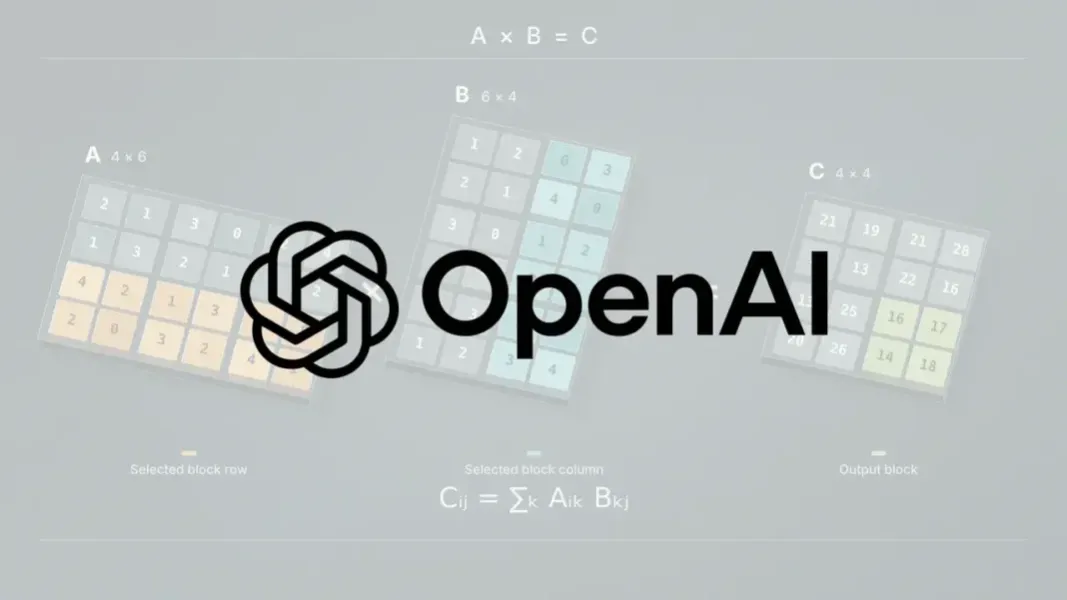
- Matrix Multiplication: OpenAI claims to have established a fundamental speed limit for multiplying grids of numbers, a key operation in AI. For square matrices of size n × n, it says no exact algorithm can achieve a computational growth exponent below 2.25 (9/4).
- Competing Claim: Mathematician Zhi-Wei Sun claims that the optimal exponent is 2, meaning the amount of computational work could grow almost as slowly as the number of entries in the resulting matrix.
- Fourier Transform: OpenAI also claims to have established a theoretical limit on how efficiently signals can be broken down into their component frequencies, even when computational circuits reuse calculations across multiple signals.
OpenAI claims to have established a fundamental speed limit for matrix multiplication, a mathematical operation at the heart of modern artificial intelligence. Matrices are grids of numbers, and multiplying two square matrices with n rows and n columns using the traditional method takes roughly n³ arithmetic operations. OpenAI’s November 24 preprint claims that no exact algorithm can reduce the exponent below 9/4, or 2.25. In October, OpenAI showed that algorithms could get arbitrarily close to that exponent in the same number system. If correct, the two results would together establish the best possible exponent in that setting.
OpenAI makes a similar claim about the Fourier transform, a mathematical technique for breaking a signal into its component frequencies, much like separating a sound into its individual tones. Its second paper presents both a faster way to compute the transform and a theoretical limit on how efficiently a computational circuit can perform it. OpenAI credits an unnamed internal AI model with producing its research papers.
Computational complexity researcher Scott Aaronson singled out both lower bounds on November 25. What surprised him most about the matrix multiplication result was not the proposed exponent of 2.25, but the prospect of proving any exponent greater than 2. The output itself contains n² numbers, making 2 the natural minimum. Proving that even the cleverest possible algorithm must have a higher exponent would be a major mathematical breakthrough.
Why the Matrix Lower Bound Matters
Multiplying two square matrices produces a third grid with the same number of rows and columns. A grid of side length n has n² distinct output entries, which gives the basic lower exponent of 2. The textbook calculation adds up n products for each entry, so its arithmetic work grows with the cube of the side length. Volker Strassen showed that sharing calculations across entries could bring the exponent below 3. An algorithm gives an upper bound by showing how much arithmetic suffices.
Strassen’s method also provides a comparison at one size. Applying it twice over successively smaller blocks uses 49 scalar multiplications for a pair of 4-by-4 matrices. In 2025, Google DeepMind’s AlphaEvolve found a way to multiply two 4-by-4 complex matrices using 48 scalar multiplications.
OpenAI’s October paper addressed how the count grows across sizes. It gave an upper bound of 9/4 for matrices with complex numbers as entries. A separate upper-bound proof obtained the same estimate over every field, a number system with rules for addition, subtraction, multiplication and division. The November paper claims a matching lower bound in every field for formal arithmetic circuits. Those circuits treat the matrix entries as variables and must produce each entry of the product exactly using the four arithmetic operations.
The proof starts with a network that sorts a list and compares neighbors for repeats. The authors argue that a matrix exponent below 9/4 would give them mathematical identities for compressing many such networks into one. The compression lets independent lists share table lookups and groups wires at fewer junctions. The model counts junctions and wires, with at most three bits handled by each junction. The paper argues that repeated compression would cut that count below the lower bound it derives for the same kind of list checking.
OpenAI researcher Sébastien Bubeck said the model had been working on the lower bound since the October release.
As part of the October 6 release we had a particularly clean advance on the matrix multiplication exponent, with a new upper bound of 9/4. Since then, the model has been working on a LOWER BOUND for this exponent. This is already pretty crazy since NOTHING was known for lower…
— Sebastien Bubeck (@SebastienBubeck) November 25, 2026
In a September preprint, mathematician Zhi-Wei Sun claimed an exponent of 2 over every field. His proposed construction represents the matrix product as a limit of simpler formulas. It then uses interpolation, a way of reconstructing a formula from its values, to recover exact results. If the construction holds, it would bring the exponent down to the power at which the output entry count grows and undercut OpenAI’s proposed floor.
How Far Fourier Circuits Can Cut the Work
The discrete Fourier transform takes a list of samples, such as points in an audio recording, and expresses them in terms of frequencies. The classic fast Fourier transform shares intermediate sums across those frequencies. At power-of-two lengths, it takes on the order of N times the logarithm of N operations, where N is the number of samples.
OpenAI’s Fourier preprint counts gates in an exact linear circuit. Each gate adds two available values after multiplying them by chosen weights. The circuit can choose any weights from its number system and reuse each result. The claim covers the ordinary transform over complex numbers for lists of two samples or more.
OpenAI puts the lower bound at a constant times N times the square root of the logarithm of N. The proof argues that a smaller circuit could only produce a transform whose weights split into two parts. Short paths would account for a part with few input-to-output connections. Long paths would account for a correction built from few independent combinations of the inputs. The authors argue that the weights of the Fourier transform itself cannot be represented by that combination.
To build a faster circuit, the authors share work between outputs, predict many values cheaply and repair the remaining errors to produce the exact transform. The construction gets arbitrarily close to one-half from above for the power on the logarithm. The square root in the lower bound is the same half-power. The claimed floor still applies on average when a circuit shares calculations across independent signals of the same length. Whether a circuit can get down to N times the square root of the logarithm of N, up to a constant factor, remains open.
Which Bounds Have Machine-Checkable Proofs
OpenAI formalized the square matrix exponent in Lean, software that checks an encoded proof against its assumptions. The formal result covers the exponent even when division is allowed. OpenAI also formalized both Fourier bounds for individual signals and batches.
Three proof checkers accepted the encoded matrix exponent for algorithms without division in an AI-assisted audit organized by Carlos Toledo. On November 26, The File reported that its search found no published assessment by outside mathematicians of OpenAI’s lower-bound proof. In his update that day, Aaronson argued that software can verify a proof before mathematicians understand the ideas behind it.
OpenAI’s Lean release lists a separate matrix bound as unformalized. The paper argues that a sufficiently cheap method at one size could be repeated at larger sizes to reduce the growth exponent. It uses that link to derive a lower bound for every size from 2-by-2 up, counting multiplications of two input-dependent values and divisions by an input-dependent value. The paper puts that floor at one-half times the side length raised to the power of 9/4, rounded up.