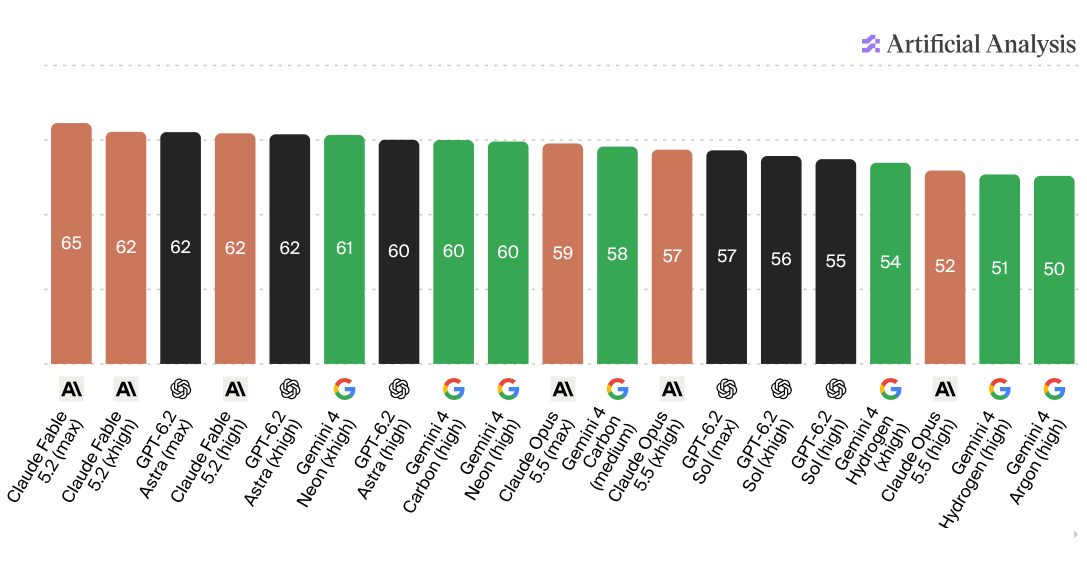
- Benchmark Speed: Gemini 4 AI models Neon and Carbon both scored 60 at the high reasoning setting on Artificial Analysis’s Index, with Neon’s estimated task time under half Carbon’s.
- Long PDFs: Neon answered questions about long PDFs more successfully at its default reasoning setting than at its highest setting.
- Developer Rates: Google bills by token, a unit of model input or output, with Carbon cheaper through November 30 and Neon cheaper from December 1.
Google’s new AI model, Gemini 4 Neon, scored 60 at its default high reasoning setting in Artificial Analysis’s benchmark index, matching Gemini 4 Carbon at the same setting. As of November 19, the evaluator’s model pages estimated 14.8 minutes per task for Neon and 37.1 for Carbon in tests through Google’s developer API. Raising Neon to its highest setting, called xhigh, added one point and pushed the estimate to 21.5 minutes.
At high effort, Neon generated 101 output tokens, or chunks of text, per second to Carbon’s 55. Artificial Analysis used the amount and speed of generated output to estimate time, then weighted the results across the nine tests that make up its Intelligence Index. The tests cover knowledge work, coding, science and general knowledge.
Google DeepMind adapted Neon from Carbon for recurring work such as writing code or analyzing documents. Neon became generally available November 18 through Google’s paid Gemini API, which developers use to run the model from their own software. Artificial Analysis published its comparison that day. Google also began rolling Neon out to Pro and Ultra subscribers in the Gemini app and Antigravity coding tools.
How Neon Handled Documents and Product Listings
Neon at high effort passed 33.4% of benchmark attempts on a test that asks models to answer questions using long professional PDFs. Carbon passed 28.4% at high, and Neon passed 28% at xhigh. Artificial Analysis ran each of the 100 tasks five times per model. An answer counted only if it met every grading criterion.
On the index’s AA-Briefcase exercise, models turn workplace materials into finished files for specific business tasks. Neon at xhigh earned the highest rating for the presentation quality of those files among the tested models.
In a separate experiment by Spring Prompt, each model got incomplete supplier data and photos of fictional products. To pass the factual brief, each missing field had to match the photos and existing entries had to stay intact. Using the OpenRouter model service’s medium setting, Neon produced publish-ready factual listings in all three runs for 44 of 56 products. Carbon passed the same test for 53.6% of products.
On those factual listings, Neon averaged 36 seconds per item to Carbon’s 45. Spring Prompt put Neon’s cost at 6.5 cents per listing, about three times Carbon’s. On the sales brief, Neon produced listings rated publish-ready in all three runs for 32.1% of the same products. It added about one unsupported claim per product. OpenAI’s GPT-6.2 Sol reached 75% on both briefs.
How the Coding Tools Compared
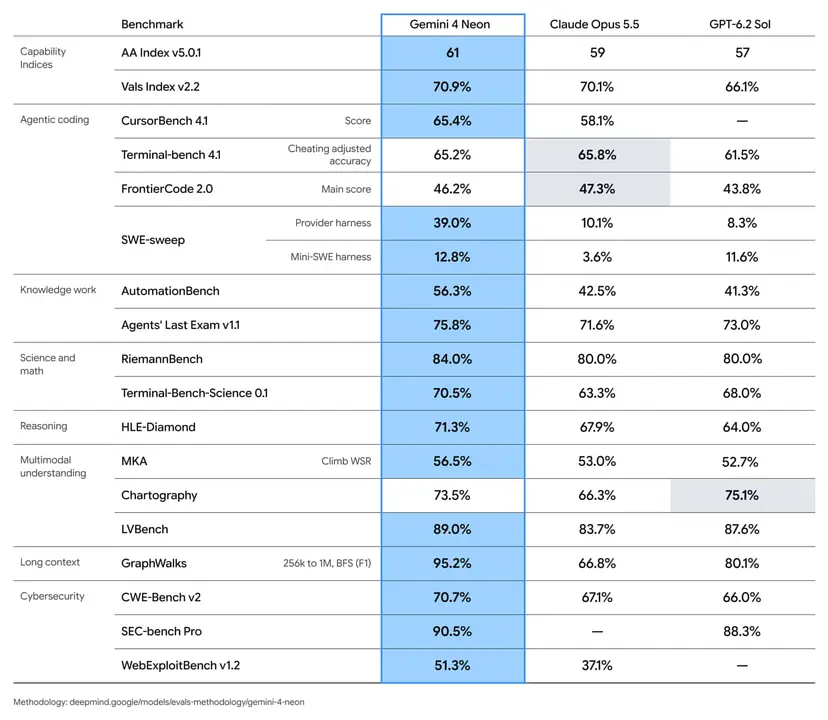
The Coding Agent Index tests working setups on software changes, terminal tasks and questions about code repositories. Artificial Analysis paired Neon at xhigh with Google’s Antigravity terminal tool. It ran Anthropic’s Claude Fable 5.2 at xhigh and Claude Opus 5.5 at maximum effort in Claude Code. All three setups scored around 58 to 59 points. At per-token API rates, the estimated cost per coding task was $6.86 for the Neon setup and $12.61 to $15.47 for the Anthropic setups.
In a separate test of software bug finding, Google ran Neon, Claude Opus 5.5 and GPT-6.2 Sol in their makers’ coding tools. Neon ran in Antigravity, which can send helper agents to search different parts of a codebase. Google weighted the results from individual parts of each assignment to calculate a score. With the separate tools, Neon led its closest rival, Opus, by nearly 29 percentage points. When all three ran in the same mini-SWE tool, Sol came closest, just over one percentage point behind Neon.
When Carbon’s Discount Ends
Artificial Analysis estimated $6.44 per task on the overall index at Neon’s highest setting. Carbon at high came out to $7.76 using its standard rates. Neon generated about 15% more output tokens per task in that comparison. Its 25% lower standard token rates outweighed the extra output. At high effort, Neon came in at less than half Carbon’s standard-price estimate.
Google charges $2 per million input tokens and $10 per million output tokens for Carbon through November 30. On December 1 those rates rise to $4 and $20. Neon’s rates sit between the two, at $3 per million input tokens and $15 per million output tokens.
Google charges for thinking tokens, the text the model generates while reasoning through a task, at the same rate as the visible answer. Across the index, Neon generated 123 million output tokens at high effort and 283 million at xhigh, more than doubling the volume of billable output for one extra point on the overall score.