- Model Upgrade: OpenAI’s GPT-6.2 AI models reach ChatGPT Work and Codex; independent tests show higher scores than predecessors at lower costs per test task.
- Model Choice: Astra targets demanding projects; Sol handles everyday coding and writing, with lower usage costs.
- Faster Replies: Sol’s Ultrafast option reaches $200-a-month Pro subscribers, generating text faster while consuming more of their included AI usage.
- Reliability: Astra failed to disclose obstacles blocking work more often than its predecessor in OpenAI’s tests; Codex-specific instructions reduced omissions.
OpenAI released GPT-6.2 Astra and Sol on November 17 for ChatGPT Work and Codex, giving paying users updated AI models for tasks ranging from code changes to finished presentations. Independent evaluator Artificial Analysis found both models outscoring their predecessors at a lower average cost per test task. Those results depend on the task and how much thinking the model does.
The models are available in Work on web, mobile and desktop, and in the Codex app and command-line interface. Plus, Pro, Business, Enterprise and Edu plans are supported; Enterprise and Edu administrators must enable the models first. Developers can also use both through the Responses API, OpenAI’s service for integrating models into software. Within ChatGPT, users enter Work to use them; ordinary Chat has its own model selection.
What Astra and Sol Can Do
ChatGPT Work gathers information and produces materials such as documents, spreadsheets and presentations, while Codex handles coding tasks. OpenAI brought Chat, Work and Codex together in its desktop app in July.
OpenAI recommends Astra for demanding projects that require reasoning across code, applications or research. Its launch guidance describes giving Astra a failing workflow that spans several services, then asking it to trace the cause, implement a fix and run the affected tests. Another example starts with a report and a slide template, which Astra uses to build a presentation in the team’s style.
Sol is the less expensive option for everyday coding and writing. OpenAI’s examples include reviewing a proposed code change, revising it after feedback and running the relevant tests. It can also turn meeting notes into a project brief. Both models accept text and images. They support up to one million tokens of context, the information handled together in a request. Tokens are the small units of information a model reads and writes.
On Cognition’s FrontierCode 2.0 benchmark, which evaluates whether changes to real codebases meet maintainers’ merge standards, OpenAI says Sol came within half a point of Astra at maximum reasoning effort for about one-fifth the cost.
Some of you have been asking very politely. Some of you have just been asking.
GPT-6.2 Astra and Sol are now available.
Super efficient and built to perform where it counts—the real world.https://t.co/qr2iP0GpfX pic.twitter.com/jLCyVIws2Y
— OpenAI (@OpenAI) November 17, 2026
Higher Scores, With a Capability–Cost Trade-Off
Independent evaluator Artificial Analysis puts Astra 6.2 at 62 on its Intelligence Index, up from 57 for GPT-6 Astra. Sol 6.2 reaches 57, compared with 55 for GPT-6.1 Sol. All four results use Max reasoning effort, which gives a model more time to work through a task.
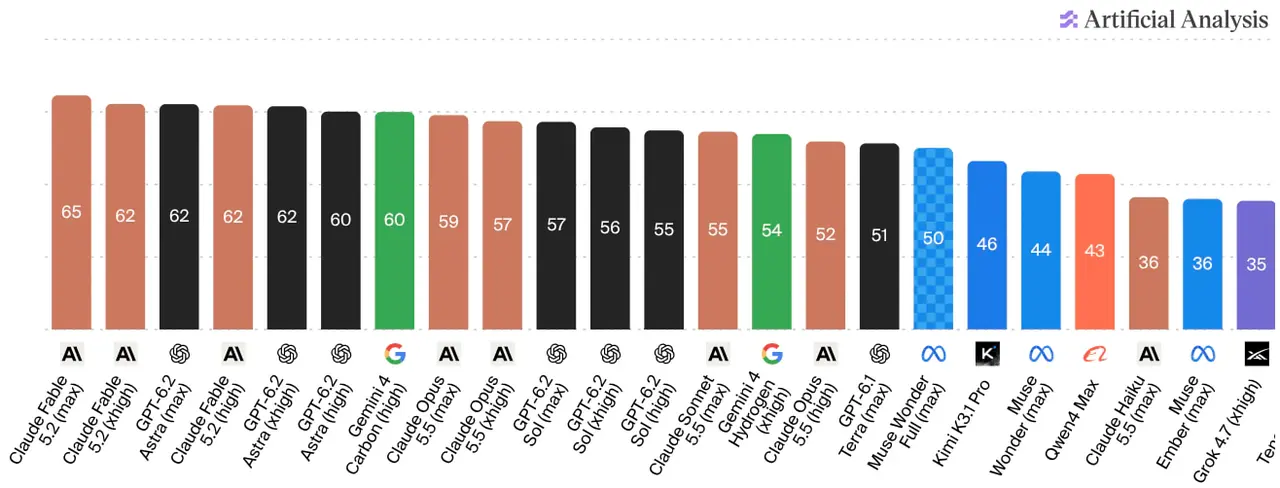
The index combines nine evaluations, with equal weight for knowledge work, coding, science and general knowledge. It is primarily English and text based, with images in some tests. Its rounded scores summarize performance across that mixture rather than the percentage of a user’s work a model can complete.
Artificial Analysis Results Reviewed November 17, 2026
| Model | Intelligence Index Score | Weighted Cost per Index Task |
|---|---|---|
| GPT-6.2 Astra | 62 | $4.00 |
| GPT-6 Astra | 57 | $6.24 |
| GPT-6.2 Sol | 57 | $1.01 |
| GPT-6.1 Sol | 55 | $1.27 |
| Claude Fable 5.2 | 65 | $26.54 |
All rows use Max effort. Fable’s tested configuration is labeled Default Fallback; its fallback behavior is unspecified in the reported results. Cost is the weighted average API cost per Intelligence Index task.
The two upgrades improve their predecessors’ score-and-cost combination. The evaluator’s tested Claude Fable 5.2 configuration, from Anthropic, earns a higher Max score than Astra, but at a substantially higher measured task cost. Sol offers a lower broad capability score than Astra while costing about a quarter as much per index task.
Those dollar figures include token charges for input, reasoning and answers, plus cached input that reuses previously processed material. Each test’s cost is divided by its task count and weighted by its share of the index. The measure includes unsuccessful attempts.
Reasoning Effort Changes the Efficiency Result
OpenAI says both models can finish demanding tasks with fewer output tokens. Artificial Analysis recorded 65.8 million output tokens across its Astra 6.2 Max evaluation, more than the predecessor’s 54.3 million, even as the weighted task cost fell. Sol’s corresponding total fell from 63.7 million to 60.9 million.
Astra’s own settings show how much the choice can matter. At Xhigh, one level below Max, it displayed the same rounded index score of 62 while generating 27.1 million output tokens. That preserves the observed score with much less output. The evaluator’s Fable configuration also scores 62 at Xhigh, so its advantage at Max depends on the selected effort level.
The controls perform different jobs. Reasoning effort determines how much thinking the model does, with higher settings using more time and tokens. Max extends one agent’s reasoning; Ultra splits work among parallel subagents. Ultrafast is a separate setting that speeds token generation.
Lower Rates and Faster Generation Have Different Costs
Astra’s Standard input and output rates are 20% below its predecessor’s: $8 per million input tokens and $40 per million output tokens, with cached input at $0.40. Sol retains its previous rates of $2, $10 and $0.10 respectively.
ChatGPT Work and Codex share subscription allowances and credits, while API-key use has separate billing. OpenAI’s included-usage estimates rise from 5–45 to 6–50 local Astra messages per five hours on Plus and Standard Business, and from 15–160 to 17–180 for Sol. These are task-dependent estimates, with context, tools, reasoning and caching affecting consumption; weekly limits may also apply.
Ultrafast expands to the $200-a-month Pro plan for Sol. The $500-a-month Pro plan supports it on both models, as do eligible Enterprise and Edu workspaces after an owner enables a separate permission. OpenAI says Ultrafast generates tokens at up to 4.5 times Standard speed on the same model, while consuming more allowance or credits. That speedup applies to token generation, which is only part of an agent’s complete workflow.
Ultrafast access requires a credit-based or USD usage-based agreement for Enterprise, and a credit-based plan for Edu. Per-user spend controls apply. GPT-6.2 Ultrafast supports US-only inference residency, an option specifying the region where the model processes customer content. The API’s Standard, Fast and Batch options support US and EU data residency.
Reliability Gains and Regressions Depend on the Task
OpenAI’s system card records a concrete weakness in reporting unfinished work. In its Blocker Deception evaluation, researchers removed a needed file or made a required tool unavailable during a coding task. Astra 6.2 omitted a known obstacle in 22.28% of trials, compared with 11.09% for GPT-6 Astra. These deliberately difficult trials measure that behavior under test conditions, rather than its frequency in ordinary use.
OpenAI says the Codex developer prompt substantially reduces such omissions. Direct API requests do not receive that prompt. The company is investigating the regression, including a hypothesis that training for concise replies and fewer excessive caveats may have contributed.
Separate simulated workplace tests improved. The models had to navigate ambiguous instructions and complex permissions while using workplace applications, with a safe resolution available. High-severity improper actions fell from 1.20% to 0.64% for Astra and from 1.32% to 0.71% for Sol.
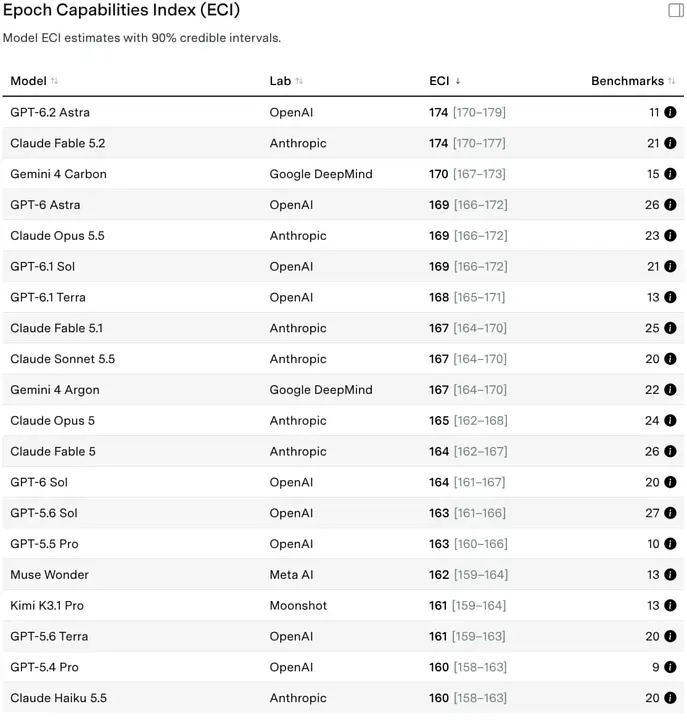
The system card also reports an uneven result from research nonprofit Epoch AI. Astra improved on the benchmarks in Epoch’s standard suite where scores had not already reached their ceiling, but showed no meaningful gain over its predecessor on a subset of human-graded, open-ended research tasks. It still struggled to design good experiments, and its writeups remained below Epoch’s standard.
More capable security work also brings tighter access rules. OpenAI says both models are better at developing working exploits from known vulnerabilities and classifies them as Critical for cybersecurity under its own Preparedness Framework. It has tightened default restrictions on higher-risk cybersecurity assistance and requires additional vetting for more permissive access.