
- Skills Donation: Anthropic’s Agent Skills format for reusable AI instructions has joined the Agentic AI Foundation, with shared technical governance planned.
- Team Workflows: Skills bundle instructions, scripts and resources that colleagues can reuse across compatible AI agents.
- Shared Direction: Maintainers from several companies will serve as individuals; using or contributing to the standard requires no foundation membership.
- Platform Support: Anthropic reports more than 70 platform integrations, including ChatGPT, Cursor, GitHub Copilot and VS Code.
Agent Skills, Anthropic’s format for packaging reusable instructions for AI agents, has joined the Agentic AI Foundation under the Linux Foundation. The format is already used across competing AI products. The contribution is intended to give developers outside Anthropic a say in the standard their workflows depend on.
For teams that have captured their procedures in skills, those decisions affect how their instructions can travel between tools. Anthropic says it is donating the Agent Skills name and logo, GitHub organization and agentskills.io domain. The foundation plans a technical steering committee drawn from multiple organizations to guide the standard’s future.
Turning Team Knowledge Into Reusable Instructions
A skill supplies the steps and context an AI agent needs for a particular job. Its basic package is a folder containing SKILL.md, a file with a name, description and instructions. Authors can add scripts, reference documents and templates alongside it.
The agent initially reads the names and descriptions of available skills. When one is relevant to a task, it loads the full instructions, then accesses supporting files as needed. That arrangement lets a team keep many specialized procedures available without putting every instruction into every conversation.
Anthropic introduced Skills in October 2025 and published the format as an open standard that December. The project’s code, specification and documentation are openly licensed; individual skills can carry separate terms, including proprietary licenses.
In a June account of its internal marketplace, software team BetterFutureLabs described engineers keeping useful skills on separate machines before distributing them through a shared GitHub repository and Claude Code plugin.
Its production code-review skill runs before an external review tool examines each pull request. When the external tool catches a recurring class of issue the skill missed, the team changes the skill’s instructions, increases its version number and merges the update. Colleagues who have installed the plugin receive the revised instructions in their next session. That distribution process carries a lesson from one review into the guidance other engineers use.
The foundation’s vice president, Angie Jones, makes that accumulated team knowledge central to her case for neutral stewardship. Teams may change agents or use different ones across departments; a common format gives them a shared way to carry their procedures with them. The receiving agent still needs the tools, access and capabilities required to do the work.
What Skills Share With Other Agent Standards
AGENTS.md files give coding agents a predictable place to find a repository’s build steps, tests and conventions. It supplies persistent project context. A skill instead packages a particular task’s procedure and supporting resources for use when needed, including in other repositories.
Model Context Protocol, or MCP, connects an agent to external tools, data and applications. A skill can explain which of those tools to use and in what order. Both MCP and AGENTS.md were among the foundation’s launch projects in December 2025, when Anthropic contributed MCP.
The loading difference can affect results. In a Vercel evaluation focused on Next.js 16 programming tasks, the agent did not invoke an available documentation skill in 56% of cases. A compressed documentation index placed in AGENTS.md performed better in the same test suite. Vercel’s explanation was that persistent context removed the agent’s decision about whether to load the skill; it still saw on-demand skills as useful for explicitly requested tasks, such as upgrading a framework version.
Independent developer Simon Willison described the short specification as underspecified in December 2025, highlighting its loosely defined extensions. The Skills specification allows authors to identify requirements such as a particular product, software packages or network access. Its experimental allowed-tools field, which lists tools pre-approved for use, can be handled differently by different agents.
A Large Catalog With Concentrated Use
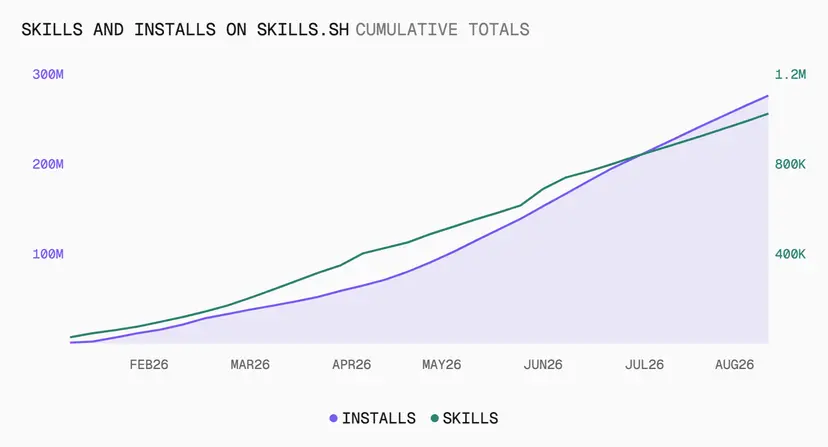
Anthropic reports that more than 70 agent platforms have integrated Agent Skills, naming ChatGPT, Cursor, GitHub Copilot and VS Code among them. The larger published and installed totals trace to Vercel’s skills.sh registry, which recorded one million listings and nearly 280 million installations in its first seven months.
Vercel’s registry report shows that activity is highly concentrated: 375 skills, about 0.04% of the catalog, accounted for 62% of installations. Its counters measure registry listings and installations, not unique people. The format’s scale therefore includes both a long tail of published workflows and a small group attracting most installs.
Moving Beyond Anthropic-Led Decisions
The governance proposal explains why the project sought a foundation home. In September, it described Anthropic employees making specification decisions without a separate steering body or a written approval rule, even as other companies shipped implementations.
Anthropic’s October 22 announcement names David Soria Parra and Mahesh Murag as lead maintainers. Engineers from Anthropic, Google, OpenAI and other companies will maintain the standard as individuals. Using it or contributing to it will not require joining the foundation.
The committee’s composition and decision rules were to be settled during onboarding, according to the proposal. Anthropic’s proposed starting roadmap covers versioned releases, a formal proposal process and security guidance for skill authors and users. The September plan set out twelve months of work, including moving from continuously updated specification documents to tagged releases with changelogs, so implementers can target and test a specific version.