- Reasoning Gain: MiniMax’s M3.1 Flash AI outperformed predecessor M3 in independent reasoning tests.
- Test Costs: Across broader AI capability tests, its weighted average cost per task was $0.22, versus M3’s $0.51.
- Factual Reliability: It answered 56% of knowledge questions correctly; 93% of remaining responses were wrong, rather than partial answers or no attempt.
- Usage Controls: Five effort settings control how much reasoning it does before answering; reasoning stays on and defaults to the highest level.
- Model Access: The AI runs on MiniMax’s servers; MiniMax promises files to run it on users’ own hardware on October 23.
MiniMax has released M3.1 Flash, an AI model built for coding and multi-step software work, with stronger independent test results at a lower evaluation cost than its predecessor. The October 19 release lets developers send requests to the model running on MiniMax’s servers.
The Chinese AI company’s model can accept text, images and video, produce text and select software tools to use and offers a one-million-token context window. Tokens are the chunks of text that models process and generate.
Independent evaluator Artificial Analysis tested M3.1 Flash at its maximum reasoning effort. Its results show a substantial improvement over MiniMax M3, alongside a weakness that matters for knowledge-based work: the new model attempts almost every factual question, including ones it gets wrong.
Reasoning Gains With Different Strengths
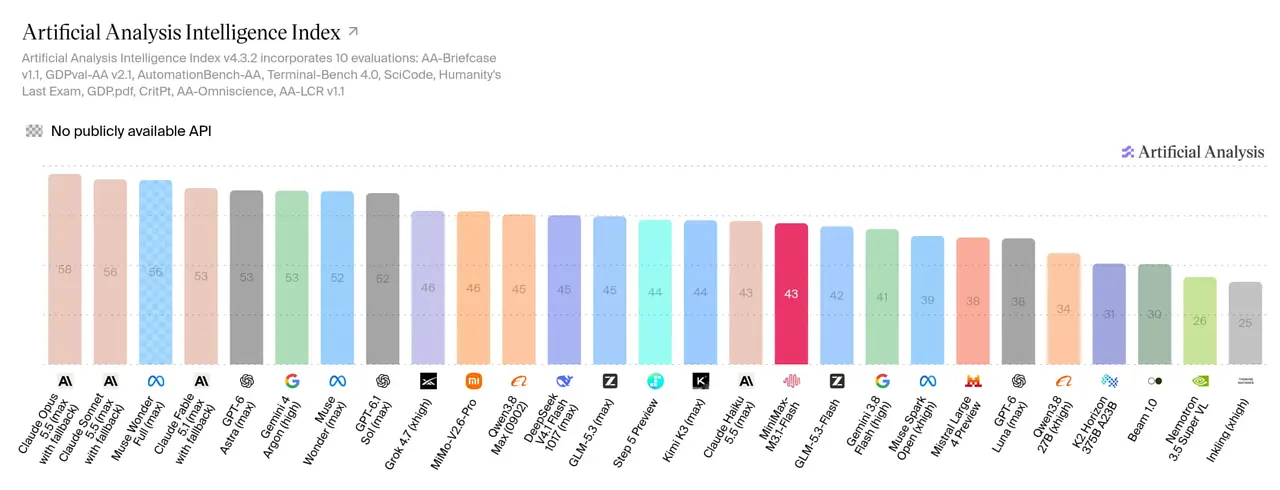
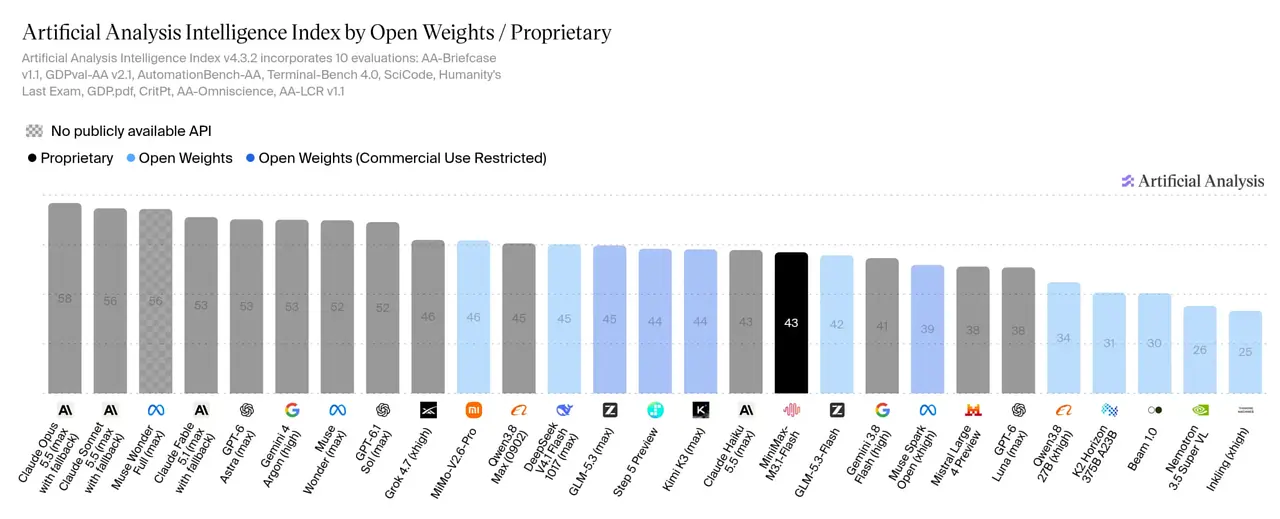
M3.1 Flash scored 43 on the Artificial Analysis Intelligence Index, up from M3’s 29. The index combines 10 evaluations of agents, coding, scientific reasoning and general capabilities, primarily through English-language text tasks.
The improvement includes harder problem-solving. On Humanity’s Last Exam, Artificial Analysis’s run of 2,158 text-only academic questions, M3.1 Flash reached 48% against M3’s 39%. On CritPt, which tests research-level physics reasoning, it rose from 4% to 22%. The evaluator uses 70 physics challenges, with five repeats and first-attempt scoring.
Those gains put the model among competitive low-cost alternatives, with different strengths across the tests. The comparison below uses the configurations in Artificial Analysis’s October 19 results. GLM-5.3-Flash comes from Z.ai, Gemini 3.8 Flash from Google, and V4.1 Flash 1017 from DeepSeek.
Artificial Analysis’s Comparison
| Model and Effort | Intelligence Index | Humanity’s Last Exam | CritPt | Evaluation Cost per Task |
|---|---|---|---|---|
| MiniMax M3 | 29 | 39% | 4% | $0.51 |
| MiniMax M3.1 Flash, max | 43 | 48% | 22% | $0.22 |
| GLM-5.3-Flash, max | 42 | 40% | 15% | $0.28 |
| DeepSeek V4.1 Flash 1017, max | 45 | 43% | 24% | $0.26 |
| Gemini 3.8 Flash, high | 41 | 48% | 18% | $1.24 |
Higher scores are better; lower cost is cheaper. Cost is the weighted average per Intelligence Index task. M3 is the matched predecessor baseline.
DeepSeek retains the overall and physics lead, while MiniMax scores higher on the academic-question test.
Business Workflows and Coding Split
MiniMax’s own Automation-Bench v1.0.6 comparison puts M3.1 Flash ahead, with a score of 62.2 against 60.5 for DeepSeek V4.1 Flash 1017 and 50.3 for Anthropic’s Claude Opus 5. AutomationBench tests agents in simulated business applications, such as customer-record systems, calendars and inboxes. A task supplies an initial state and tools for changing it, then checks whether the agent leaves the applications in the required state.
For financial work, MiniMax describes multi-step planning, consistency across documents and chained tool calls. The previous M2.5 model already targeted creating Word, Excel and PowerPoint files for enterprise tasks.
The company’s own coding comparison favors DeepSeek. MiniMax reports 73.7% on DeepSWE v1.1, which involves understanding code, building features, fixing problems and testing the changes; DeepSeek scores 77% in the same reported table.
AA-Omniscience tests factual knowledge with 6,000 questions across 42 topics, using an AI grader to compare responses with reference answers. M3.1 Flash correctly answered 56% of the questions, versus 43% for DeepSeek’s tested Flash model and 28% for GLM-5.3-Flash.
But it attempted almost every question. Among responses that were not fully correct, 93% were classified as wrong.
Lower Rates, With Reasoning Still Running
Artificial Analysis put M3.1 Flash’s weighted evaluation cost at about $0.22 per task, against M3’s $0.51. It attributed the low cost to inexpensive token rates combined with fewer generated tokens than the other Flash models in its comparison. Its accounting includes input, caching, reasoning and answer tokens.
The MiniMax rate card lists $0.15 per million input tokens, $0.60 per million output tokens and $0.015 for reading cached input. Reusing a cached prompt costs less than sending the same material as uncached input.
For standard-tier requests containing up to 512,000 input tokens, M3.1 Flash’s input and output rates are half the predecessor’s. MiniMax separately claims 70% lower overall usage cost for agent tasks.
M3.1 Flash always thinks before answering and defaults to maximum effort; M3 leaves thinking off by default. Developers have five reasoning-depth settings, from low to max. Thinking tokens consume the generated-token allowance, and exhausting it during reasoning can leave no final text response.
DeepSeek’s October 19 pricing schedule adds perspective to the cost comparison. Its V4.1 Flash 1017 model matches MiniMax’s uncached input and output rates off-peak, with cheaper cached input. Peak rates are twice as high.
API Rates in US Dollars per Million Tokens
| Model and Period | Uncached Input | Output | Cached Input |
|---|---|---|---|
| MiniMax M3.1 Flash, flat | $0.15 | $0.60 | $0.015 |
| DeepSeek V4.1 Flash 1017, off-peak | $0.15 | $0.60 | $0.003 |
| DeepSeek V4.1 Flash 1017, peak | $0.30 | $1.20 | $0.006 |
DeepSeek peak hours are 01:00–04:00 and 06:00–10:00 UTC, Monday through Friday, excluding Chinese public holidays. All other hours are off-peak.
Equal unit rates can still produce different task bills when models generate different amounts of text or reuse different amounts of cached material.
MiniMax advertises median everyday output above 170 tokens per second. In a separate streaming-output measurement, Artificial Analysis recorded 120.1 tokens per second on MiniMax’s API.
Hosted Access Before Self-Hosting
M3.1 Flash is available through the MiniMax API, which lets software send requests to the model, as well as the M Plan subscription and MiniMax Code desktop application.
OpenRouter announced 72 hours of free access for M3.1 Flash starting October 19. Vercel’s AI Gateway offers free access until October 22, specifically when MiniMax serves the request; those requests revert to MiniMax’s standard rates after the offer.
Stealth model reveal 🐰
Space Bunny was OpenRouter’s #1 model for 10 straight days, processing 56.7T tokens! The most of any stealth model we’ve run.
Space Bunny hopped off OpenRouter on Oct 5. It’s back today as @MiniMax_AI‘s M3.1 Flash, and it’s free for the next 72 hours. pic.twitter.com/2i0HsEibp5
— OpenRouter (@OpenRouter) October 19, 2026
MiniMax promises the model weights, the files needed to run the model on users’ own infrastructure, on October 23.
MiniMax M3.1 Flash: Space Performance + Bunny Speed
🚀🐰 Yes, Space Bunny – which has topped global leaderboards with 200T+ tokens – was an earlier version of M3.1 Flash.
💰Redefining the performance economics of agentic AI. M3.1 Flash achieves frontier-level intelligence… pic.twitter.com/j0tCfNYYgo
— MiniMax (official) (@MiniMax_AI) October 19, 2026