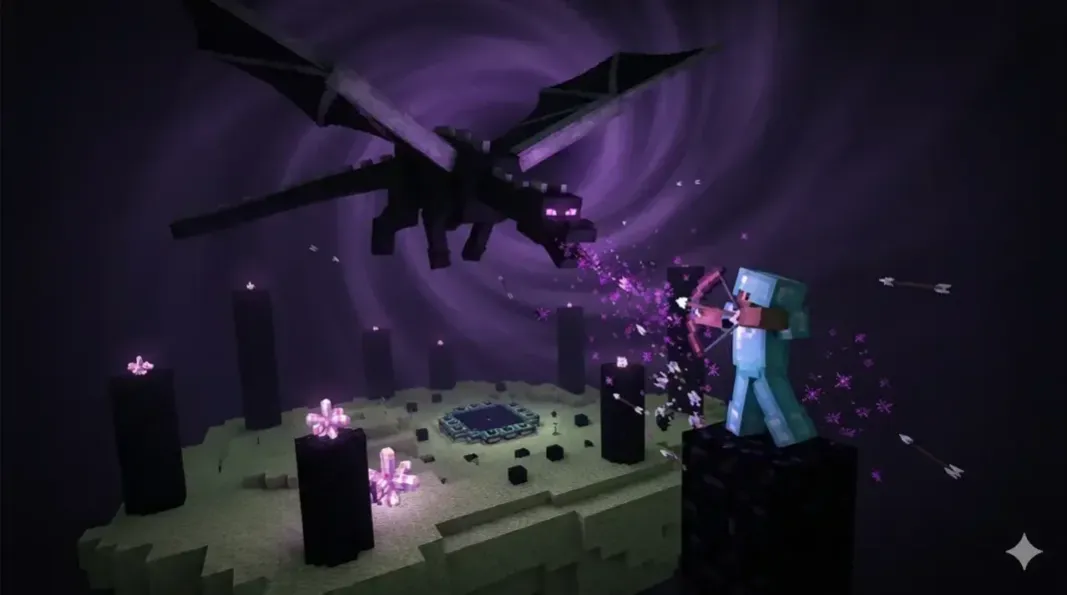
- Minecraft Win: Four Gemini coding agents defeated Minecraft’s final boss in one 27-hour run without human gameplay input.
- Code and Teamwork: The agents wrote 2,783 programs, shared notes and rescued supplies after deaths.
- Bot Interface: The agents read exact game data and used automated navigation instead of interpreting screenshots.
- Reliability: The team died 605 times; how often the setup would win again remains unknown.
Four general-purpose AI coding agents powered by Google’s Gemini 4 Argon defeated Minecraft’s final boss Ender Dragon in a Google DeepMind experiment that ran for more than a day without human gameplay input. The agentic team recovered lost supplies and revised its attack when the dragon kept healing, carrying a shared objective through thousands of self-written programs.
Google DeepMind researchers Maxence Faldor, Satinder Singh and Roberta Raileanu describe the experiment in an arXiv technical report dated October 15. From the first program to victory took 27 hours and 14 minutes, during which the four players wrote and ran 2,783 JavaScript programs and died 605 times.
Their objective was to defeat the Ender Dragon, Minecraft’s final boss. The game’s open-ended worlds continue after that encounter. Completing the objective required gathering resources, crafting equipment, opening portals and surviving the final fight.
Four Gemini 4 Argon agents, one shared Minecraft world, one goal: defeat the Ender Dragon. 27 hours and 2,783 self-written programs later, the dragon fell. https://t.co/Cx7Djg1VTx
— Maxence Faldor (@maxencefaldor) October 16, 2026
Code Turns Decisions Into Actions
Each agent controlled one player through Mineflayer, an open-source library for Minecraft bots. It wrote a short program, ran it, read the returned text and wrote the next program. The feedback could describe its position, health, inventory, what it found or an error it needed to fix.
Mineflayer supplied basic actions such as walking, digging, placing blocks and crafting, while a pathfinding plugin planned routes around obstacles. The agents chose what to do and in what order. They received exact information about nearby blocks and creatures, including blocks behind rock and the dragon’s internal state, rather than interpreting screenshots.
The experiment used Minecraft Java Edition 1.20.4 in Survival mode, with a randomly generated world, Easy difficulty and cheat commands disabled. On Easy, monsters do less damage than on Normal or Hard, and hunger cannot kill a player. Gemini also brought prior knowledge of Minecraft and Mineflayer from its training.
Humans supplied the objective, infrastructure and general coding-agent instructions, which encouraged checking results, building reusable tools and recording lessons. Each agent had persistent private and shared memory; game chat carried messages to every player.
The players worked out their own division of labor. About ten minutes in, one proposed roles and another revised the plan. They split food gathering, mining, toolmaking and portal preparation. Shared information also became reusable code: a workaround for a Mineflayer crafting quirk appeared in 655 programs written by all four agents.
Recovering the Items Needed to Finish
To reach the dragon, the team needed Eyes of Ender, items made from blaze powder and ender pearls that locate a stronghold and activate its portal to the End, the dragon’s realm.
One agent threw two Eyes from different places, sampled their flight positions every 50 milliseconds and calculated where the directions crossed. Its estimate was 1.3 kilometers from the village and 43 meters from the actual portal room.
Then a player called auratian drowned carrying all twelve Eyes needed for the portal. Auratian and another teammate sent a nearby player, bulicame, the items’ exact location and the time they would vanish. Bulicame recovered all twelve with two and a half minutes to spare, preserving the team’s ability to open the portal. At 13 hours and 17 minutes, it reported the portal lit.
Changing the Attack on the Dragon
The team entered the End after 13 hours and 33 minutes, but the dragon killed its players 69 times. They inspected its internal behavior state and developed rules for approaching it. When the dragon became stuck, all four deliberately died to leave the area empty, allowing the End to unload and the dragon to reset.
About 21 hours into the run, auratian identified another obstacle: ten crystals on obsidian pillars were restoring the dragon’s health. The agents devised a way to reach them, stacking dirt beside each pillar and digging back down by hand.
Destroying all ten took four hours and forty minutes. Thirty-nine minutes after the last crystal fell, the dragon died. The researchers’ report reproduces the server’s record of the final advancement, Free the End.
Earlier Agents Received Different Help
In 2023, the GPT-4-powered Voyager bot generated objectives and programs, refined them from feedback and accumulated a reusable code library. Its supplied architecture included an automatic curriculum to guide exploration.
Two community projects had also reported defeating the dragon before the Argon report. Compared with those projects, DeepMind’s agents received less game-specific preparation, a distinction highlighted in MadRobot’s analysis of the experiment.
The Mine AI MCP dataset records a Claude Opus 5 agent’s dragon kill on September 15. That system used ready-made Minecraft tools, and its initial prompt supplied detailed strategy, including equipment preparation and ways to destroy the healing crystals. DeepMind’s players had to devise that game plan themselves.
The separate Astra/JEV Minecraft agent paired a planning model with an action selector. Its documented run used a fixed, separately surveyed world with known coordinates and an already-active End portal. That removed the need to collect blaze rods for the portal.
The win still involved frequent failures: 22% of the team’s programs ended in errors, and the End stage took nearly fourteen hours. The authors describe the experiment as their first launch. How often the same setup would succeed remains unknown.