- Wider Access: Google’s Gemini 4 Argon brings sustained AI reasoning to paid plans and higher-tier subscribers.
- Long Reasoning: It shares 1,048,576 tokens, units of processed text, among prompts, internal thinking and answers; generation can continue across requests.
- Uneven Results: At maximum reasoning, it leads a business automation test but trails several rivals on tasks controlled by typed computer commands.
- Human Review: Google’s engineers shipped two of six proposed code optimizations after an overnight Argon run.
- Developer Pricing: Rates of $2 per million input tokens and $10 per million output tokens double on December 1.
Google has opened Gemini 4 Argon, its new AI model for sustained reasoning and complex tasks, to paying developers, businesses and higher-tier subscribers. The October 13 rollout extends access beyond an initial group of cybersecurity partners, giving more users a model whose business-work gains come with uneven coding results.
Paid Access and Background Tasks
The broader rollout includes developer and enterprise programming interfaces, with access through Google AI Studio and Google’s enterprise agent platform. Google AI Pro and Ultra subscribers get Argon in the Gemini app and AI Mode in Search; Ultra subscribers also get it in Antigravity, Google’s environment for AI agents that carry out coding tasks.
The Gemini app adds a toggle from chat to tasks that can continue while users are away. The app connects to more than 40 services, including Instacart for groceries and OpenTable for reservations. On macOS, Antigravity’s coding interface is available inside the Gemini app.
Google is also offering 10,000 scientists six months of its highest Antigravity usage tier free of charge, with rolling onboarding subject to eligibility, capacity and selection. The paid rollout follows September 30’s restricted release through its Fairwind cybersecurity-partner program.
Google’s Reported Coding Scores
| Evaluation | Gemini 4 Argon | GPT-6 Astra | Claude Opus 5.5 |
|---|---|---|---|
| DeepSWE v1.1: repository changes, pass@1 (success on one attempt) | 77.9% | 74.1% | 74.2% |
| FrontierSWE v2: project work, average task score | 55.0% | 65.5% | 62.3% |
| Terminal-Bench 4.0: terminal tasks, pass@1 | 57.4% | 58.2% | 66.4% |
More Room to Reason
In July, Google’s Flash and Flash-Lite lineup distinguished general-purpose work from high-throughput tasks while Gemini 4 pre-training was getting underway. Argon’s longer generation allowance is aimed at difficult reasoning and coding that may exceed an ordinary response limit.
Argon’s combined context window holds 1,048,576 tokens. Input, internal thinking and the answer all consume that same budget. A large prompt therefore leaves less room for reasoning and output.
Generation can continue across requests. Streaming requests send output as it is generated and allow up to 65,536 thinking and output tokens. Direct non-streaming HTTP requests return a complete response at once and allow 32,768. Supported versions of Google’s software development kit carry the generation forward automatically. Long generations can run for several minutes. Ordinary Argon defaults to MEDIUM reasoning.
Stronger Work Results, Uneven Coding
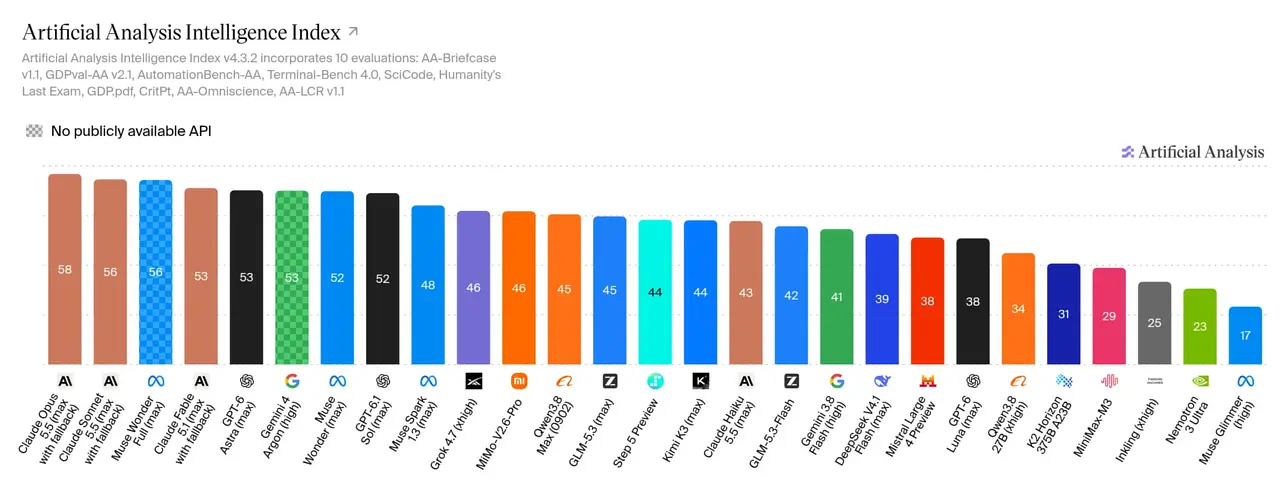
Artificial Analysis’s September 30 evaluation gave Argon at HIGH reasoning a composite score of 53. That was 23 points above Google’s earlier Gemini 3.1 Pro Preview and 12 above Gemini 3.8 Flash at HIGH. The gains include tasks that require an AI agent to work through several steps.
On AutomationBench-AA, its business-automation test, Argon completed 78% of tasks versus 71% for Claude Sonnet 5.5 at MAX reasoning. The order reversed on command-line coding tasks in Terminal-Bench 4.0: Argon scored 57%, behind Sonnet’s 64%, Claude Opus 5.5’s 60% and GPT-6 Astra’s 59%.
AA-Briefcase tests professional work products made from supplied files. In the September evaluation, Argon passed 65% of its pass/fail rubric checks, the highest share Artificial Analysis had recorded. The evaluator described analysis and presentation as weaker parts of Argon’s result. Those quality measures compare the rigor and professional presentation of submitted files against another model’s work, using AI judges.
Argon’s 68.90% aggregate score on the Vals Index, as of October 13, covers finance, coding, legal and tax benchmarks, weighted by the sectors’ shares of US economic output. Argon leads its multi-step finance test, while Sonnet leads app building and code migration, and Claude Fable 5.1 leads spreadsheet modeling and tax work. Some Sonnet, Opus and Fable scores include another model answering after a refusal; Argon had no such fallbacks.
Vals called Argon its first Gemini model to top the index in its September 30 announcement.
Gemini is on top of the Vals Index for the first time.
Gemini 4 Argon takes the #1 spot on the Vals Index at 68.9%. pic.twitter.com/d5mzzEXsGR
— Vals AI (@ValsAI) September 30, 2026
Meta’s new Muse Wonder Full adds another option. In Artificial Analysis’s October 12 evaluation, it scored 56 on the composite index and matched Argon’s 57% terminal-task result. Its access was confined to Muse Code, while Muse Wonder is also offered through Meta’s API.
Arena’s September 30 snapshot put Argon at HIGH reasoning first in Text Arena, where people compare model answers, and eighth in its web-development leaderboard.
Big news: Gemini 4 Argon (High) by @GoogleDeepMind just landed #1 in Text Arena with 1525 pts, and #8 in Code Arena: WebDev with 1679 pts!
This release has reshaped the Text Arena Pareto frontier with a blended $8/MToken! Gemini 4 Argon (High) is now the most cost efficient… https://t.co/FJONqKOxvp pic.twitter.com/V229tf3czw
— Arena.ai (@arena) September 30, 2026
Artificial Analysis found that Argon was more likely to acknowledge uncertainty rather than guess incorrectly. But it answered 50% of the knowledge-test questions correctly, compared with GPT-6 Astra’s 63%.
Its 15% hallucination rate is based on a different denominator: incorrect answers as a share of all non-correct responses, including partial answers and questions not attempted.
An Overnight Coding Run with Human Review
Google’s Agent Development Kit team used Argon in an 11-hour overnight coding run. ADK is a roughly 205,000-line Python framework for running AI agents. Argon proposed six optimizations; maintainers shipped two.
One changed how ADK retrieves conversation history. It filtered the events a caller needed before copying them, avoiding copies of unwanted history. Google measured about 40% less session-preparation overhead for its in-memory service, which keeps conversation history in memory. A performance test kept from Argon used instant model and tool responses to isolate the framework’s work: a 158-turn run fell from 65.6 to 56.1 seconds. Read times for external database-backed session stores were unchanged.
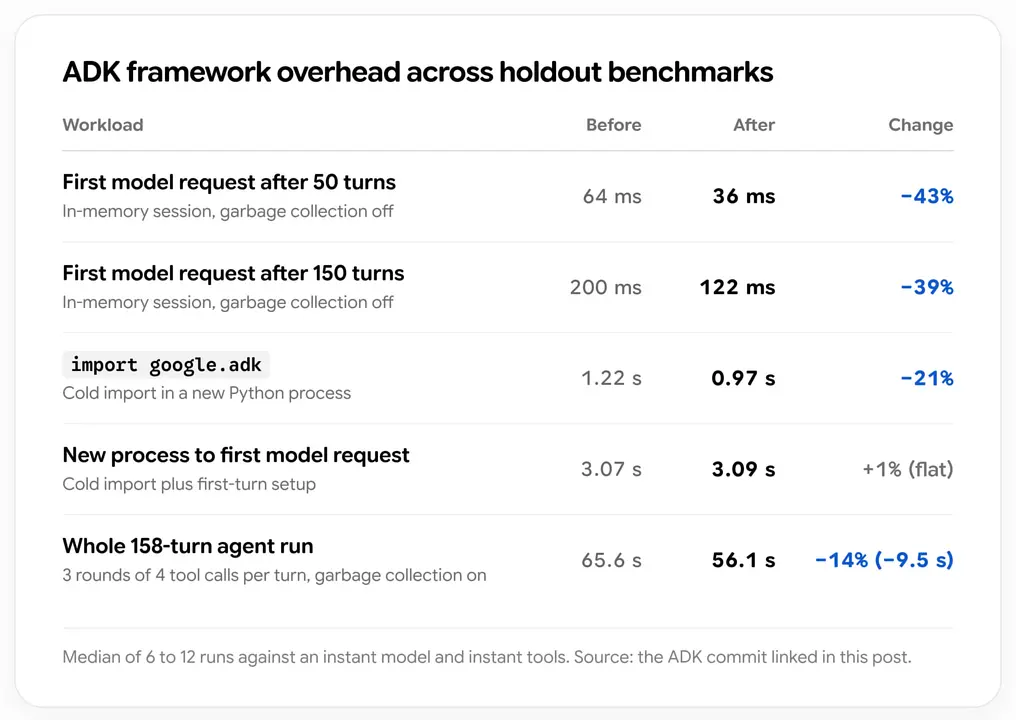
The other change delayed loading heavy packages until needed. Google reports 21% faster initial loading of the ADK Python package, while the time to the first model request stayed essentially unchanged. The first version passed all 16,892 public tests but failed 25 internal test targets that accessed particular components directly. The shipped approach kept those components accessible.
Maintainers rejected four proposals, including a cache that could return stale data and changes that added complexity without improving that performance test.
Introductory Prices and Billable Continuation
The Standard Developer API prices are introductory through November 30. Thinking tokens are billed as output.
Standard Gemini Developer API prices in US dollars per million tokens.
| Token Type | Through November 30, 2026 | From December 1, 2026 |
|---|---|---|
| Input | $2 | $4 |
| Output, including thinking | $10 | $20 |
| Implicitly cached input | $0.10 | $0.20 |
A long generation also changes billable usage. On Google’s enterprise platform, each continuation processes the prompt and earlier generated tokens again as input. Qualifying back-to-back requests receive a 95% implicit-cache discount, with a 6,144-token minimum and a 15–20 minute cache lifetime. Google Search use is charged per query, so one user request can produce several charges.
Artificial Analysis measured $1.99 per Argon task on its evaluation workload, versus $3.26 for GPT-6 Astra and $0.72 for GPT-6.1 Sol. Argon used about 62,000 output tokens per task, against Astra’s 27,000. At the later rates and unchanged tested token use, the evaluator estimates Argon’s cost would rise to $3.98 per task.
Knowledge and Safety Limits
Google says in its model card that it could not rule out Argon reaching risk thresholds for biological information, cyberoffensive work, and capabilities that could weaken human control. The human-control category concerns models able to use details of their deployment setting and bypass basic oversight. Google assesses its safeguards as reducing the residual risks below those thresholds.
The model’s knowledge cutoff is March 2026, with some domains less up to date. Google also identifies occasional slowness and timeouts among its limitations.