- Hourly Forecasts: WeatherNext 3 starts forecasts every hour, with several-hour publication delays. Its roughly 5 km grid applies only to station-trained temperature and dew point.
- Forecast Range: Four daily cycles reach 15 days; the other 20 cover 48 hours for surface and station-trained outputs.
- Data Access: Approved users can access forecasts through Cloud Storage, BigQuery and Earth Engine. Google explicitly says WeatherNext 3 is not open source.
- Product Rollout: Google says integration into Search, Gemini, Maps and the Maps Platform Weather API began on September 3, 2026.
Google DeepMind and Google Research announced its WeatherNext 3 weather prediction model on September 3, 2026, combining more frequent satellite observations with finer forecast grids. WeatherNext 3 aims to improve guidance for rapidly changing rain systems and local surface conditions. But “hourly,” “5 km” and “15 days” describe different capabilities—not a single forecast product available instantly at the finest resolution.
Hourly Forecasts
WeatherNext 3 produces 64 ensemble members: alternative forecast scenarios that help represent uncertainty. It initializes a new run every UTC hour and provides hourly forecast steps. Those are separate from the forecast horizon: the 00:00, 06:00, 12:00 and 18:00 UTC cycles extend 360 hours, or 15 days. The intervening 20 cycles extend 48 hours and deliver surface and station-trained fields, not the full upper-atmosphere dataset.
Google’s forecast dissemination schedule targets Cloud Storage delivery 7 hours 10 minutes after an interim run’s nominal initialization, and 7 hours 25 minutes afterward for BigQuery and Earth Engine. For the four main cycles, the corresponding targets are 7 hours 45 minutes and 8 hours 10 minutes. These are estimates: Google describes typical variation of about 15 minutes and occasional delays of an hour or more.
Where the 5 km resolution applies
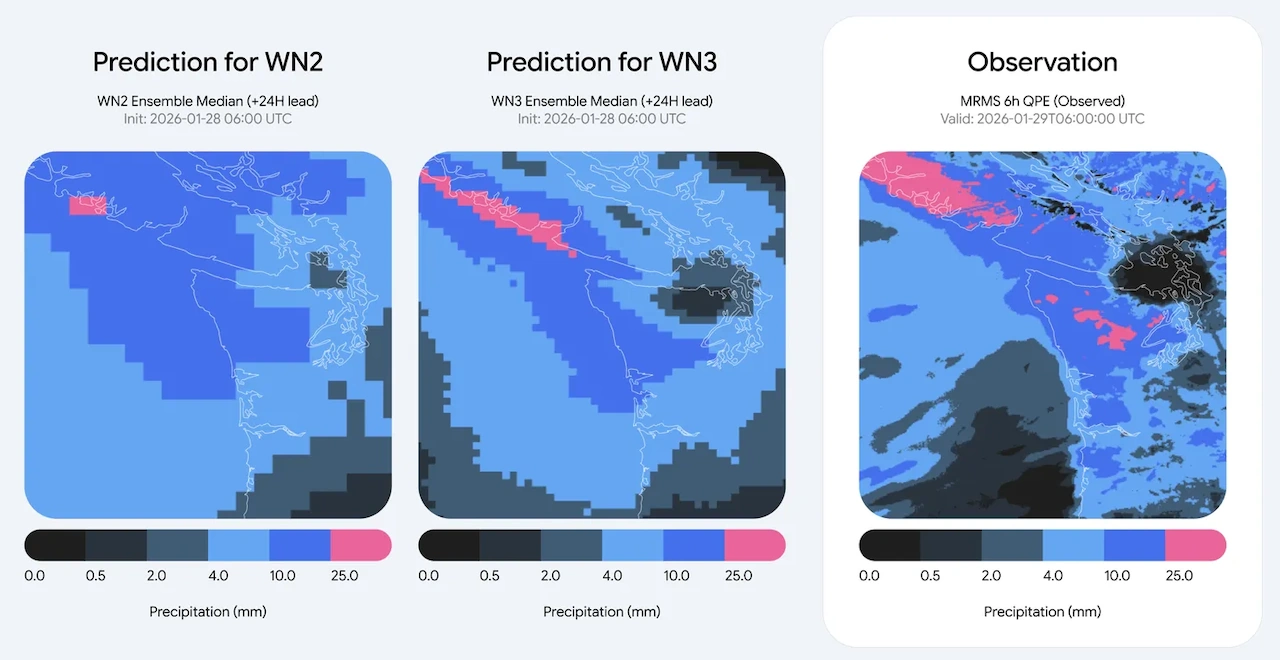
The WeatherNext 3 model specifications separate operational output into three spatial resolutions. The finest grid does not apply to precipitation, wind or the whole atmosphere.
| Output | Grid spacing | Available cycles |
|---|---|---|
| Station-trained 2 m temperature and dew point | 0.05°; roughly 5 km | All hourly cycles |
| Gridded surface fields, including precipitation, wind, clouds and solar radiation | 0.1°; roughly 10 km | All hourly cycles for hourly fields |
| Upper-air fields across 13 pressure levels | 0.25°; roughly 25 km | The four main cycles only |
The kilometer figures are rounded labels. At the equator, those angular spacings correspond to approximately 5.6, 11.1 and 27.8 km; east–west spacing decreases toward the poles. More importantly, grid spacing is not a guarantee of forecast accuracy at that scale. A finer temperature map does not imply equally detailed predictions of an individual downpour.
Satellite observations supplement conventional weather analysis
WeatherNext 3 combines ECMWF atmospheric analysis with geostationary satellite mosaics. A shared, mesh-based forecasting network connects specialized input and output components for different data types and resolutions. More frequent satellite input allows updates between the conventional six-hour analysis cycles; it does not mean ECMWF supplies a completely new analysis every hour or that the model no longer depends on physics-based weather systems.
The station-trained output learns temperature and dew point from local observations rather than only from gridded analysis. The research also uses model-derived “pseudo-stations” to reduce biases in poorly observed areas. These forecasts are predictions informed by station data—not measurements from a weather station in every grid cell.
Rain forecast gains depend on the comparison
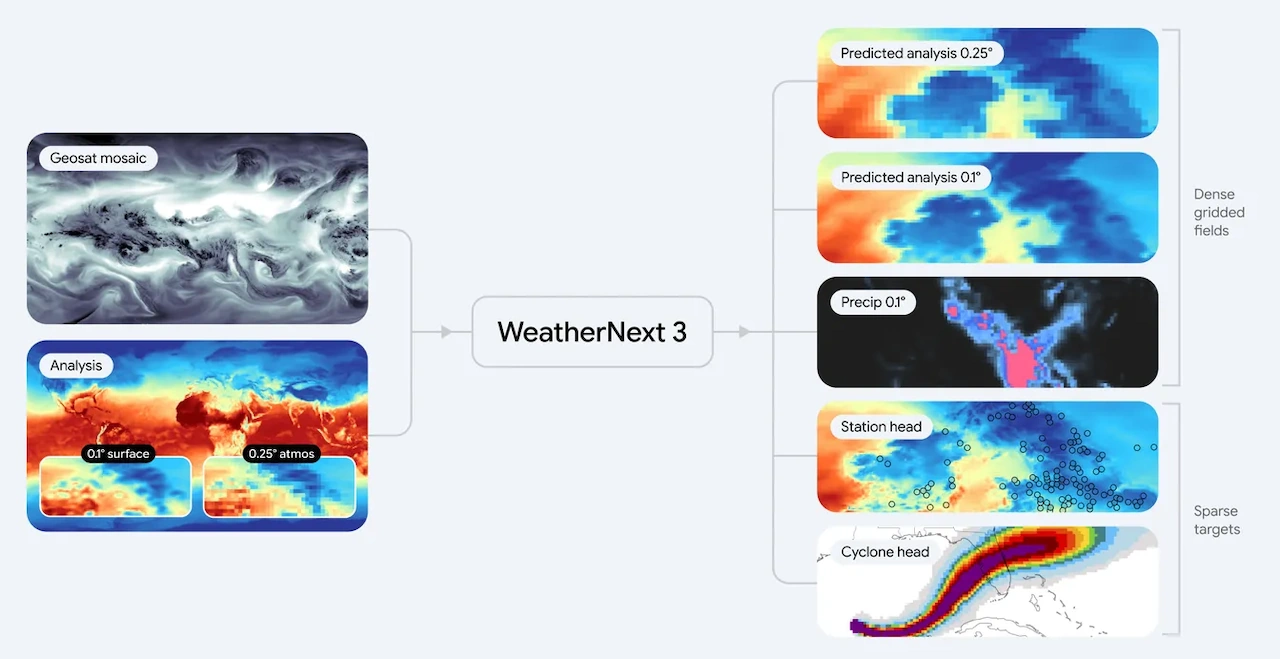
The WeatherNext 3 research preprint reports early-lead precipitation improvements against WeatherNext 2 and ECMWF’s conventional ensemble, ENS. Its continuous ranked probability score, or CRPS, assesses the predicted distribution of outcomes; lower scores are better. Across those baseline comparisons, the reported maximum reductions are 60% when evaluated against NASA’s IMERG satellite estimates, 30% against the US-focused MRMS radar product and 10% against rain gauges.
MRMS and gauges provide additional checks, with different coverage and measurement limitations.
The Brier-score evaluation examines probabilities of exceeding rainfall thresholds up to 4 mm in six hours. It does not establish performance for extreme-rain thresholds. Separately, a latency-adjusted comparison against IMERG finds roughly two to three hours of additional early-lead skill from hourly rather than six-hourly starts. That is a forecast-skill result, not a demonstrated extension of severe-weather warning time.
Independent benchmarks
Brightband’s Operational WeatherBench methodology includes WeatherNext 3 but currently excludes its precipitation outputs because of differences in resolution and verification targets. Its surface scores use 0.1° ECMWF analysis, not a direct test of the 0.05° station-trained outputs against ground stations. The leaderboard therefore cannot independently confirm Google’s precipitation percentages or establish that every local forecast is best in class.
The paper also evaluates operational forecasts from July 1 to August 11, 2026, using a production model trained through June 30. Comparisons include ECMWF’s AI ensemble, AIFS ENS v2. Six weeks is a limited sample, not year-round validation. The authors additionally identify spatial artifacts and jumps between some hourly predictions in individual ensemble members. These limitations matter when applications depend on coherent forecast trajectories rather than only pointwise summary statistics.
WeatherNext 3 is not open source
Google’s forecast access guide asks users to apply with the Google account they use for Cloud services. Requests are typically approved within five to seven business days, and one approval covers Cloud Storage, BigQuery and Earth Engine. An existing paid Google Cloud contract is not required.
Cloud Storage provides the raw 64-member ensemble, including upper-air fields for the main cycles, as well as a separate statistics dataset. BigQuery and Earth Engine expose surface means and selected percentiles rather than the complete ensemble.
Google’s Cloud Storage guide says 2024 and 2025 historical archives are being backfilled; users should check coverage before planning a backtest. The full-ensemble bucket has Requester Pays enabled, while the statistics bucket does not. Network-transfer and platform costs should be assessed for the intended workflow.
Google’s open-model documentation explicitly states that WeatherNext 3 is not open source. WeatherNext 2, Gen and Graph have separate open-model offerings; their availability does not provide WeatherNext 3 weights or self-hosted inference.
The WeatherNext 3 Earth Engine catalog also cautions that operational accuracy may differ from the research model’s reported accuracy. Benchmark percentages should therefore not be treated as guarantees for every delivered forecast.
What changes in Google products and practical use
Google says WeatherNext 3 is rolling out into Search, Gemini, Maps, the Maps Platform Weather API and Earth Engine on September 3. Its announcement also claims precipitation forecasts up to 50% more accurate for planning a day or more ahead. That product-level claim should not be treated as interchangeable with the paper’s CRPS results.
The Maps Platform Weather API offers a service that combines station observations, numerical forecasts and AI systems. However, it is not a raw WeatherNext 3 endpoint, and its product forecasts should not automatically be assigned the model’s exact grids, horizons or publication schedule.
For renewable-energy planning, WeatherNext 3 includes 100 m wind, cloud cover and solar-radiation fields. Those variables can inform generation estimates, but the release does not establish a measured financial benefit for a particular wind or solar project. Local validation remains necessary before translating forecast improvements into operational decisions.
Google’s WeatherNext terms and safety disclaimer apply experimental terms to forecasts for the future and times less than one hour ago; data relating to times at least one hour in the past is licensed under CC BY 4.0. They also state that WeatherNext outputs are not official forecasts, watches or warnings. For decisions involving life or property, use national meteorological services and local emergency authorities rather than relying on WeatherNext alone.