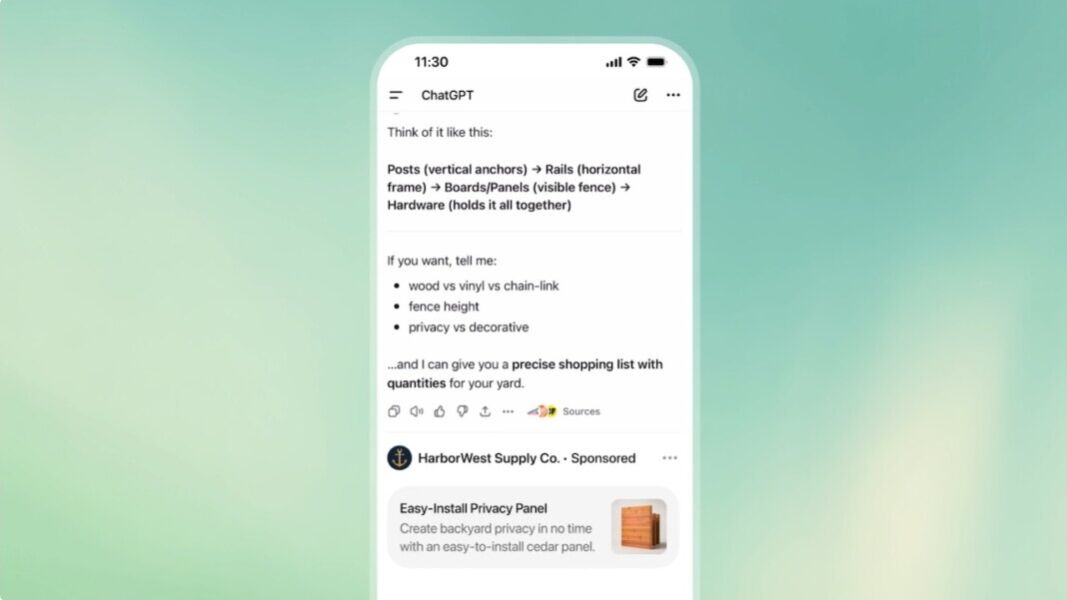
- Revenue Pace: On August 31, OpenAI said ChatGPT Ads reached a $1 billion yearly revenue pace in less than 200 days.
- Monthly Equivalent: The figure annualizes about $83 million in monthly ad revenue by multiplying it by 12; it is not a year’s earnings.
- Buyer Expansion: OpenAI is rolling Ads Manager into India, Europe, the Middle East and North Africa, widening direct advertiser purchasing.
- User Rollout: Europe has partner-mediated ChatGPT ad availability; direct access and user availability in India and MENA remain unconfirmed during the rollout.
OpenAI says ChatGPT Ads have reached a current run rate that would equal $1 billion over a year if sustained, less than 200 days after a starting point the company did not disclose. As of August 31, 2026, OpenAI paired that milestone with a rollout of Ads Manager, its self-service campaign tool for advertisers, across India, Europe, the Middle East and North Africa. The fast pace and wider buying access show how quickly ads have become a meaningful new business for OpenAI.
An annualized revenue run rate expresses a current pace as a 12-month equivalent if that pace continues. In this case, the reported calculation multiplies current monthly ad revenue by 12, implying roughly $83.3 million a month.
What the $1 Billion Pace Measures
The figure describes OpenAI’s advertising revenue pace on August 31, 2026. The company did not disclose the underlying monthly revenue window, its recognition basis, advertiser retention, average spending or profit from the business. That leaves its durability and margin unknown.
OpenAI’s “less than 200 days” description also depends on a starting point it did not identify. The public U.S. test began on February 9, 203 elapsed days before August 31. An independent research team first observed ads in its synthetic accounts on March 8, 176 days before the claim.
A March update offers only a directional baseline. On March 26, an OpenAI spokesperson said the pilot had exceeded $100 million in “annual recurring revenue” and involved more than 600 advertisers. The August announcement refers to an “annualized revenue run rate” and tens of thousands of advertisers. Both point to rapid expansion, but the different labels and undisclosed inputs do not form a clean audited series or a precise tenfold revenue comparison.
Advertiser Access and User Availability Are Separate
OpenAI has widened the ways advertisers can buy ChatGPT placements in stages. It began with managed sales, added agency and technology partners, and opened a beta self-service Ads Manager in May. Self-service lets an eligible advertiser create and manage a campaign directly instead of securing a managed relationship or using a partner.
Europe shows the two rollout tracks. By August 24, Criteo said its clients could buy ChatGPT Ads in 31 European markets through the advertising technology company’s integration. OpenAI then said direct Ads Manager access would begin rolling out across India, Europe, the Middle East and North Africa later on August 31.
The regional language described an advertiser rollout, not completed self-service access in every country. User-facing ads are available in more than 40 countries. Partner-mediated ads are available in Europe, while user availability in India and the Middle East and North Africa remain unknown.
ChatGPT Free and ChatGPT Go are the ad-supported ChatGPT plans in eligible markets. Plus, Pro and Enterprise were reported as ad-free during the European expansion. Advertisers reach that inventory through OpenAI’s managed team, agencies, technology partners or direct self-service where each route is available.
Advertisers Have More Tools, but Returns Remain Unclear
The ad system supports impression, click and conversion-focused bidding. OpenAI has also added its Pixel and Conversions API so advertisers can connect exposure to activity on their own sites. These features make the product more usable than the high-touch early pilot, but OpenAI has not disclosed a universal performance benchmark.
OpenAI says tens of thousands of marketers have used its platform so far. Criteo separately says more than 2,000 brands have used ChatGPT inventory through its partner channel. Those figures describe different populations and cannot be added together or treated as a count of direct Ads Manager customers.
Early Testing Checked the User Experience
OpenAI is expanding the buyer side while promising that ads will remain visually separate from answers, will not influence ChatGPT’s responses and will not give advertisers access to private conversations. Those promises define the user-facing conditions of the new revenue channel. An academic audit of the early U.S. test checked what appeared on screen. Researchers using 91 synthetic accounts saw “Sponsored” labels and visual separation, and they found almost no ads in the health, mental-health and political categories OpenAI had said it would exclude.
The same study found lower-income synthetic accounts were more likely to receive ads. It covered an early U.S. period, used artificial accounts and was disrupted when the system may have detected them, so it cannot describe the later global product. The researchers did not observe the data flows behind ad selection or whether advertising affected answers. Their work therefore supports the promised visible labeling in that limited setting.
Why Ads Matter to OpenAI’s Business
Advertising gives OpenAI another way to make money from the large part of ChatGPT’s audience that does not pay for a subscription. In April, OpenAI finance chief Sarah Friar said about 95% of more than 900 million weekly users paid nothing. She also said business customers contributed about 40% of revenue at that point. Consumer subscriptions, enterprise products and usage-based API access remain separate parts of the company alongside ads.
A $1 billion annualized pace gives OpenAI a needed source of revenue from free usage even before self-service access has reached every announced region. OpenAI has however not disclosed the ad business’s share of company revenue or its profit margin as the company continues to burn through billions of cash.
OpenAI’s ad-supported strategy also differs from Anthropic’s approach. Anthropic promises that Claude will remain ad-free and relies on enterprise contracts and paid subscriptions.