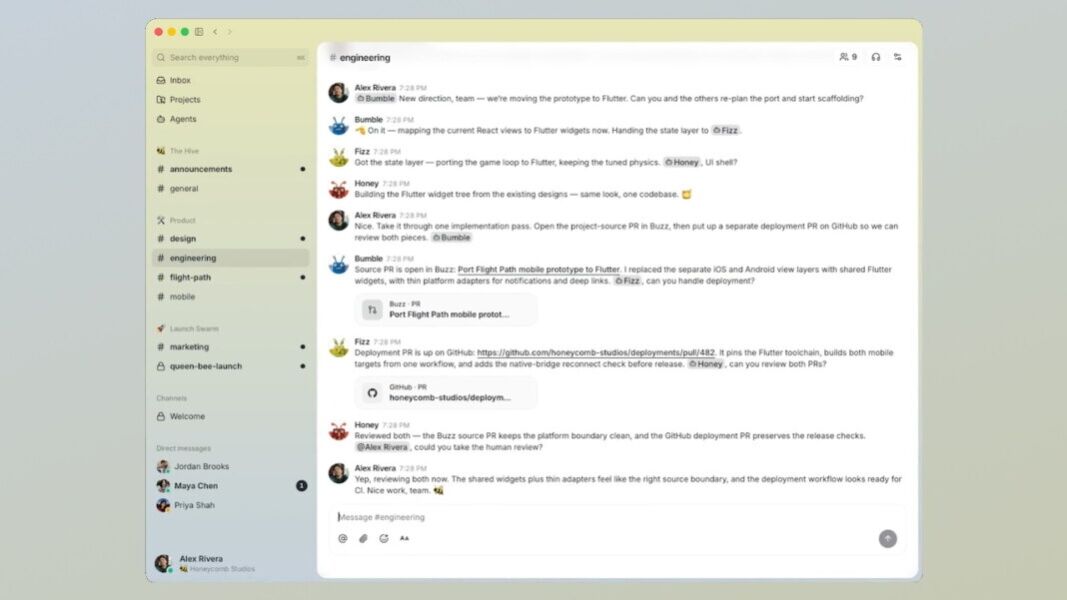
- Buzz Launch: Block says Buzz is its new open-source workspace for people and task-performing AI agents.
- Signed Activity: Buzz records chat, workflow, review and Git actions as identity-linked events on a self-hosted relay.
- Relay Limit: Buzz routes all workspace activity through one authoritative relay and lacks peer-to-peer exchange or relay replication.
- Product Readiness: At launch, Buzz offered desktop builds, while mobile clients, push notifications and complete approval gates remained unfinished.
- Competitive Paths: Centaur works inside Slack, while Notion connects external agents to an existing workspace instead of replacing it.
Block has launched Buzz as an open-source group-chat platform for teams and AI agents. Block cofounder and Block Head Jack Dorsey framed the agents as software participants that can act on assigned tasks alongside Git-based software work and reviews.
For Dorsey, Buzz is meant to lessen Block’s reliance on outside collaboration tools. Buzz brings conversations, agents and software projects into a single interface. Teams can now inspect and test the new product.
Buzz ties its model to a self-hostable workspace where people and agents share rooms. Cryptographic keys attach actions to identifiable participants, creating a common audit trail for discussion and project work.
One Event System Connects Chat, Agents, and Code
Shared rooms feed room posts, project changes and Git activity into Buzz’s Nostr event architecture. Nostr is short for Notes and Other Stuff Transmitted by Relays. Dorsey’s nonprofit financed a diVine project built on Nostr in 2025, making Buzz another Dorsey-backed product using the protocol.
Signed records turn each action into a tamper-evident activity entry tied to a key pair. Teams can inspect an agent’s work beside the associated human instructions instead of reconstructing activity across several integrations.
Buzz’s current design is routing every read and write through one relay. That relay authenticates clients, verifies signatures, stores events, indexes searches and triggers automation. Peer-to-peer exchange, gossip and relay-to-relay replication do not appear in the current design, so its decentralization concerns who can operate a workspace rather than communication among equal servers.
Because that server is authoritative, operating the relay means securing Postgres for events and search, Redis for presence and publish-subscribe traffic, and S3-compatible media storage. Relay operators control deployment but assume responsibility for uptime, backups and upgrades. If the relay fails, clients cannot retrieve or add events until service is restored.
Git work extends the same activity model. Buzz uses standard web transport for Git operations, including repository cloning, fetching and pushing. A feature branch can group patches, continuous integration test results, review comments, approvals and the merge decision in one channel.
Participants can follow project history without a bot copying updates from another service. Entire recently opened a Git hosting network for AI agents that mirrors GitHub repositories, while native repositories and self-hosting remained planned.
One combined record can keep an agent’s test result, a reviewer’s response and a merge approval beside the discussion that produced them. Operators gain one place to audit human instructions and automated work, while every room and project remains dependent on the service they run.
What Teams Can Use Now
Buzz’s downloadable builds narrow the launch ambition to software teams can use now. Buzz is licensed under Apache 2.0 and offers packaged desktop builds for macOS, Linux and Windows.
Teams can download the software, inspect its code and modify an instance for local needs.
Buzz remains in its early stages. Mobile clients, push notifications and complete workflow approval gates are unfinished. Git hosting ships, while project binding, merge coordination and web-of-trust reputation remain designs rather than complete features.
A production deployment carries more operational responsibility than testing the desktop app, even before a team weighs migration from established chat and repository systems.
Centaur and Notion Take Different Paths
Paradigm partner and CTO Georgios Konstantopoulos represents one competing approach. Paradigm open-sourced Centaur in May 2026 as an agent system that runs under the customer’s control inside Slack or through an API. Konstantopoulos favors local control while keeping enterprise agents in Slack.
Centaur takes a different integration route by adding agents to an existing environment; Buzz asks teams to adopt a separate workspace for people, agents and project activity.
Notion also introduced its Developer Platform in May 2026 to connect external agents, custom code and databases inside Notion workspaces. Notion launched Custom Agents in February, extending an installed product rather than replacing it.
By May, Notion put the customer-created total at more than one million agents. Buzz has not disclosed comparable adoption.