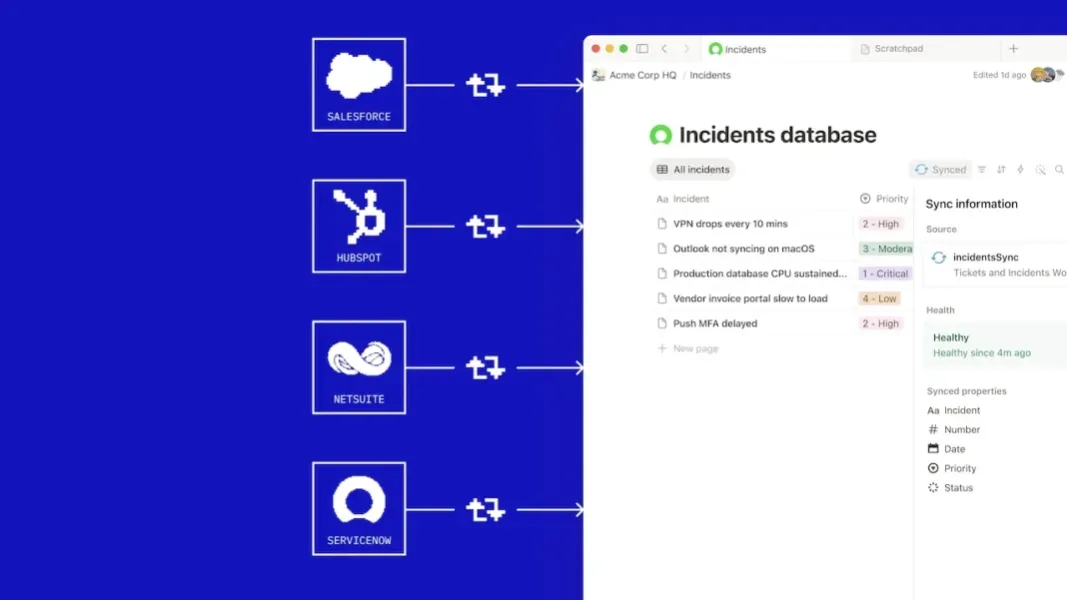
- Platform Launch: Notion launched a developer platform that brings data, code, and AI agents into one workspace.
- Adoption Signal: Notion says customers have already built 1 million agents since the February Custom Agents launch.
- Developer Access: The platform adds Workers, an External Agents API, and free developer testing through August 2026.
- Competitive Bet: Notion is betting companies will keep agent workflows inside its workspace instead of separate automation tools.
Notion has launched a developer platform to push its workspace beyond note-taking. Synced data, custom code, and AI agents now sit in the same product where teams already manage documents, projects, and databases.
Notion says customers built 1 million agents since launch. That figure gives the update more weight than a routine feature drop because companies were already using Notion’s agent layer before this broader platform push. It also sets up a practical enterprise test: whether automations stay inside Notion instead of spilling into separate workflow tools, especially as Google Workspace agent access pushed rivals to expose their own suites to AI agents.
How Notion Wants Agents to Work Inside Its Workspace
Notion centered the release on a Workers environment for hosted code. Workers give companies a sandbox where custom code can trigger actions, handle webhooks, and keep live syncs close to the documents and databases those actions depend on. Notion also says the platform extends Custom Agents, supports multistep workflows, and keeps those flows inside one shared workspace instead of sending them out to a separate automation console.
Teams can also plug outside systems into the same workspace. Notion’s External Agents API keeps that activity close to documents, databases, and the broader enterprise workflow push already reshaping business software.
Ivan Zhao, Notion co-founder and CEO, framed the launch as an attempt to keep data, tools, and agents in one place.
“Any data, any tool, any agent — that’s the big picture for the Notion Developer Platform.”
Ivan Zhao, Notion co-founder and CEO (via TechCrunch)
Notion’s product details make that pitch concrete. Teams can sync data from Salesforce, Zendesk, and Postgres.
Workers can apply custom logic when MCP connections are not enough. Live business data and agent actions can stay in one product instead of being spread across separate note-taking, integration, and automation layers.
Why the Developer Tooling Matters
Developers get a more explicit route into the product than they would from a simple assistant upgrade. With the Notion CLI, internal teams can authenticate with a workspace, manage Workers, and send API requests from the terminal. In practice, that workflow makes the platform look more like an operational runtime that can connect to existing business systems.
Documentation also shows that teams can Deploy and manage Notion Workers as part of a supported workflow. Business and Enterprise customers can reach the External Agents API through standard admin controls, which places the feature set closer to production use than a one-off experiment. Security and governance teams get a clearer reason to test agent activity inside a managed workspace instead of handing it off to disconnected tools.
Access still comes with a practical testing window. Workers are free for developers through August 2026, which lowers the cost of trying the hosted-code layer before companies decide whether it belongs in day-to-day workflows.
Launch materials also listed supported partner agents including Claude Code, Cursor, Codex, and Decagon. Those launch examples give developers immediate signs of the outside systems Notion wants running inside the workspace rather than beside it.
Where Notion Fits in the Workplace AI Race
Notion built this platform on the layer it added in February, when it introduced Custom Agents. February’s launch gave the product an agent layer before this broader release turned the workspace into a programmable surface for data access, code execution, and external connections.
In February, Custom Agents also extended the product across connected apps and custom MCP servers. That progression shows this week’s launch as an expansion of a product line Notion had already started, not as a sudden jump into the category.
Competitors are moving along related paths with different emphasis. Slack already shipped search answers, channel recaps, and thread summaries inside workplace communication. Google has framed Gemini Enterprise for Google Workspace as a workplace AI platform, while OpenAI, Anthropic, xAI and other AI providers are extending tool access.
Notion’s narrower bet is that teams may prefer one workspace for documents, structured data, code execution, and agent actions instead of a looser chain of separate products. In that framing, the launch becomes more than a branding shift toward programmable workplace infrastructure. It is an adoption test for whether customers want agent workflows to stay inside the same workspace where the rest of their work already lives.