
- Model Debut: Chinese AI developer Moonshot AI has unveiled its Kimi K3 AI model with 2.8 trillion parameters, native vision, and a one-million-token context window.
- Expert Routing: Its mixture-of-experts design activates 16 of 896 experts, limiting the computing work used for each token.
- Weight Release: Moonshot plans to release downloadable full weights by July 27; its rollout covers Kimi products and a developer interface.
- Test Trade-Offs: Independent tests place K3 near Opus 4.8, while hallucinations reached 51 percent and reasoning effort remained fixed at maximum.
Chinese AI developer Moonshot AI launched Kimi K3 on July 16. Its new native-vision model has 2.8 trillion total parameters and a one-million-token context window, the amount of text and visual input it can process at once.
Moonshot’s rollout plan covers Kimi’s website, desktop products, coding tool, and API access. Moonshot says it plans to release the full model weights by July 27, giving developers the freedom needed to inspect, adapt, and host the model themselves. Until then, K3 remains a hosted product whose practical value depends on performance, operating cost, and available controls.
What 2.8 Trillion Parameters Buy in Practice
Kimi K3 uses a mixture-of-experts architecture, which activates only a subset of specialized subnetworks for each token. K3 activates 16 of 896 experts, separating its total size from the computing work performed for one response. Its 2.8 trillion parameters also exceed Kimi K2’s one-trillion-parameter design, although parameter count alone does not establish capability or efficiency. K3’s selective routing makes the very large system more practical to serve.
Moonshot’s Kimi K3 launch pricing charges $0.30 per million cached input tokens, $3 per million uncached input tokens, and $15 per million output tokens. Cached prompts cost one-tenth as uncached input, while output costs five times the uncached-input rate. Long reasoning traces put more billable tokens in the highest-priced category, so developers must test latency, verbosity, cache reuse, memory needs, and output quality on their own workloads.
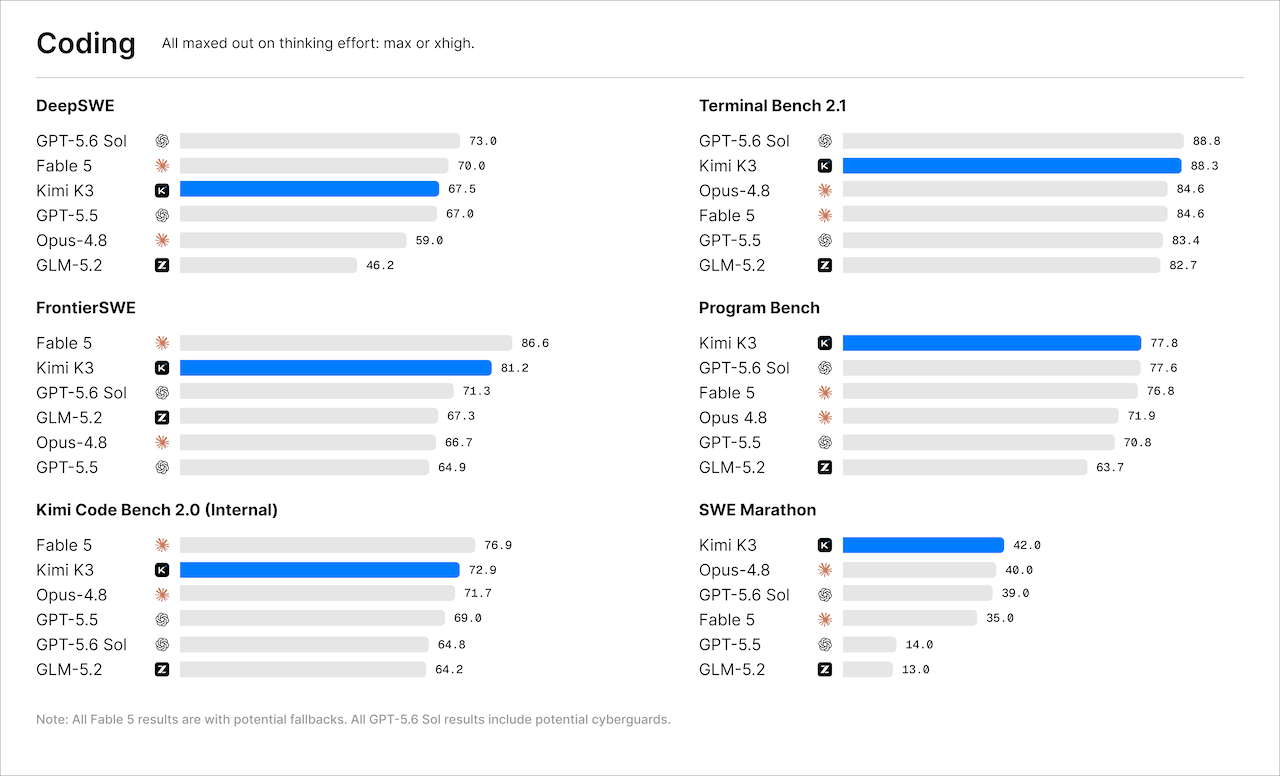
Moonshot’s evaluation suite places K3 behind Claude Fable 5 and GPT-5.6 Sol overall but ahead of Anthropic’s Claude Opus 4.8 on many listed tests.

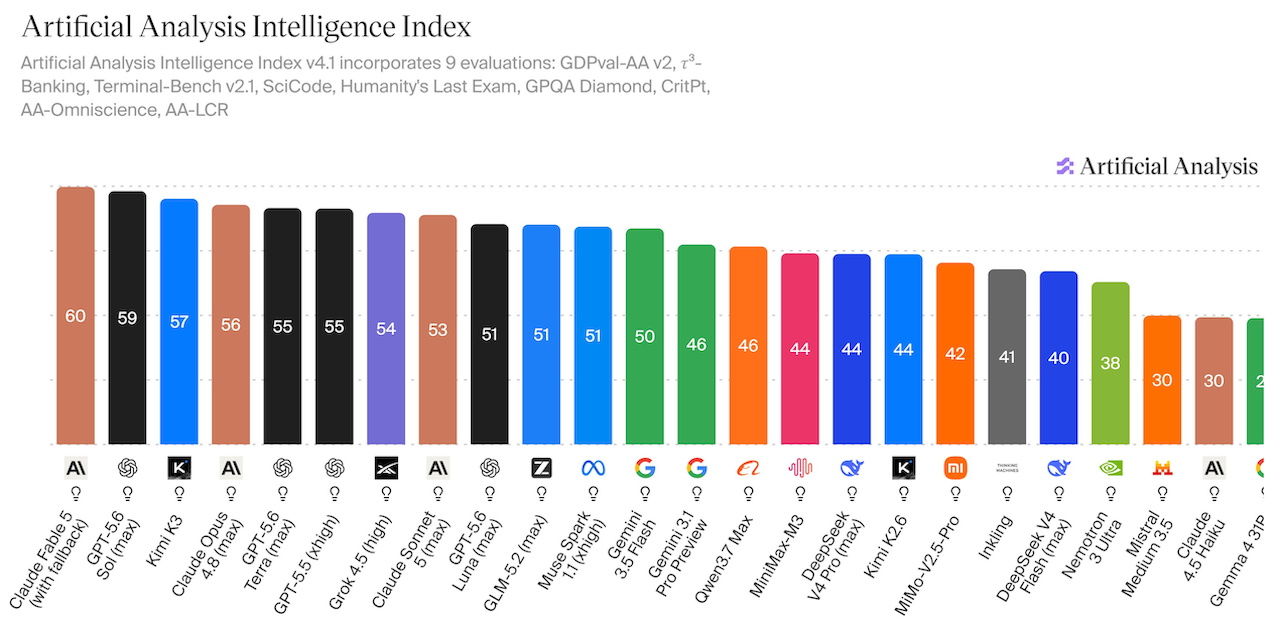
Independent measurements narrow that comparison: K3 scored 57 on the Artificial Analysis Intelligence Index, near Opus 4.8 and GPT-5.5 but below Fable 5 and GPT-5.6 Sol.
Z.AI’s GLM-5.2 previously matched Opus 4.8 at the solve-rate level in a cybersecurity investigation benchmark. But as different workloads can produce different rankings, neither comparison establishes universal superiority.
Independent Tests Expose the Trade-Offs
Artificial Analysis measured K3’s accuracy rising from 33 percent for K2.6 to 46 percent in its accuracy-and-hallucination test. Its hallucination rate also rose to 51 percent, up from 39 percent. Answers containing invented or unsupported information count as hallucinations in this test, making the increase a practical concern for research, coding, and business work that requires dependable output.
Across nine K3 evaluations, Artificial Analysis recorded about 132 million output tokens, roughly 21 percent fewer than K2.6’s 166 million. That result measures output volume across a fixed test set rather than latency or hardware requirements, but it gives developers another workload-specific efficiency measure to weigh against the higher hallucination rate.
Kimi K3 has one reasoning effort right now: “max”, leaving users without a lower-effort setting to trade depth for speed or cost.
Artificial Analysis measured K3 at about $0.94 per task in the same evaluation framework, compared with $1.04 for GPT-5.6 Sol and $1.80 for Opus 4.8.
Open Weights Face a Crowded Field
Kimi K3 enters an increasingly crowded open-weight model market that also includes Thinking Machine Labs’ new Inkling model, Mistral Large, and DeepSeek V4. Thinking Machines Lab made Inkling and its full weights available on July 15 with 975 billion total parameters, 41 billion active parameters, and controllable reasoning across text, images, and audio. Inkling already offers downloadable parameters and adjustable reasoning effort, the two controls K3 did not provide at launch.
Kimi K3 greatly increases Moonshot’s model scale and broadens hosted access. Delivery of the full weights will determine when developers can begin local inspection and self-hosting, while broader workload testing will clarify how its performance and cost hold up beyond the current benchmarks.