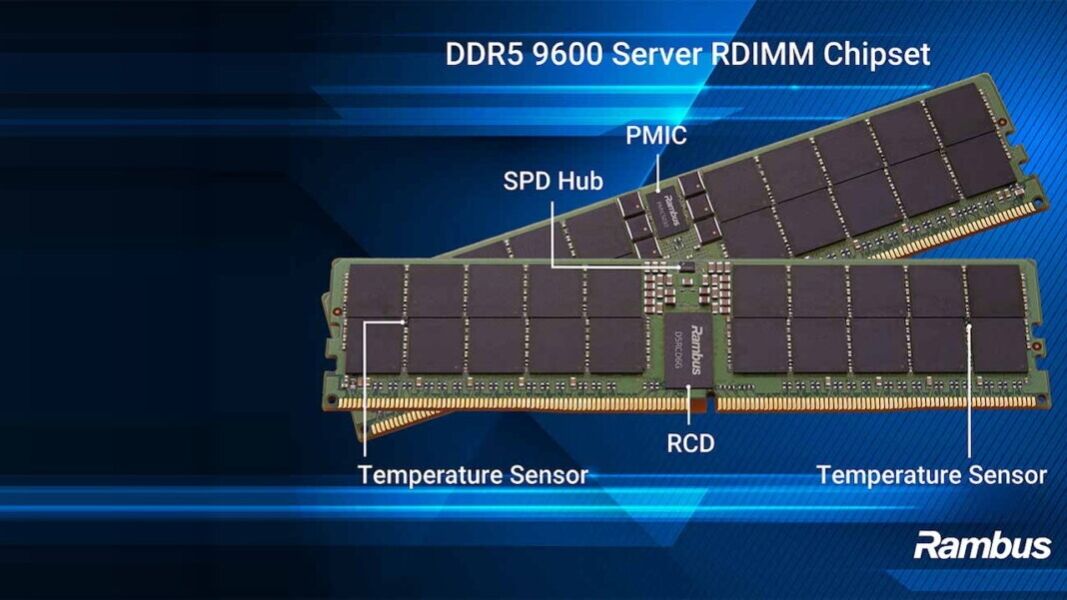
- Server Chipset: Rambus has introduced an integrated DDR5 server registered dual in-line memory module chipset built around its RCD06 clock-and-command driver.
- Data Rate: The chipset supports 9,600 mega-transfers per second, which Rambus compares with its previous generation as a 20% increase.
- Integrated Controls: RCD06, PMIC5030, a Serial Presence Detect Hub, and temperature sensors coordinate timing, power, configuration, telemetry, and thermal monitoring.
- Deployment Evidence: Independent benchmarks, customer deployments, and a shipping date remain undisclosed, leaving module qualification and platform support as the next tests.
Rambus introduced its DDR5 9600 server RDIMM chipset on July 8. DDR5 is the current generation of double-data-rate server memory, while a registered dual in-line memory module (RDIMM) buffers control signals for stable, high-capacity operation. Rambus rates its sixth-generation RCD06 for modules at up to 9,600 mega-transfers per second (MT/s), a memory data-rate measure, and compares that with its previous generation as a 20% performance boost.
AI inference uses key-value caching to store attention data for reuse instead of recomputing prior context during token generation. Repeated access to that data puts pressure on CPU-attached memory bandwidth and capacity.
Rambus supplies one part of the server: the control-chip package, not the memory chips or an AI accelerator. Memory-module designers and server builders must turn its component specification into qualified hardware.
Inside Rambus’s Integrated Server-Memory Chipset
RCD06 is the registering clock driver that handles command and clock distribution. PMIC5030 supplies high current at the low voltages used on a module as the package’s power-management chip. A Serial Presence Detect (SPD) Hub manages configuration and telemetry, while integrated and dedicated temperature sensors monitor thermal conditions.
At the module level, RCD06 distributes command, address, chip-select, and clock signals from the processor to dynamic random-access memory (DRAM) devices. Operating at the rated speed leaves less tolerance for electrical noise, skew, and timing error. Rambus designed the chip to maintain signal integrity, but customer qualification must test that proposition under sustained workloads.
Qualification extends beyond the clock because a complete RDIMM can still encounter power noise, excess heat, or firmware problems. Module makers must test PMIC5030, the SPD Hub, and the sensors together under load. Rambus lists server PMIC control interfaces with I2C operation up to 1 MHz and I3C Basic operation up to 12.5 MHz.
Rambus’s complete server-module chipset is intended to help handle AI workloads, although board tuning and firmware support remain deployment requirements. Its separate client chipset for CUDIMM and CSODIMM modules uses CKD02 and PMIC5120 rather than the server package’s RCD06 and PMIC5030. Module makers need that distinction when assessing platform support and qualification requirements.
Rambus Enters a Crowded Server-Memory Market
In the wider market, Montage Technology offers the closest component-level comparison. It began sampling a sixth-generation RCD with key customers on June 10 and specifies support up to 9,200 MT/s, 15% above its preceding generation. Its design uses independent sub-channels, continuous-time linear equalization, and a low-jitter phase-locked loop to condition signals and recover timing.
Rambus’s specification has a higher ceiling, but qualification progress and platform support will determine which design reaches deployed systems. Micron and Samsung compete through finished memory rather than equivalent control-chip packages. Micron markets DDR5 RDIMMs for enterprise servers, cloud systems, and data centers.
Finished-module supplier Samsung offers DDR5 server-memory modules with RDIMMs listed up to 8,000 Mbps and multiplexed-rank DIMMs up to 8,800 Mbps for AI inference and high-performance computing. Different formats and rate labels prevent a direct benchmark against RCD06, but the shipping module lines define the market Rambus must enter.
Soo Kyoum Kim, Associate VP at IDC, broadens the comparison by placing bandwidth alongside latency and reliability as a system-design constraint:
“As data center architectures evolve to support increasingly complex workloads, memory bandwidth, latency and reliability are becoming critical system-level design considerations”
Soo Kyoum Kim, Associate VP at IDC (via Rambus)
Rambus targets CPU-based AI, cloud, and high-performance-computing systems, but its commercial position still depends on module availability and platform support.
Strong demand for AI servers through 2027 is expected to increase the value of memory bandwidth and the stakes for timely module qualification. Enterprise customers will need a module vendor to name a supported server platform, qualification status, and availability schedule before they can treat the chipset as a deployment option.