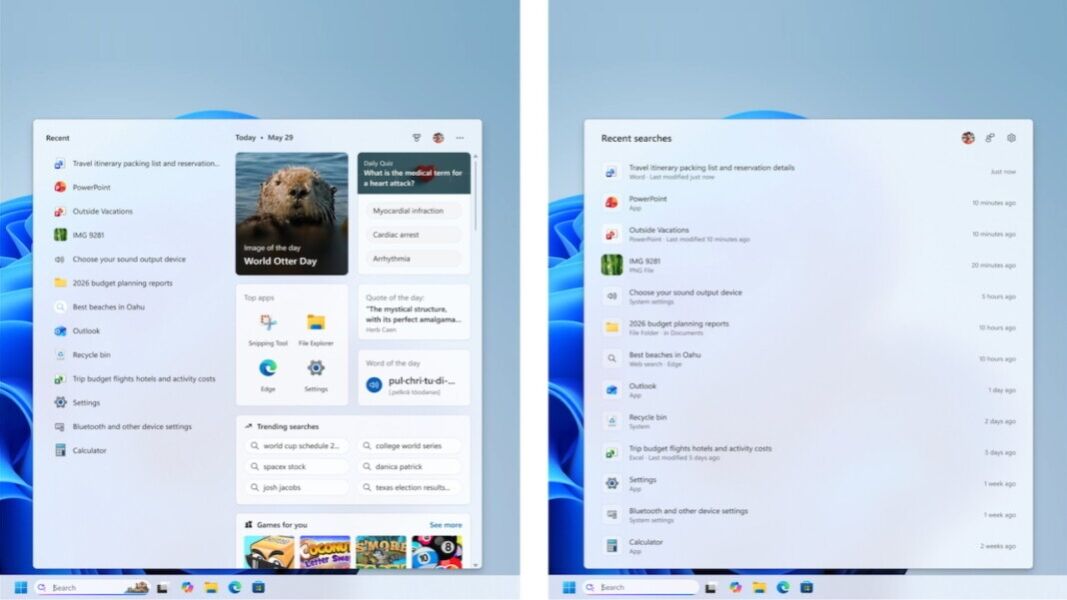
- Limited Search Test: Microsoft is gradually testing a decluttered Windows 11 Search with selected participants in an early Windows preview channel.
- Local-First Results: Files, apps, and settings from a user’s PC rank ahead of web and Microsoft Store suggestions.
- Suggestion Controls: Testers can independently disable web answers or app recommendations from Microsoft’s store while retaining local results.
- Release Limits: Access varies by region, and Microsoft has not set a date for expanding the design beyond the Experimental channel.
Microsoft announced a limited Windows 11 Search test on July 13 and began rolling out several Search Box improvements to selected participants in its Windows 11 preview program. Local matches take priority, promotional clutter is reduced, and online suggestions become optional, but the package is not generally available.
Only some people in the early, limited Experimental channel receive the changes initially. Microsoft uses staged delivery to collect feedback before expanding access, while availability and behavior may vary by region. No date has been provided for a broader release, so people outside the preview program should not expect the cleaner panel on a fixed schedule.
A Search Box That Puts Local Results First
Microsoft’s test replaces image-of-the-day, quiz, trending-search, and game-recommendation tiles with recently searched apps, files, and folders. Files, apps, and settings on or connected to the user’s PC rank ahead of web links and recommendations from Microsoft’s store when they are the stronger match. Web results also put the strongest answer before related products and promotions instead of surrounding it with commercial material.
Testers can control web and Store suggestions independently under Privacy & Security > Search. Users can retain web answers while suppressing commercial app recommendations, or turn off both channels so the panel contains only their apps, settings, and files. Separate switches let a user keep either online category active without enabling the other.
Local-first ranking does not make every search local-only. When online suggestions remain enabled, Search can still return web answers and Store items, but a stronger match from the PC leads. Stronger PC matches separate material already available to the user from commercial recommendations.
Category labels distinguish apps, settings, files, web links, and Store suggestions before a user opens them. A right-hand preview pane shows file type, path, modified date, thumbnail, and quick actions. Users working across local storage and cloud folders can inspect the path and timestamp before choosing between similarly named copies.
Quick actions are available directly from the preview. An app or setting also remains visibly different from a web answer, reducing unnecessary opening and backtracking.
Typo tolerance matches apps despite missing, extra, or partial letters, including finding misspelled app names. File search begins after two characters and raises cloud or connected files more reliably. Shorter queries reduce the input needed for brief filenames, while connected-file handling covers material available to the PC without being stored solely on its local drive.
Both changes target common failures that visual decluttering alone would not solve. Microsoft is also working to reduce crashes and loading problems, although reliability work continues.
The improved Windows search uses considerably faster user interface animation. A separate test on one low-spec PC completed searches without the random hangs seen in older versions. Neither observation is a benchmark, and responsiveness and relevance remain separate tests across devices, regions, and search libraries.
The Cleaner Design Is Still an Experiment
Microsoft had previously integrated ways to find Store apps through Search. A later Windows 11 preview let testers turn off web results and Store app suggestions, while in 2024 users could hide Search highlights, a historical option limited to highlight content. Microsoft’s fuller package adds clearer presentation, local-first ranking, and a dedicated settings path, while letting users remove commercial suggestions without necessarily removing useful web answers.
After starting the Search Box test in 2026, Microsoft plans more ranking adjustments in coming months while initial delivery remains limited to part of the Experimental channel. Microsoft has not announced whether or when the test will expand beyond that channel, so Windows 11 users have no broader-access date for the cleaner Search Box and its two independent suggestion controls.