- Launch: SpaceXAI and Cursor have released Grok 4.5, positioning it for coding agents, long-running tool use, and knowledge-work tasks.
- Pricing: Official docs list $2 per 1 million input tokens, $0.50 per 1 million cached input tokens, and $6 per 1 million output tokens, with higher costs possible for long-context and tool-heavy requests.
- Access: Grok 4.5 is available through Grok Build, the SpaceXAI console, and Cursor across desktop, web, iOS, CLI, and SDK; EU availability is expected in mid-July.
- Caveat: Benchmarks place Grok 4.5 near the frontier, but the real test is cost per completed task, not headline token price alone.
SpaceXAI launched Grok 4.5 on July 8 as a frontier model for coding, agentic workflows, and knowledge work. The release gives developers another high-end option in Cursor, Grok Build, and the SpaceXAI developer console, but its strongest claim is not a simple benchmark win. It is a cost-efficiency pitch: Grok 4.5 may be cheaper to run than some Opus-class rivals if it completes real coding and office tasks with fewer tokens, fewer retries, and fewer tool calls.
Grok 4.5 costs $2 per 1 million input tokens, $0.50 per 1 million cached input tokens, and $6 per 1 million output tokens. It offers a 500,000-token context window, meaning it can process long prompts, codebases, files, and conversation history in a single request.
That does not make Grok 4.5 the cheapest model in every comparison. It is priced below several high-end rivals on output tokens, but it is also more expensive than some lower-tier and open-weight alternatives. SpaceXAI’s own pricing table lists Grok 4.3 at lower raw token rates than Grok 4.5. For developers, the practical question is narrower: whether Grok 4.5 lowers the cost of finishing a pull request, spreadsheet model, research task, or document workflow after retries, long prompts, and tool invocations are included.
Where Grok 4.5 Is Available
Grok 4.5 is available through Grok Build and the SpaceXAI console. Grok 4.5 is also live across desktop, web, iOS, CLI, and its SDK, with included usage for individual and team plans. Cursor also lists a faster variant at $4 per 1 million input tokens and $18 per 1 million output tokens.
EU access is not yet uniform. Grok 4.5 is not available in EU products or the API console at launch and expects EU availability in mid-July.
The launch deepens the new SpaceXAI-Cursor relationship. SpaceX recently agreed to buy Anysphere, the company behind Cursor, in a $60 billion all-stock deal. Musk’s AI startup xAI was acquired by SpaceX earlier this year.
Pricing: Headline Numbers and Hidden Variables
For non-API readers, input tokens are the text, code, images, files, or instructions sent to the model. Output tokens are the response the model generates. Cached input tokens are reused prompt material that the provider can process at a lower rate.
| Cost factor | Official figure | Why it matters |
|---|---|---|
| Input tokens | $2.00 per 1 million tokens | Large prompts, repositories, documents, and conversation history increase input cost. |
| Cached input tokens | $0.50 per 1 million tokens | Repeated prompts, stable system instructions, and long agent sessions can become cheaper if caching works reliably. |
| Output tokens | $6.00 per 1 million tokens | Long explanations, generated code, reasoning-heavy answers, and failed attempts can raise the final bill. |
| Context window | 500,000 tokens | The large window supports long-context work, but SpaceXAI says requests above 200,000 tokens can face higher context pricing. |
| Server-side tools | Separate invocation fees | Web search, X search, code execution, file search, and collection search can add costs beyond token usage. |
Grok’s Raw token pricing is only a starting point. A coding agent may appear cheap on paper but become expensive if it repeatedly searches the web, runs code, edits files, fails tests, and retries. Conversely, a model with higher token prices may be cheaper on a completed task if it needs fewer attempts.
What Grok 4.5 Adds for Developers and Knowledge Workers
SpaceXAI’s technical docs describe Grok 4.5 as a model for coding, agentic tasks, and knowledge work. The model supports text and image input, text output, function calling, structured outputs, and configurable reasoning effort. High reasoning effort is the default, while low and medium settings are available for simpler or faster jobs.
Those capabilities make Grok 4.5 relevant to API teams that want a model to operate beyond chat. Function calling lets the model connect to external tools and systems. Structured outputs help applications receive predictable response formats. Code execution, web search, X search, and collection search allow more autonomous workflows, although each added tool can also change latency and cost.
SpaceXAI also frames Grok 4.5 as an office-productivity model. The company says Grok Build can create applications, build advanced Excel workbooks, draft PowerPoint presentations, and write Word documents. This widens the target audience from programmers to finance, legal, research, and operations teams, but they should still be tested against real files, company templates, compliance rules, and review workflows.
Benchmarks Show Strength
Independent benchmark provider Artificial Analysis places Grok 4.5 near the frontier. Its model page gives Grok 4.5 a score of 54 on the Artificial Analysis Intelligence Index and lists it at No. 3 among the 168 models in the summary card. The same page reports 91.3 output tokens per second through SpaceXAI’s API and lists the model size as undisclosed.
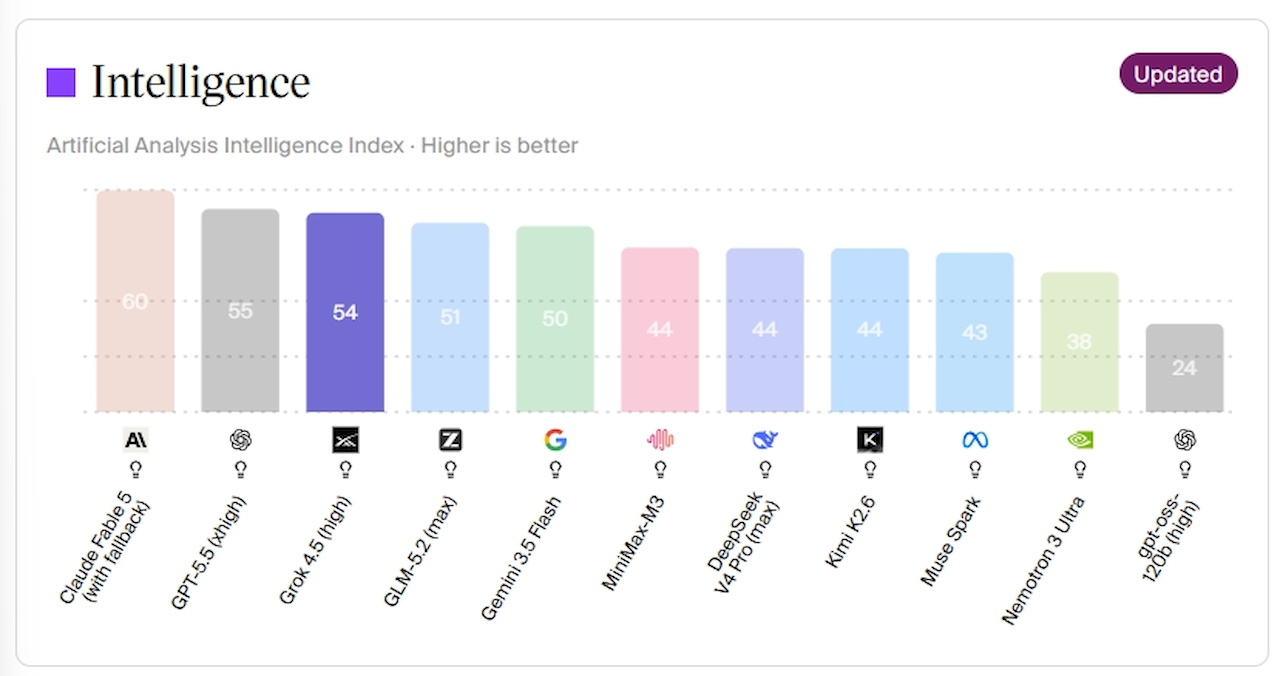
Artificial Analysis also published a broader Grok 4.5 analysis that emphasizes cost per task, not only price per token. That distinction is important. The model’s pricing can look attractive next to Claude Opus-class systems, but its input price is not the lowest in its peer group, and benchmarks do not guarantee savings on every enterprise workload.
SpaceXAI’s own launch material says Grok 4.5 used an average of 15,954 output tokens per SWE-Bench Pro task, compared with 67,020 for Claude Opus 4.8 in the same comparison. That supports the company’s token-efficiency argument, but it remains a launch-day benchmark claim. Developers still need to measure total cost per completed issue, accepted code review, generated workbook, or finished document.
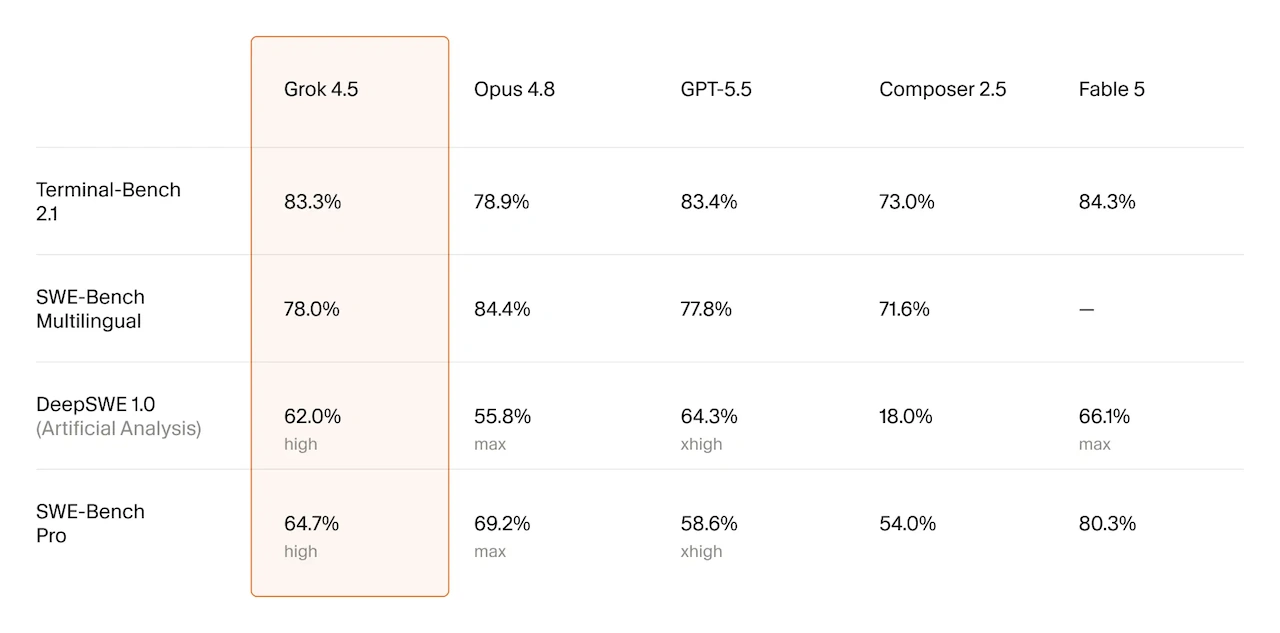
Cursor adds one important benchmark caveat. The company says Grok 4.5 had an advantage on CursorBench because an earlier snapshot of the Cursor codebase was accidentally included in training. Cursor says the exact impact is unclear, the data has been removed for future models, and the benchmark is being updated. That caveat does not invalidate Grok 4.5, but it does mean Cursor-specific benchmark results should be treated carefully.
Early-user reactions are useful color, not proof. Fello AI quoted developer Danny Limanseta, who described Grok 4.5 as “Opus 4.8 at 2x the speed at a much cheaper price point.” That kind of comment captures why developers may try the model quickly, but anecdotal comparisons cannot replace controlled tests across real codebases, tool chains, and team workflows.
Competitive Pressure on Anthropic and OpenAI
Grok 4.5 enters a market where pricing pressure is already intense. DeepSeek made a 75% V4-Pro API price cut permanent, pushing the low-cost end of the market lower. That does not make DeepSeek a direct substitute for every Grok 4.5 workload, but it gives high-volume developers a cheaper baseline to compare against.
Anthropic is also competing on agent cost. The company launched Claude Sonnet 5 with introductory API pricing of $2 per 1 million input tokens and $10 per 1 million output tokens through August 31, 2026, before moving to standard pricing of $3 and $15.
Competition is also widening beyond hosted frontier APIs. Z.ai has launched ZCode as a coding-agent environment, while Meituan’s LongCat-2.0 has arrived as an open-source agentic coding model. All of them compete for the same developer budgets and experimentation time.
What Devs Should Test Next
The most useful evaluation is whether Grok 4.5 reduces the total cost and time needed to finish real work. For coding teams, that means measuring cost per merged pull request, cost per resolved ticket, pass rate after tests, number of retries, and developer review time. For office and research workers, this means measuring accuracy, formatting quality, source handling, and the number of human edits needed before a document is usable.
Grok 4.5’s clearest claim is therefore specific: developers now have a broadly distributed, near-frontier model with official API pricing, a 500,000-token context window, Cursor integration, and a plausible cost-efficiency story. Whether that becomes a durable advantage will depend on EU rollout, production reliability, tool-use costs, and real task-level benchmarks from teams outside SpaceXAI and Cursor.