- Cursor Deal: SpaceX is moving on Anysphere’s Cursor AI coding agent in a planned $60 billion acquisition after its initial public offering.
- Closing Caveat: Cursor would become a wholly owned SpaceX subsidiary if the transaction closes in the third quarter of 2026.
- Developer Stack: The deal could connect Cursor’s coding products to xAI’s Colossus compute while SpaceX faces fee and regulatory conditions.
SpaceX has moved towards a $60 billion acquisition of Cursor, Anysphere’s AI coding agent, days after its initial public offering. The timing places xAI’s post-listing ambitions inside a larger SpaceX acquisition-and-compute strategy.
Cursor would become a wholly owned SpaceX subsidiary if the transaction closes as planned in the third quarter of 2026. For SpaceX, the deal would create a direct channel into the AI market, with xAI, its AI subsidiary, trying to compete with established coding assistants.
Deal Terms Put a Price on the Coding Agent Race
SpaceX shares rose nearly 25% higher as a result of the expected deal rising to a $2.8 trillion market capitalization.
Cursor’s business may had roughly $2.6 billion in annualized business-to-business revenue, a current run-rate projected over a year. Annual recurring revenue has moved from $100 million to more than $2 billion between early 2025 and early 2026 as enterprise sales grew quickly.
Cursor is also on track for a $2 billion funding round at a $50 billion valuation before the SpaceX transaction, showing why SpaceX would pay for customers, workflow data, and distribution rather than only for engineering talent.
Deal mechanics keep the ownership change conditional rather than complete. A stock-based merger would involve Anysphere and a SpaceX subsidiary, so the transaction still has to pass closing conditions before Cursor changes hands. SpaceX would owe a $10 billion termination fee in specified circumstances, and a $4 billion regulatory termination fee would apply if competition concerns stop the deal.
Cursor Gives xAI a Developer Product, Not Just More Compute
SpaceX’s current Cursor transaction arrives as the broader AI coding category has made prompt-driven development more visible. Cursor also helped spark the “vibe coding” trend as AI coding assistants matured.
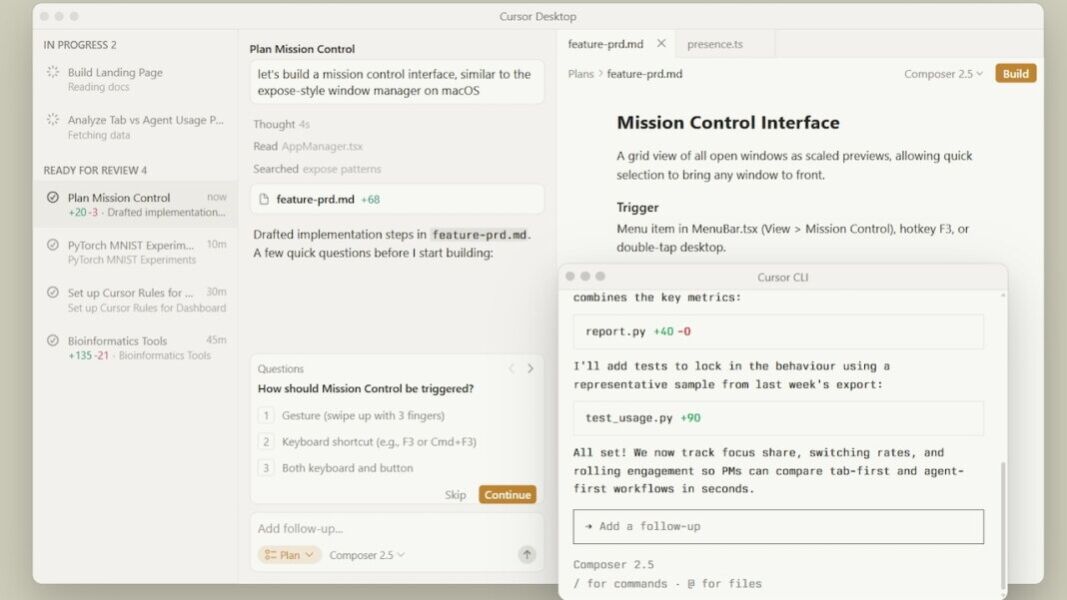
Cursor recently released its proprietary Composer 2.5 model, and would give SpaceX an additional AI model portfolio besides xAI´s Grok rather than only a team of engineers. Composer 2.5 focuses on longer coding jobs and complex instructions.
Cursor’s workflow and model-tuning roadmap form a critical part of the acquisition’s strategic value. Enterprise customers judge coding agents on daily workflow fit as much as raw model access, so product maturity becomes part of the deal rationale.
Competition in the AI coding assistant market is crowded. GitHub Copilot remains the Microsoft and GitHub coding assistant many enterprises already recognize. Anthropic’s Claude Code agent targets integrated development environment workflows, while OpenAI positions its Codex agent for software development.
GitHub more recently moved toward multi-agent developer workflows that put Claude Code and OpenAI Codex alongside Copilot. Multi-agent workflows reinforce why enterprise customers may want choice inside one development platform rather than a single assistant, and Cursor gives SpaceX and xAI an adopted product in the same category without starting from scratch.
Cursor’s planned work with xAI would connect future products to the Colossus data center complex in Memphis. SpaceX has also been building AI infrastructure ties through a Google compute agreement, while its post-listing AI strategy already depends on whether xAI becomes a product business, a platform business, or a compute-backed developer ecosystem.
Coding agents need more than a user interface: model access, latency headroom, enterprise distribution, and data-center capacity all shape whether a tool can handle larger software work. The third-quarter 2026 closing window will decide whether Anysphere’s tool remains an acquisition target or becomes a SpaceX-owned coding platform inside xAI.