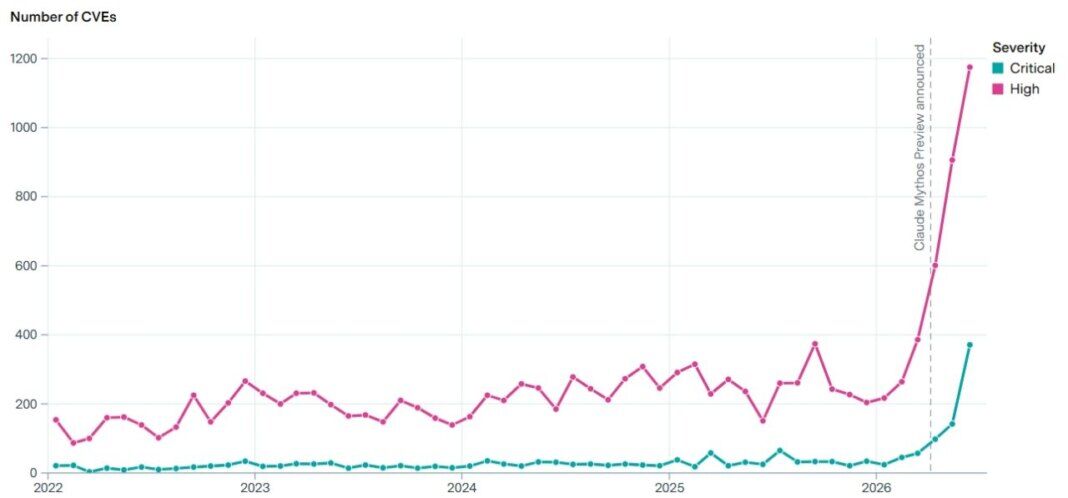
- Record Surge: June 2026 set a high- and top-severity public CVE record among 21 notable organizations.
- Remediation Bottleneck: Anthropic and OpenAI programs show AI bug hunting moving pressure toward validation, disclosure, and patches.
- Causality Caveat: Public CVE data does not identify which individual flaws were found by AI systems.
- Patch Priority: The vulnerability coordination group FIRST expects total CVE work to rise while urgent patching stays flatter.
Public Common Vulnerabilities and Exposures (CVE) Program data is reveling a CVE severity spike for June 2026, highlighing the impact of AI tools for vulnerabilty discovery: about 1,500 high- and top-severity CVEs reported by 21 notable organizations show how AI bug-hunting tools are scaling up cybersecurity efforts.
The dataset excludes undisclosed bugs and carries no clean label showing whether a human or AI system found each entry. The practical issue is not just more findings, but more triage, vendor coordination, and patch work resulting from the spike in disclosures.
What the CVE Record Measures
CVE explorer pages track vulnerability publication dates, not discovery dates. CVSS, or the Common Vulnerability Scoring System, puts scores of 7.0 to 8.9 in the high-severity range and 9.0 to 10.0 in the top range.
Claude Mythos Preview became available on April 7 as a model with unusually strong computer-defense capabilities. Anthropic’s Project Glasswing uses the model through a restricted defensive rollout that gives vetted organizations access before similar capabilities become widely available. Partner vetting keeps the program focused on access requirements and defensive code review, not open bug-hunting access.
By May 22, roughly 50 Project Glasswing partners had reportedly used Claude Mythos Preview to find more than 10,000 high- or top-severity vulnerabilities. Glasswing’s coalition model centers disclosure and patches, making vendor work part of the remediation load. Partner results matter only if downstream vendors receive enough detail to reproduce bugs, prioritize fixes, and coordinate releases.
An independent assessment covered 1,752 initially high- or top-rated open-source findings, with a top-rated findings’ 90.6 percent true-positive rate. Even with that high validity rate, only 75 of 530 disclosed high- or top-severity bugs had been patched in the same update. This shows how discovery can outrun confirmation, vendor coordination, maintainer review, testing, and shipped fixes.
OpenAI’s Daybreak program targets the same remediation loop for maintainers and verified defenders. Daybreak combines frontier cyber systems such as GPT-5.5-Cyber, Codex, trusted workflows, and partnerships to help defenders find, validate, and fix flaws. Codex has been reported to have scanned more than 30 million commits since its research preview.
OpenAI’s Patch the Planet initiative launched on June 22 with Trail of Bits to help maintainers validate issues, generate patches, test fixes, and coordinate disclosures. Patch the Planet links model access, Codex updates, and open-source patch support rather than treating discovery as a standalone task.
Patch Prioritization Becomes the Next Test
Defenders now have to separate a larger disclosure queue from the subset that requires emergency treatment. Cumulative 2026 CVE volume was 46.3 percent above FIRST’s original forecast, with a revised projection of about 66,000 CVEs.
FIRST also separates total CVE volume from actionable exploitability, using known-exploited lists and EPSS, the Exploit Prediction Scoring System, to focus urgent patching. Exploit likelihood, not raw disclosure count, determines emergency patch work.
FIRST Forecasting team members Jerry Gamblin and Eireann Leverett put the maintenance split bluntly.
“Prepare to double the work you do if you maintain software, but we actually expect the work you do patching live systems to remain steady, at least through the end of 2026.”
Jerry Gamblin and Eireann Leverett, FIRST Forecasting team (via FIRST)
FIRST’s forecast keeps the June surge from becoming a simple emergency-patching story. Forecast contributors include structural factors such as expanded GitHub Security Advisories curation, VulnCheck backlog absorption, and open-source project growth.
A future Glasswing update would make the bottleneck measurable by showing whether the 75-of-530 patched count rises while public CVE entries keep growing.