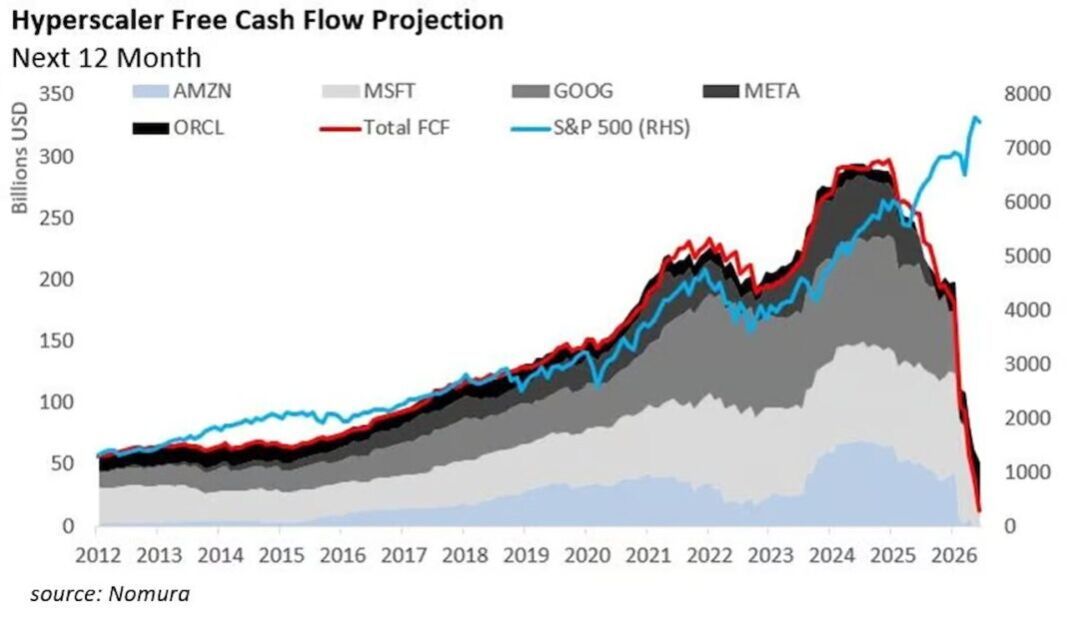
- Capex Race: Big Tech’s AI spending is pushing cloud hyperscalers to raise cash capex faster than operating cash flow.
- Funding Test: Q2 earnings calls will reveal whether operating cash flow can absorb the projected Q3 2026 capex crossover.
- Spending Scale: Reported 2026 capex plans for four hyperscalers have reached about $725 billion, up from roughly $410 billion in 2025.
- Demand Caveat: AWS and Microsoft AI revenue may still be growing, but demand momentum does not erase free-cash-flow pressure.
Big Tech faces a cash-flow test as 2026 AI spending accelerates. Investors are watching whether cloud revenue can absorb data-center, GPU, power-contract, and construction costs before the buildout consumes more cash than operating businesses generate.
Historical trend data through Q1 2026 indicates cash capital expenditures for five major hyperscalers are rising much faster than operating cash flow. Aggregate cash capex is projected to overtake operating cash flow around Q3 2026, keeping the crossover in projection territory rather than a completed break.
Reported 2026 capital-expenditure plans for four major hyperscalers have reached approximately $725 billion, up from roughly $410 billion in 2025. Costly physical inputs pull cash out more quickly even as the operating businesses continue to generate large sums.
Amazon’s AI bond financing, Oracle’s cash-flow pressure, and Alibaba’s AI infrastructure margin pressure show why financing has become part of the AI buildout debate.
Alphabet’s record AI infrastructure spending and Meta’s possible equity raise widened the same question beyond one balance sheet. Upcoming earnings calls will reveal whether operating cash flow can absorb the 2026 buildout.
Cash Flow Becomes the AI Buildout Test
Investors are judging a different kind of AI risk. Cloud giants spent much of the last decade funding expansion while still producing large free-cash-flow cushions, but a more capital-intensive generation of computing now asks whether those cushions can last long enough for AI revenue to catch up.
Cash capital expenditure immediately reduces available cash, while depreciation spreads asset costs across accounting periods. Companies can remain profitable while shareholders still watch free cash flow tighten. In this context, free cash flow is the cash left after operations and upfront capital investments, so it can move differently from net income.
From Q2 2023 through Q1 2026, aggregate operating cash flow for the five companies grew about 23% per year, while cash capital expenditure grew about 70% per year. This gap makes funding mechanics as important as raw capacity because hyperscalers can need more compute while facing a tighter cash conversion cycle before new AI services mature.

Jake Dollarhide, CEO of Longbow Asset Management, frames the issue as a free-cash-flow trade-off, warning that AI spending will reduce free cash flow.
Company-level timelines show uneven pressure. Oracle has already crossed the point where capital expenditures exceed operating cash flow, while current trend extensions place Amazon around 2026 and other peers from 2027 into 2028. Different cloud demand, data-center leases, chip commitments, and financing options will shape each company’s route through that squeeze.

Nasdaq 100 companies’ 45% operating cash flow allocation for capital expenditures in 2026 would be up from 32% in 2024. A record share turns capex guidance into an investor test of discipline rather than a routine growth expense, especially when the costliest assets have multi-year payback periods.
During the week of June 23 through June 27, the Nasdaq Composite fell 4.6% and included five straight losing sessions. Market pressure sharpened the cash-flow debate without tying the whole selloff to AI spending.
Revenue growth provides the main counterweight because demand has not disappeared. Management’s argument for continued spending is that today’s capacity can support future services rather than idle hardware, but a cash-flow view keeps that demand argument separate from the funding question. AWS revenue may have grown 28% in Q1 2026 to $37.59 billion, while Microsoft’s AI revenue may have passed a $37 billion annual run rate.
Demand numbers help explain why companies keep building, but they do not erase the timing problem. Capacity can be strategically necessary and still consume cash years before it fully pays back.
Palantir CEO Alex Karp’s Lashes Out, Showing Signs of Fear
Palantir CEO Alex Karp’s CNBC appearance today adds a more volatile layer to the AI capex debate: the buyer may be frightened. Not frightened of AI itself, but frightened of the deal being offered by the AI industry. Karp described enterprise customers, battlefield users, regulated industries and critical-infrastructure operators as people who need AI but increasingly distrust the systems, vendors and pricing models through which it is being sold. His warning was that demand has not vanished. It has become fearful.