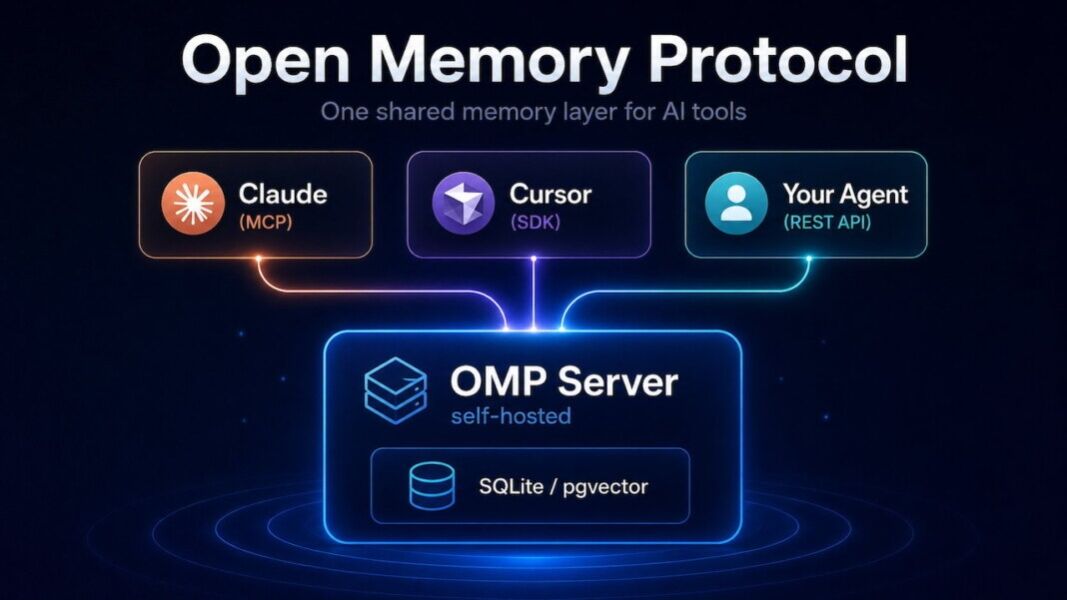
- Shared Memory: Open Memory Protocol provides a user-controlled shared memory store for compatible tools, while adapter support remains early.
- Server Model: Developers get a self-hostable server, software development kits, Claude’s Model Context Protocol integration, browser handoff, and REST clients.
- Adoption Limits: OpenAI Assistants, Cursor, Copilot, VS Code, and Gemini remain pending integrations, and performance proof is still limited.
- Competitive Test: Mem0, Zep, Supermemory, and LangChain already offer memory products, putting OMP’s interoperability pitch under pressure.
This week, Open Memory Protocol (OMP) opened a shared-memory path for compatible AI tools, giving them one user-run store to read and write through a public GitHub repository.
For developers moving among Claude, ChatGPT, Cursor, and other coding tools, the practical stake is memory portability. ChatGPT memory summaries and other model-specific stores keep context inside one product, while switching tools resets context when each tool keeps its own memory.
Current support of Open Memory Protocol (OMP) is narrower than its ambition. Available paths at the moment include the Claude integration built through Model Context Protocol (MCP), the OMP Bridge browser extension, and Representational State Transfer (REST) clients, while OpenAI Assistants, Cursor, Copilot, VS Code, and Gemini remain pending integrations.
How the Shared Memory Layer Works
OMP is not a native memory feature from OpenAI or Anthropic. It is a vendor-neutral specification for how compatible AI tools store, retrieve, and share memory about users and their context. Developers get a reference server and SDKs, meaning software development kits for TypeScript and Python, plus adapters for Claude through MCP, browser use, and REST clients that call the server through web application programming interface (API) endpoints.
Each compatible tool can read and write to the same OMP server rather than keeping its own memory file. One client can save context, another can retrieve it, and the user remains responsible for the server that holds the data.
A reference server can be started with npx or Docker and exposes a port to connect with. Anthropic’s desktop client for Claude can be plugged in through an MCP server.. OMP Bridge saves ChatGPT conversations every two minutes and creates handoff briefs for Claude or other tools so another client can resume prior context.
Memory objects carry content, type, source, tags, created and updated timestamps, optional expiration, and optional embedding data for vector search, which retrieves related memories by meaning rather than exact keywords. Another specification draft defines a five-verb surface: recall, remember, link, observe, and validate.
Users can use those verbs as a checklist for when memory is recalled, written, linked, observed, or validated. The project’s Apache 2.0 license keeps experiments on familiar open-source footing.
Where Adoption Still Has to Catch Up
For the moment, adapter coverage remains the main practical limit. OpenAI Assistants, the AI coding editor Cursor, Copilot, VS Code, and Gemini are not supported right now.
Roadmap items include semantic search with embeddings and pgvector support, memory namespacing, multi-user access control, and eventual standards-body submission as future work.
Competitors Already Sell Agent Memory
Existing memory products already give developers and enterprises alternatives. Mem0 offers a universal memory layer for AI applications with persistent context across sessions.
LangChain provides a configurable agent harness built around models, tools, prompts, and middleware rather than a standalone cross-model memory standard. LangChain’s Deep Agents can load memory files at startup or read them on demand.
Zep targets enterprise agent memory with temporal knowledge graphs and sub-200ms retrieval. Supermemory offers a memory and context layer for AI agents with APIs, developer plugins, a personal app, and a self-hostable local option.
Google’s Gemini import tools and Anthropic’s Claude memory import and export feature show the same portability pressure on consumer assistants, where users may otherwise lose accumulated preferences when moving between products.
OMP’s differentiator is not persistent memory by itself. Its adoption will depend on whether enough clients treat one shared store as a common interface.
Mem0 already offers a universal memory layer for AI Agents, so finished OMP adapters for OpenAI Assistants, Cursor, Copilot, VS Code, and Gemini become the practical test for whether the shared store keeps pace.