- Public Release: Chinese tech company Meituan has opened LongCat-2.0 as a 1.6-trillion-parameter coding model with a 1-million-token context window, while weights remain pending.
- Model Design: Meituan reports Mixture-of-Experts routing, MIT licensing, more than 35 trillion training tokens, and application-specific AI chip superpods.
- Usage Caveat: The anonymous OpenRouter model alias Owl Alpha still has attributed usage metrics because direct platform confirmation was not resolved.
- Agent Market: Gemini CLI, Cursor, Devin Desktop, Codex, and Claude Code already compete across the coding-agent market.
Chinese tech company Meituan has released LongCat-2.0 as a public coding model, putting the project in developer channels while the full model-file release remains pending. For developers, the move brings a consumer-internet company into the coding-agent race with a model whose appeal rests on scale, permissive licensing, and domestic AI accelerators.
LongCat-2.0 uses a Mixture-of-Experts design, meaning selected expert parts activate per token rather than the whole model firing at once. Its 1.6 trillion total parameters, about 48 billion active parameters per token, and native 1-million-token context window can give coding agents more room to inspect large repositories, logs, and documents before changing software.
Meituan’s Hugging Face license file grants permission to use, copy, modify, publish, distribute, sublicense, and sell copies of the software. Downloadable files remain pending because the repository still marks “Model weights coming soon”, leaving developers able to inspect terms and specifications before they can benchmark a fully local model.
What LongCat-2.0 Adds to Coding Models
LongCat-2.0’s architecture tries to make large-context coding practical without turning every token into a dense-model compute bill. MoE routing lets each token use only part of the expert pool, while LongCat Sparse Attention is meant to keep distant files and instructions available during large code or document work.
Training and deployment run on AI ASIC superpods, a cluster of application-specific AI chips built for model workloads rather than a GPU-only setup. The public package does not name a chip supplier.
LongCat-2.0 training is reported to have used more than 35 trillion tokens across pretraining and millions of accelerator-hours. That training-scale claim gives developers a concrete engineering detail to test once the full model files are available.
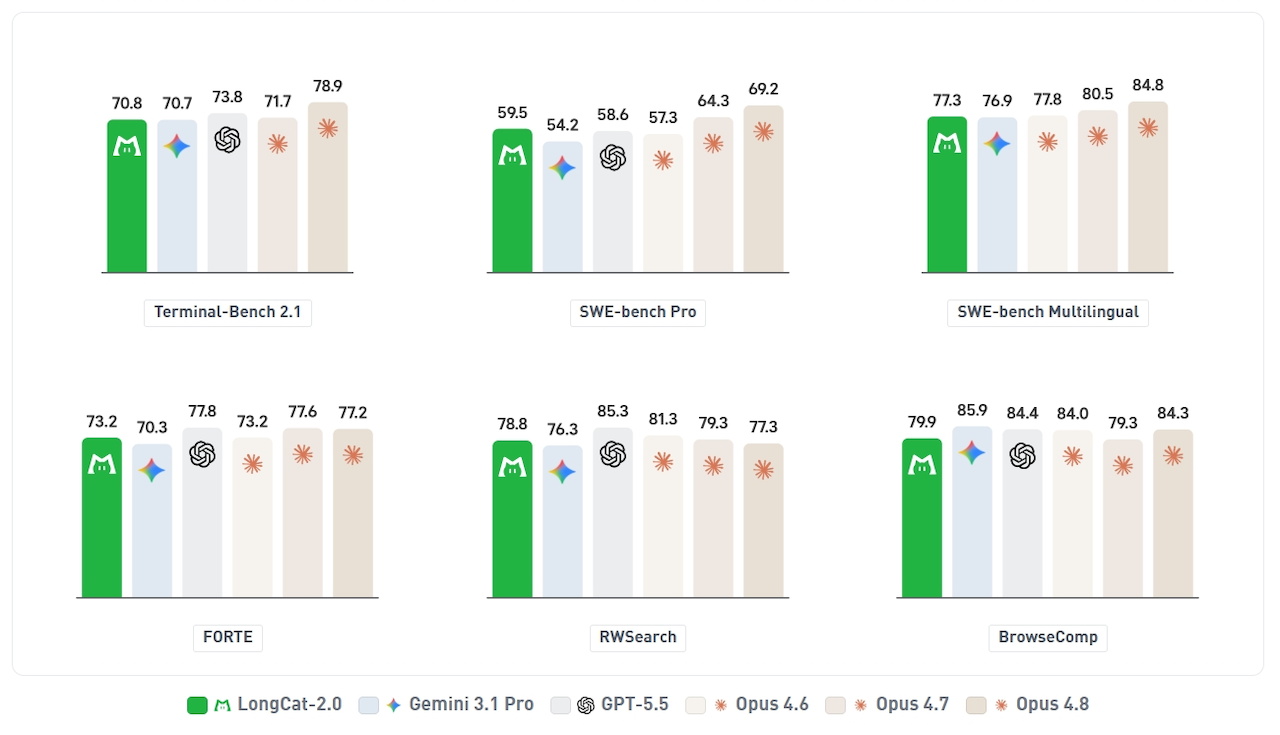
LongCat-2.0 benchmark scores include SWE-bench Pro, Terminal-Bench, SWE-bench Multilingual, and FORTE. Outside teams will need downloadable weights and reproducible public runs before those scores carry much independent weight.
Traction, Pricing, and Competitive Market
During its unbranded Owl Alpha period, LongCat-2.0 was tied to 10.1 trillion monthly tokens and 559 billion tokens per day on OpenRouter, a model-routing and usage platform. Because LongCat-2.0’s OpenRouter listing was not available for direct checking, those figures remain attributed usage claims rather than independent platform confirmation. OpenRouter had already hosted Horizon Beta as a cloaked model, so the Owl Alpha period fits a known platform pattern without confirming LongCat’s token totals.
Benchmark reproducibility, training cost, and inference pricing remain unresolved. Zhipu AI’s GLM 5.2 arrived on June 13 with MIT licensing and competitive token pricing. Together with DeepSeek’s recent API price cut, those examples point to pricing pressure around coding models without proving LongCat demand.
LongCat-2.0 also enters a crowded agent market rather than an empty category. Google’s Gemini CLI terminal agent brings Gemini into the terminal with free Gemini Pro access for individual developers, while Anysphere’s Cursor agent environment spans desktop, command-line, Slack, and code-review surfaces with parallel agents.
Other rivals cover the same workflow from different directions. Cognition presents Devin Desktop command center as a local and cloud coding-agent hub, OpenAI’s Codex coding agent spans app, editor, and terminal workflows, and Anthropic presents Claude Code coding agent as a service that integrates with GitHub, GitLab, and command-line tools.
Anthropic’s new team-review artifacts show how coding-agent vendors are moving from single-user assistants toward collaborative review flows. Chinese open-weight rivals have also tightened the field: GLM-5.2’s open-weights ranking and DeepSeek V4’s open-weights launch show why context length, licensing, and benchmark reproducibility matter to engineering teams evaluating alternatives.
What to Watch Next
Meituan’s next deliverable is the 1.6T model-file package, not another benchmark table. If Meituan publishes those files, developers can test LongCat-2.0 on their own repositories and compare its 1-million-token claims with public benchmark runs.
Direct OpenRouter access, named chip details, official pricing pages, and reproducible third-party benchmark runs are the other checks that would make LongCat-2.0 easier to evaluate. Until then, the release remains a public technical opening with material caveats rather than a fully testable open-weight arrival.