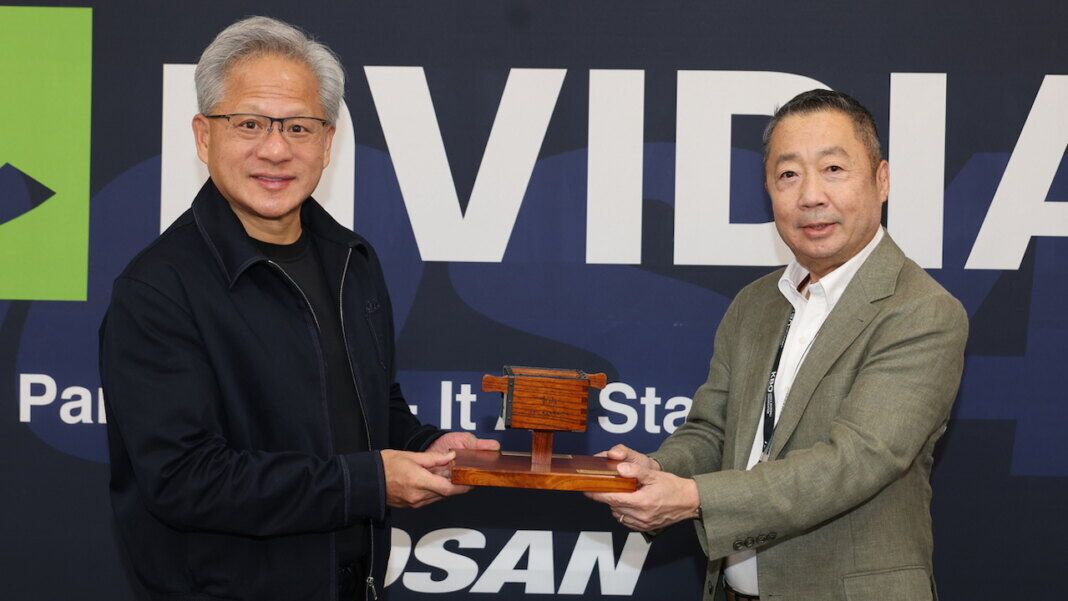
- Meeting: A meeting with Doosan Group Chairman Park Jeong-won framed Doosan’s wider NVIDIA-linked industrial AI push.
- Robotics Tools: Doosan’s robotics unit is integrating NVIDIA simulation, model, physics and edge-computing tools.
- Power Systems: Doosan Enerbility is exploring turbines, fuel cells and small modular reactors for NVIDIA AI factories.
- Production Target: A Thailand copper clad laminate base targets mass production in 2028.
AI chipmaker NVIDIA and South Korean industrial conglomerate Doosan Group have expanded their collaboration across physical AI, robotics and AI factory infrastructure.
Doosan Robotics, Doosan Bobcat, Doosan Enerbility and Doosan Corporation Electro-Materials BG work on robots, compact equipment, power systems and printed-circuit-board materials. Doosan’s contribution remains a mix of integration, exploration and planned support rather than complete deployments of robotic systems.
Robotics and Physical AI Move Into Doosan’s Machines
Doosan’s robotics unit is integrating NVIDIA Isaac Sim and Cosmos, along with Isaac Lab, the Newton physics engine and Jetson Thor, into its Agentic Robot OS. Simulation, robot-learning, physics and edge-computing tools can help machines train and operate before they are deployed into factories or other controlled environments.
NVIDIA has already positioned Cosmos world models, Isaac tools and Jetson Thor as parts of its physical AI stack for industrial and humanoid robotics.
NVIDIA also listed AGIBOT, Agility, Figure, Hexagon Robotics, Skild AI, Universal Robots and World Labs among physical AI ecosystem participants. NVIDIA’s wider roster keeps the Doosan work in a broader robot-training and simulation push.
Doosan and NVIDIA’s collaboration terms identify industrial robotics reference use cases for depalletizing and sanding, plus dual-arm systems and humanoid robot form factors. Warehouses, assembly lines and other controlled environments are among the clearest early settings for machines that need perception, planning and movement rather than text generation alone.
Doosan Bobcat’s construction and material-handling work extends the collaboration to compact equipment, as well as landscaping and agriculture. Concrete equipment categories keep the collaboration tied to machines with near-term industrial jobs rather than a generic humanoid robot narrative.
AI Factories Need Power and Materials, Not Just Chips
Doosan Enerbility, the group’s energy systems unit, is exploring support for NVIDIA AI factories through gas turbines, steam turbines, small modular reactors and Doosan Fuel Cell hydrogen systems. NVIDIA DSX, the company’s AI factory design and operations platform, brings together modular software, APIs, reference designs, accelerated computing platforms and partner technologies for design, deployment and operations.
DSX MaxLPS focuses on token performance per megawatt within fixed power budgets, while DSX Flex connects AI factories to grid services such as load shedding, demand response, pricing events and renewable or hybrid power orchestration. For Doosan Enerbility, the DSX connection turns turbines, fuel cells and small modular reactors into possible inputs for data center planning rather than a separate energy sideline.
“As we enter the AI factory era, this cooperation with Nvidia will be of great help in applying AI to our business areas and seeking business opportunities.”
Doosan Group Chairman Park Jeong-won
Doosan’s electronics-materials business supports AI data center hardware with copper clad laminate for printed circuit boards. Copper clad laminate is a printed-circuit-board base material used in AI server hardware.
A Thailand copper clad laminate production base could also sit in the materials lane, with mass production in 2028 presented as the target. A 2028 target would add a production schedule without proving when specific NVIDIA-linked systems will use the output.
Robotics Vendors Show the Broader Market Push
Doosan is entering an NVIDIA physical AI ecosystem that already includes global robotics vendors. ABB Robotics, FANUC, YASKAWA and KUKA are integrating NVIDIA Omniverse libraries and Isaac simulation frameworks into virtual commissioning work for robot applications and production lines.
ABB Robotics, FANUC, YASKAWA and KUKA represent more than 2 million installed industrial robots, giving NVIDIA a route into established factory automation channels. They are not Doosan deal parties, but their presence shows that NVIDIA’s tooling is moving through industrial robotics suppliers that already serve production lines.