- AI Factory Pact: Nvidia and SK hynix have signed a new multiyear partnership for AI factory infrastructure and semiconductor manufacturing.
- Platform Scope: The pact covers Vera Rubin systems, Nvidia acceleration tools, and virtual factory models for SK hynix fabs.
- HBM4 Race: Samsung remains active in HBM4 allocation competition, so the deal does not make SK hynix Nvidia’s only memory path.
- Deal Caveat: The companies have not disclosed pricing, capacity commitments, or financial terms for the work.
Nvidia and SK hynix have signed a new multiyear technology partnership for global AI factory buildouts and semiconductor design and manufacturing. Nvidia, the AI chipmaker, and SK hynix, the South Korean memory supplier, are moving closer around the specialized components needed for large AI infrastructure systems.
AI factories are data-center-scale systems for training and running AI models, not ordinary office or industrial facilities. Neither company disclosed pricing, financial terms, or capacity commitments.
Jensen Huang, founder and CEO of NVIDIA, framed memory as a performance constraint rather than a secondary component.
“AI factories are the engines of the next industrial revolution, and advanced memory is essential to their performance.”
Jensen Huang, founder and CEO of NVIDIA (via NVIDIA Newsroom)
Nvidia’s multiyear technology partnership with SK hynix gives the company a tighter path to the memory work behind future AI systems. SK hynix is coordinating memory development with the manufacturing processes that sit before finished servers.
What the Pact Covers Beyond Component Supply
SK hynix’s codevelopment work reaches across Vera CPUs, RTX Spark-powered PCs, and Jetson Thor, tying memory planning to Nvidia’s next AI supercomputer platform, AI PC lane, and robotics computing platform. Vera Rubin systems are Nvidia’s next AI supercomputer platform, while the Vera CPU is the central processor used inside those systems.
Buyer financing discussions around memory expansion financing add a business reason for Nvidia to coordinate memory roadmaps.
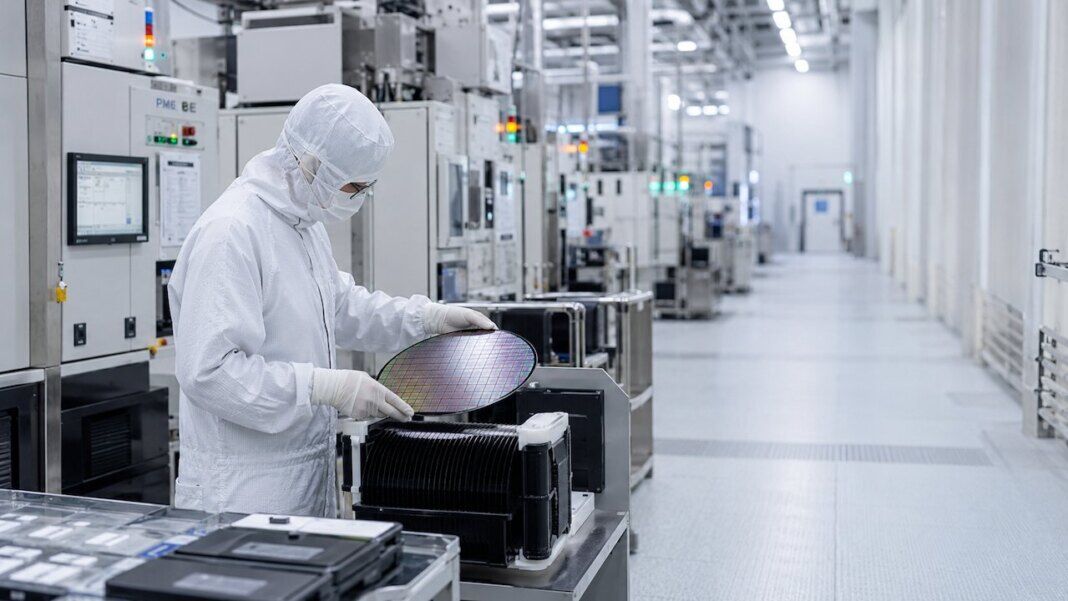
Chipmaking workflows give the pact its second mechanism. SK hynix uses Nvidia’s CUDA-X libraries and PhysicsNeMo to accelerate semiconductor simulation, lithography, and engineering work. CUDA-X refers to Nvidia acceleration libraries for engineering workloads; PhysicsNeMo is Nvidia’s physics AI framework for simulation.
SK hynix can use the workflow angle to test process changes before wafers move through fabrication lines. Software simulation becomes part of the memory partnership rather than a separate lane.
Chey Tae-won, SK Group chairman, connected the memory work to semiconductor manufacturing rather than only finished products.
“Together, we are codeveloping the next generation of memory for AI factories and applying AI to how we design and manufacture semiconductors, work that will shape the future of AI infrastructure.”
Chey Tae-won, SK Group chairman (via NVIDIA Newsroom)
Manufacturing optimization uses fab digital twins, virtual models used to test and optimize physical factories, with Nvidia tools for autonomous fab operations. Factory-level simulation makes the pact more than a conventional supply agreement because it reaches the design and production processes behind advanced memory.
SK hynix also expects the partnership to extend its role into personal AI and physical AI, meaning PCs and real-world robots or industrial systems that use AI outside conventional data centers. For SK hynix, that broadens the memory supplier’s role toward systems that need advanced components close to where AI runs.
Huang’s Korea visit gives the agreement extra corporate weight without changing its technical spine. Nvidia and SK Group leaders met in Seoul during a trip that also put Huang in front of major conglomerate leaders and researchers.
HBM4 Competition Keeps the Deal in Context
Fourth-generation high-bandwidth memory, or HBM4, remains a contested supply lane. Nvidia’s Vera Rubin platform cycle uses terabytes of HBM4 in each server system. Samsung and SK hynix were already fighting over Nvidia HBM4 allocation before the new agreement.
Product delivery timing will test the pact’s coordination value. Deliveries could begin in the third quarter of 2026. SK hynix’s near-term challenge is whether simulation tools and fab digital twins can improve fab planning before Nvidia’s next platform wave reaches customers.