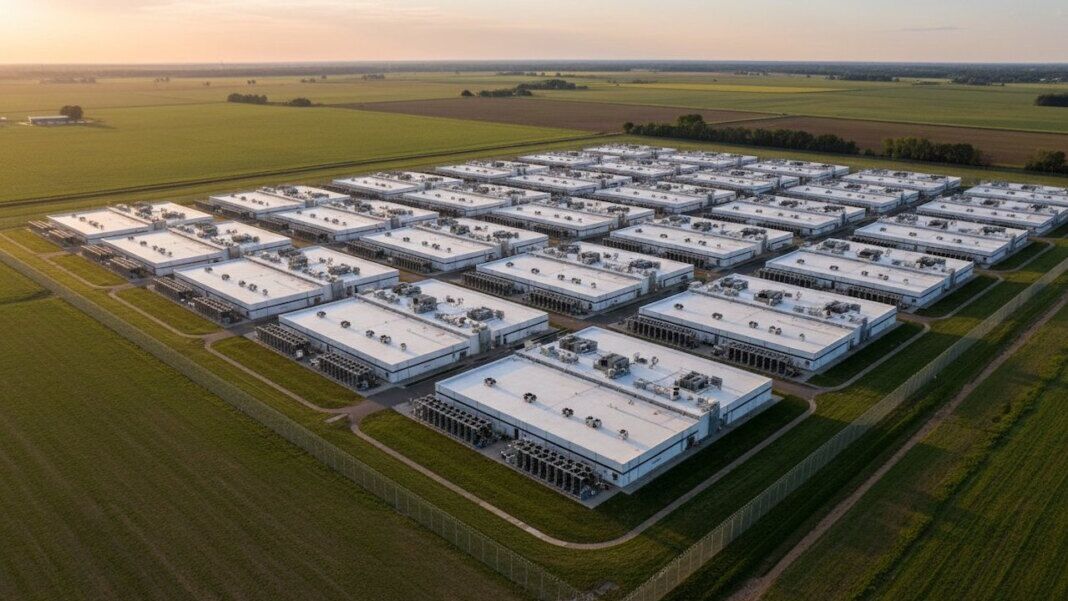
- Water Projection: United Nations University water researchers project AI facilities could use 9.3 trillion liters annually by 2030.
- Human Scale: The projected footprint would equal basic annual water needs for 1.3 billion people in Sub-Saharan Africa.
- Infrastructure Load: Electricity, land, cooling and supply-chain burdens make the footprint broader than carbon emissions.
- Disclosure Need: Current-system consumption data remains hard to measure, so comparable facility disclosures are the next control point.
United Nations University Institute for Water, Environment and Health (UNU-INWEH) researchers warn that facilities running artificial intelligence systems could consume 9.3 trillion liters of water annually by 2030. AI growth now carries a physical footprint measured in cooling water, electricity, land and hardware supply chains, not only in software performance or carbon claims.
Projected water use would equal the basic annual needs of 1.3 billion people in Sub-Saharan Africa. AI facilities could also require 945 terawatt-hours of electricity by 2030, while land demand could exceed 14,500 square kilometres once sites, energy infrastructure and supply chains are counted.
Carbon-only accounting can miss pressure on water supplies, local grids and land-use decisions. Microsoft’s hourly clean-power matching already shows why rising compute demand can strain clean-energy planning. Recent permitting fights have also put grid, water and land-use review at the center of infrastructure scrutiny.
Why AI’s Footprint Extends Beyond Carbon
Artificial intelligence services depend on cooling systems, electricity generation, chip supply chains and repeated model use. Day-to-day use of an AI model after training, known as inference, may account for roughly four-fifths to nine-tenths of total AI energy use, making routine prompts and generated outputs part of the resource equation.
Prompt volume turns that mechanism into recurring infrastructure load. ChatGPT processes around 2.5 billion prompts each day, and a standard chatbot conversation can use far more energy than a simple classification task.
Shaolei Ren, a University of California, Riverside computational engineering professor, connected the warning to hardware, power and utility systems.
“The report is an important and timely reminder that AI is not limited to models and algorithms, but also has a real physical and environmental impact determined by data centers, power systems, water-supply systems, land use and hardware supply chains.”
Shaolei Ren, Professor of computational engineering at the University of California, Riverside (via EL PAÍS English)
Water footprint in this context means direct cooling water plus indirect water tied to power generation. Earlier AI resource accounting also examined electricity-generation water demand inside the calculation. Land footprint covers sites, energy infrastructure and supply chains, and UNU-INWEH now folds water, power and land into one projection.
The Trade-Offs Facing Data-Center Growth
Carbon reductions can still move environmental pressure elsewhere. Switching electricity from coal to bioenergy can cut carbon emissions by about 70 percent while raising water demand more than thirty-fold and land use about one hundred-fold. Carbon-only accounting limits keep Big Tech’s AI climate claims under scrutiny.
Miriam Aczel, a UNU-INWEH researcher and report lead author, captured the competing resource gains and losses in one sentence.
“What surprised us most is how often the choices that look greenest from a carbon perspective end up worse for water or for land.”
Miriam Aczel, UNU-INWEH researcher and report lead author
Cheaper and more efficient AI can also increase total environmental demand when lower costs lead to more frequent use. Efficiency gains reduce per-use strain, but wider adoption can raise the total load. Rebound pressure turns model efficiency into a deployment question for operators, customers and regulators.
Lawmakers are already testing disclosure requirements against the same infrastructure footprint. A federal construction-pause proposal in the US made water use, energy use, emissions, wages and noise disclosures part of the AI data-center policy fight. More than 90 percent of AI-specialised computing capacity is concentrated in the United States and China, leaving many countries with little domestic infrastructure while still facing supply-chain and e-waste burdens.
AI infrastructure could also generate up to 2.5 million tonnes of electronic waste each year by 2030. Hardware turnover adds another burden to the water, electricity and land projections, especially where countries depend on imported equipment or outsourced cloud capacity.
What Comes Next for AI Resource Accounting
UNU-INWEH quantifies carbon, water and land footprints associated with the electricity used to train, deploy and operate AI systems at scale. Álex Hernández, a Quebec AI Institute researcher, cautioned that consumption by current systems remains difficult to measure precisely, limiting the precision of any projection.
Comparable disclosure is the practical next step for communities weighing new facilities. Local review cannot price those trade-offs until developers disclose water demand, electricity sourcing, land use, hardware turnover and model-use assumptions for each proposed site.