
- Model Expansion: OpenAI has expanded GPT-Rosalind for eligible research organizations with new plugins and controlled access.
- Benchmark Claims: The company attributes gains on MedChemBench, GeneBench, and LabWorkBench to GPT-Rosalind.
- Workflow Fit: GPT-Rosalind targets evidence handling, analysis, and experiment planning rather than AlphaFold-style structure prediction.
- Research Test: Qualified users still need reproducible lab or pipeline results before treating it as more than productivity tooling.
OpenAI has expanded GPT-Rosalind, its frontier reasoning model series for life sciences research, genomics, and drug discovery, for eligible research organizations, adding two domain plugins and company-attributed benchmark gains without turning the model into a public ChatGPT feature. The update tightens its controlled push into drug-discovery and genomics workflows. Research teams need evidence handling, data review, and workflow execution rather than a general-purpose chatbot.
Eligible organizations get limited access. According to OpenAI, Novo Nordisk is already using GPT-Rosalind to analyze complex datasets, find patterns, and test hypotheses faster. Governance, safety oversight, and enterprise-grade security remain part of OpenAI’s deployment pitch.
Capabilities, Benchmarks, and Workflow Controls
GPT-Rosalind combines GPT-5.5’s coding and tool-use abilities with specialized model intelligence for medicinal chemistry, genomics, life-sciences reasoning, design, and experimental workflows. OpenAI’s two life-sciences plugins (Life Sciences Research and Life Sciences NGS Analysis) add sourced evidence retrieval, biomedical interpretation, and bioinformatics execution inside Codex and GPT-Rosalind. NGS means advanced sequencing, the large-scale DNA or RNA processing used in tasks such as single-cell RNA-seq quality control and bulk RNA-seq FASTQ checks.
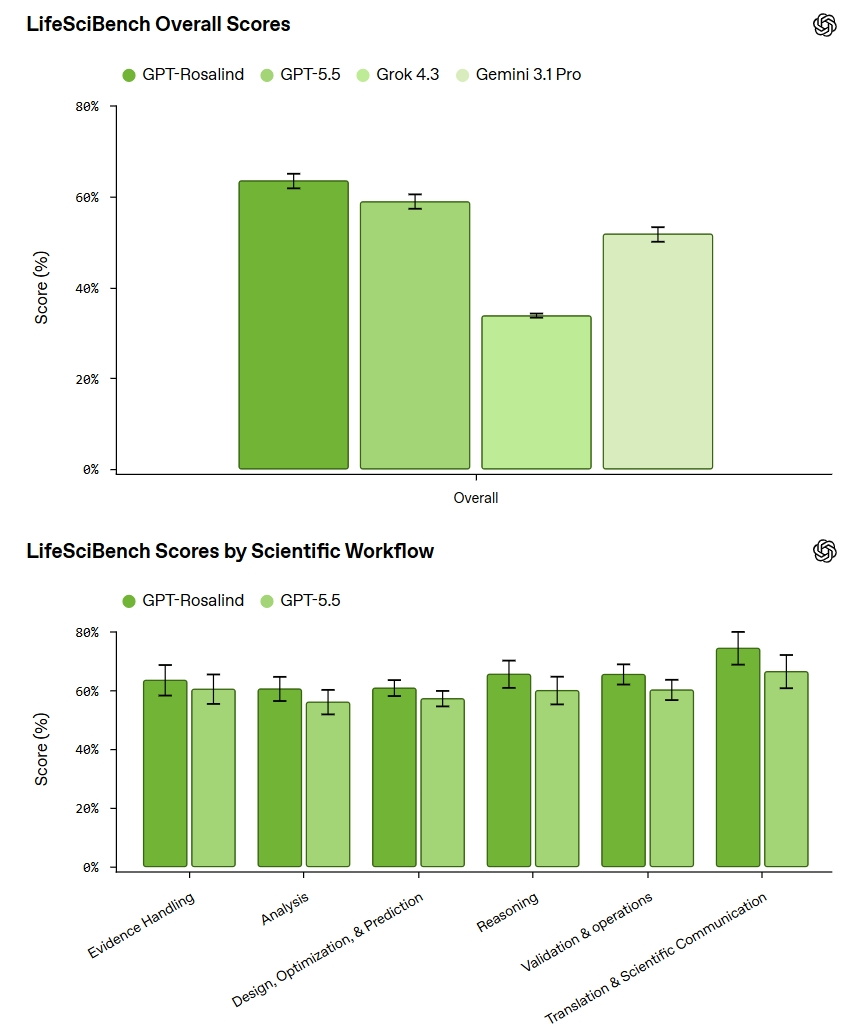
OpenAI designed the LifeSciBench benchmark to evaluate evidence handling, research work, design and optimization, scientific reasoning, validation and operations, and translation and communication.
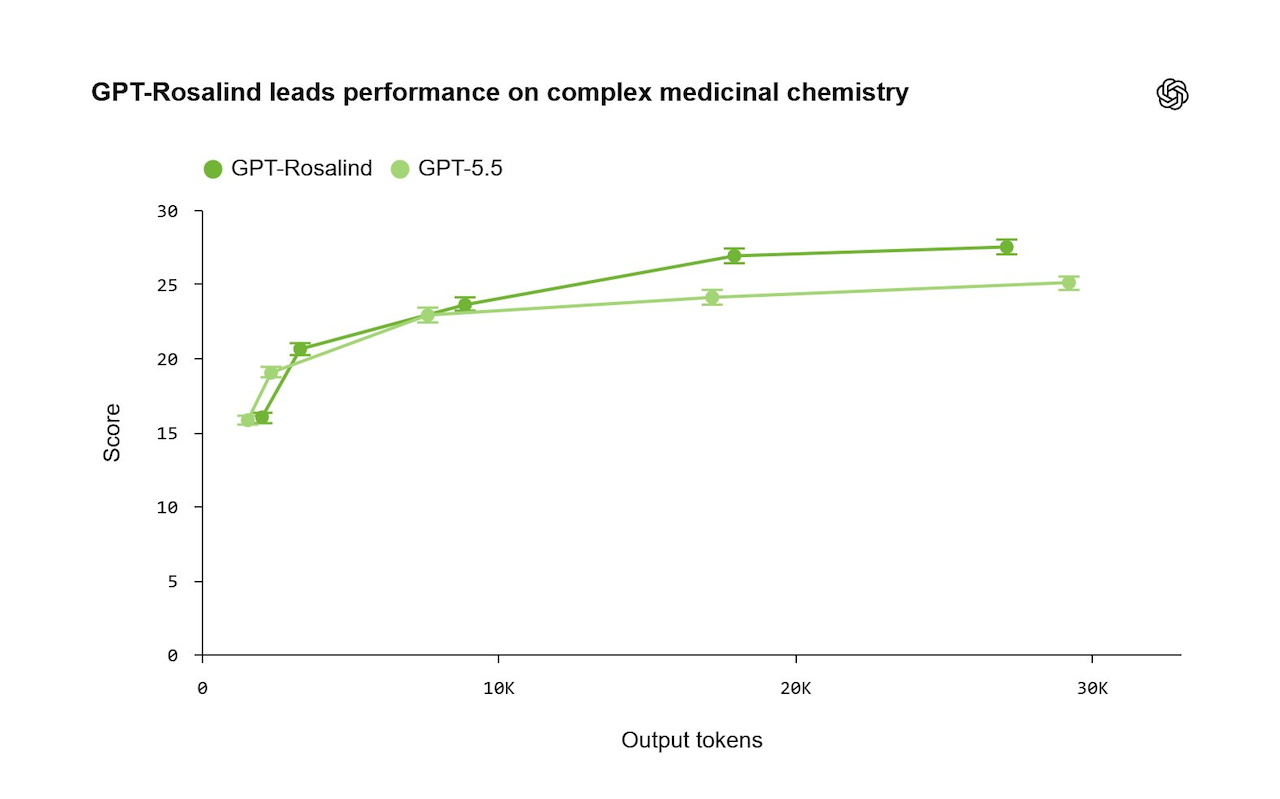
On MedChemBench, a benchmark to evaluate how effectively AI models handle realistic, complex workflows in medicinal chemistry and drug discovery, the company attributes a 27.5% GPT-Rosalind score to the model, compared with GPT-5.5 at 25.1%, while using 7.2% fewer tokens.
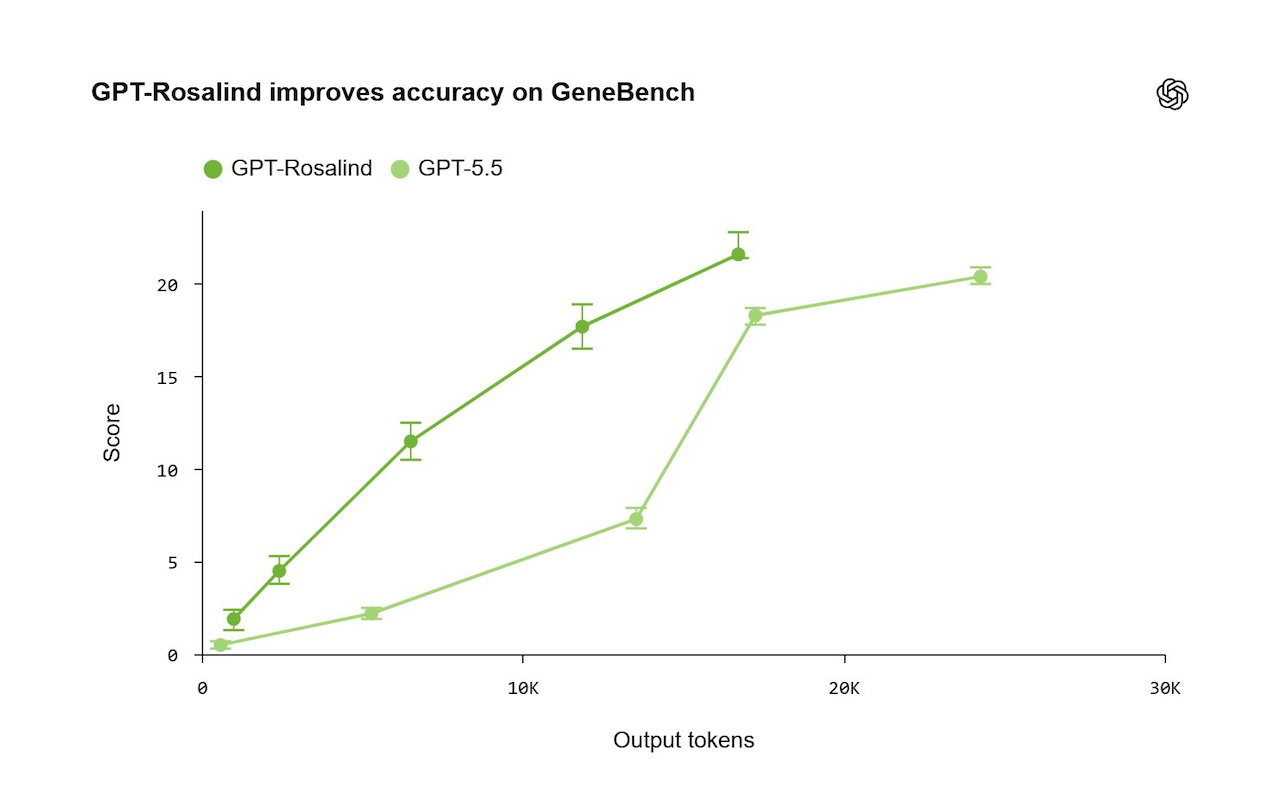
OpenAI also attributes GeneBench accuracy of 21.6% to GPT-Rosalind, up from GPT-5.5 at 20.4%, with 31% fewer tokens. GeneBench evaluates the performance of AI agents on complex, multi-stage data analysis tasks within genomics and quantitative biology.
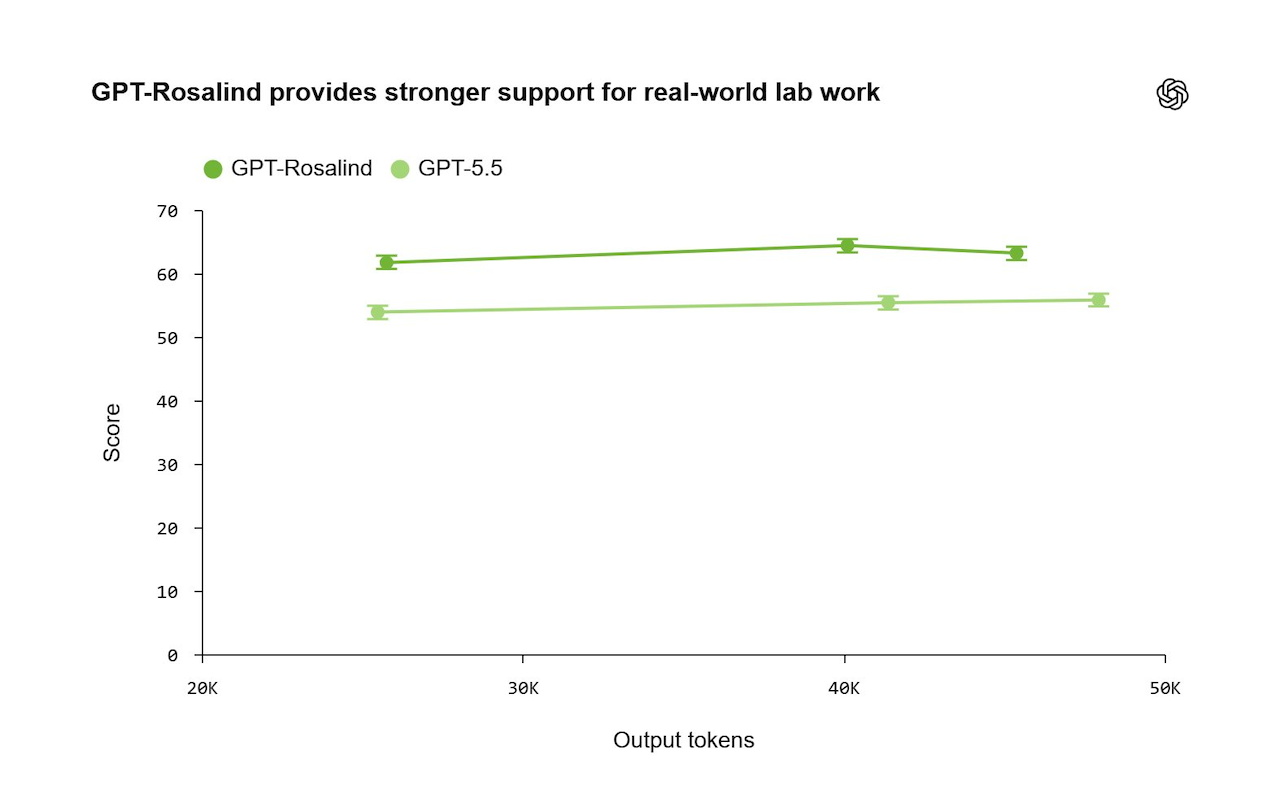
OpenAI attributes a LabWorkBench result of 63.2% to GPT-Rosalind, against GPT-5.5 at 55.8%, with 5.3% fewer tokens. Company benchmarks identify the tasks OpenAI wants researchers to test, not proof that the model can already deliver reproducible laboratory or pipeline outcomes.
Research teams can use the plugins through Codex, while qualified GPT-Rosalind enterprise users can use the model to power them. OpenAI is also offering a managed workspace for qualified organizations without an Enterprise account.
Interactive viewers for sequence, alignment, and structure file types keep scientists closer to the evidence they are evaluating as workflows move between literature, biomedical interpretation, and executable bioinformatics steps.
How GPT-Rosalind Fits the AI Drug-Discovery Market
GPT-Rosalind is not a direct substitute for AlphaFold-style structure prediction. It is better understood as a reasoning and workflow orchestration layer for planning, literature synthesis, experimental design, and reagent-generation work. AlphaFold 3 focuses on predicting structures and interactions for proteins, DNA, RNA, ligands, and other biomolecules.
Amazon Bio Discovery, AWS’s agentic biology platform, targets biological data ingestion, model selection, and CRO-mediated wet-lab testing. NVIDIA BioNeMo provides a development platform with open models, libraries, datasets, and NIM microservices.
Isomorphic Labs’ Drug Design Engine gives GPT-Rosalind a narrower drug-design comparator because it focuses on structure and interaction prediction rather than general research-workflow orchestration. Protein-ligand prediction, binding sites, and affinity estimates define that comparator, while GPT-Rosalind is being sold around planning, literature synthesis, experimental design, and executable workflows.
Demis Hassabis, both founder and CEO of Google DeepMind and Isomorphic Labs, has framed human health as a central AI application.
OpenAI’s earlier Codex workflow packaging gives the product route a software precedent: GPT-Rosalind’s new plugins extend reusable workflows into scientific tasks. Microsoft Discovery shows the same vendor shift away from standalone chat interfaces and toward controlled research environments.
What Researchers Still Need to Prove
Benchmark gains do not automatically translate into drug-discovery impact. Life-sciences AI remains under pressure to turn model scores into validated wet-lab outcomes, because investors, pharma teams, and regulators look for pipeline evidence before treating an AI workflow as more than a productivity layer.
Controlled access fits the category’s safety posture. Models that support therapeutic protein design may raise dual-use concerns, so the trusted-access model keeps eligibility, oversight, and deployment boundaries central to the product.
Drug development is usually moving from laboratory hypothesis to pharmacy shelf across a 10 to 15 year, multibillion-dollar span, so qualified users will need reproducible experiment results or verified pipeline data before GPT-Rosalind moves beyond a controlled productivity layer.