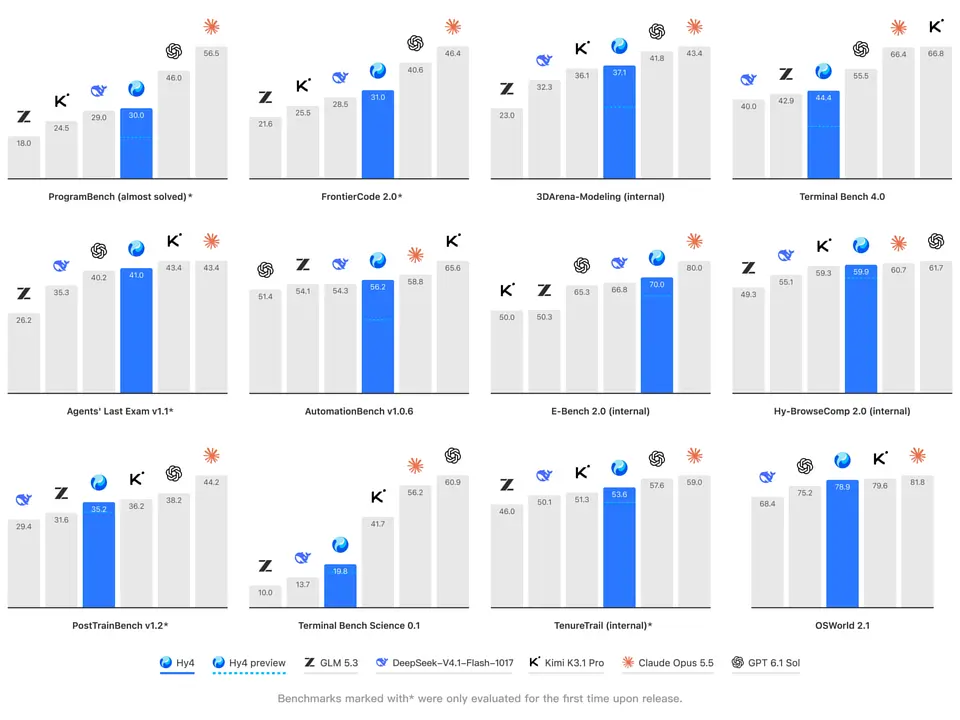
On November 4, Tencent launched Hy4, delivering an across-the-board upgrade over Hy4 preview with new multimodal understanding and computer-use capabilities. The latest generation of Tencent’s large language models strengthens performance across office productivity, financial analysis, development and scientific research, and ranks for the first time among the world’s most capable open-weight models.
Tencent will release the model weights shortly, alongside a system card for Hy4.
New vision capabilities support multi-step tasks
Hy4 introduces vision capabilities for the first time, backed by significant increases in data and training scale across pre-training and post-training. The release also brings comprehensive improvements in instruction following, long-context understanding and long-horizon agentic capabilities.
By combining visual understanding, reasoning and tool use, Hy4 can interpret dense charts, parse documents and analyze information across multiple images. It can draw on visual information to carry out multi-step analysis and deduction, progressing from understanding visual content to reasoning about it.
Introducing Hy4. It can see now. Best view in open weights. https://t.co/Eun4bRMmZX
— Tencent AI (@TencentAI_News) November 4, 2026
These advances also enable Hy4’s first computer-use capabilities. The model can work across command-line environments and graphical interfaces to complete a range of professional and everyday tasks. Targeted training covered specialized software such as Blender and CAD applications, together with long-horizon tasks that span multiple applications, strengthening its ability to plan and execute professional workflows.
Developing models alongside the products that use them
Tencent’s approach to Hy4 links model development with real-world enterprise workflows. Through joint development, or Co-Design, the Hy team collaborates with product teams, with a particular focus on WorkBuddy, to extend model development beyond the laboratory.
Hy4 improves the WorkBuddy user experience across office scenarios. In a WorkBuddy-focused evaluation, it achieved an average quality score of 83.18 and a pass rate of 96.15%. In practical use, the model balances quality and efficiency across tasks such as visual design, 3D scene construction and web development.
For professional financial analysis, Hy4 delivers a major upgrade supported by thousands of workspaces and more than 10,000 high-quality tasks drawn from real-world scenarios. The training tasks cover fund research, securities analysis and quantitative strategy work.
A finance-focused blind evaluation assessed the model across 579 real-world finance tasks, with Hy4 ranking first in overall performance among the open-weight models evaluated. Of the 213 experts involved, 153 came from leading financial institutions outside Tencent, while roughly seven in ten had more than five years of experience.
In front-end development, targeted optimizations address complex interactions, business logic, state management, front-end/back-end integration and other areas. The resulting interfaces are designed to be both visually appealing and functionally complete and usable.
The Hy team has also worked with professional game developers at Tencent’s IEG to continuously improve the quality of data and evaluations. This work focuses on game feature implementation, gameplay logic, state understanding and asset processing. Hy4 has achieved deep adaptation to mainstream engines such as UE, Unity and Godot, and has begun extending into online multiplayer game development. Relative to Hy4 preview, its performance improved by 19.1% on the GameDev evaluation and 9.8% on GameLogic.
For scientific research, Hy4 brings together complex reasoning, scientific programming and long-horizon task execution to support research workflows from end to end. TenureTrail, an internal evaluation covering seven disciplines and 123 executable research tasks, showed solid research capabilities across mathematical construction, physical modeling, earth and environmental sciences, systems engineering and socio-economic decision-making.
WorkBuddy’s development provides a broader setting for this model-product collaboration. Since its launch in March 2026, the product has maintained a rapid pace of iteration, releasing more than 100 major version updates. Token consumption has increased 50-fold from the initial launch period in March, and WorkBuddy has completed more than 9 billion task requests to date.
By user base, WorkBuddy is now the largest AI agent for office productivity in China. Its enterprise edition operates across more than 50 industries and serves 50% of China’s top 500 enterprises and 60% of its top 100 enterprises.
Safety assessments ahead of the open-weight release
Hy has taken a more responsible approach across training, open-weight release and launch to address potential risks, including those in cybersecurity and biology.
Hy4’s cybersecurity training used only defensive data related to proof-of-concept (PoC) generation and vulnerability patching. Offensive material involving exploitation, reverse engineering and penetration testing was left out to avoid any potential uplift in offensive capabilities.
In-house security experts from Tencent Xuanwu Lab and Keen Lab audited the model in areas including cryptanalysis, reverse engineering and exploitation. Their assessment showed no notable risk in Hy4’s offensive capabilities, including reverse-solving cryptographic algorithms, countering binary obfuscation and exploiting vulnerabilities.
In biological safety, Hy4 scored 30.4/100 on Hy-BioExperimentBench, with its open-ended experiment design still trailing frontier models by a wide margin. Internal experts reviewed the model’s trajectories and found that, although it has a solid grasp of foundational biology, its ability to turn that knowledge into executable experimental plans remains limited. The review found no evidence that Hy4 can meaningfully lower the barrier to carrying out biochemical harm.
Unchanged pricing and broader access
Hy4 is now available across Tencent’s product portfolio, with API access also offered through third-party platforms including OpenRouter, Hermes and OpenCode.
Tencent Hy has maintained Hy4 preview’s pricing despite the substantial capability uplift: $0.834 per million input tokens, $2.501 per million output tokens and $0.042 per million tokens on cache hits. The pricing reflects its continued commitment to cost-efficient AI services.
A further release, Hy4 flash, will follow shortly. It will retain Hy4’s capabilities while substantially lowering the cost per task, with the model designed for maximum price-performance.
WorkBuddy and CodeBuddy will provide users with a limited quota of free usage from November 4 to November 15 to gather feedback and support continued improvements in model capabilities. Hy4 will also be billed at 50% of its list price on Tencent Cloud TokenHub from November 4 through December 31, 2026.
Tencent Hy is also preparing for a future phase of research into recursive self-improvement (RSI), exploring how models can accelerate model development and help address frontier problems.
Since rebuilding its AI infrastructure in February 2026, the team has released a major model roughly every two months. Model scale has grown from under 300 billion parameters in Hy3 to 770 billion in Hy4, with Hy5 expected to extend that further.
The Tencent Hy team said Hy4 is already among today’s most capable open-weight models, while acknowledging a considerable gap with leading closed-source models. The team will continue to scale pre-training and post-training steadily and in a measured way to narrow that gap.