- Battery Removal: iFixit’s teardown found easier battery removal in Apple’s folding iPhone Duo, which received a provisional 5/10 for repairability.
- Display Repairs: The matte screen cover can be replaced separately; replacing the inner display requires delicate disassembly and new adhesives.
- Screen Failures: iFixit’s hinge model suggests a possible stress point near reported damage; the cause and frequency of owners’ failures remain unestablished.
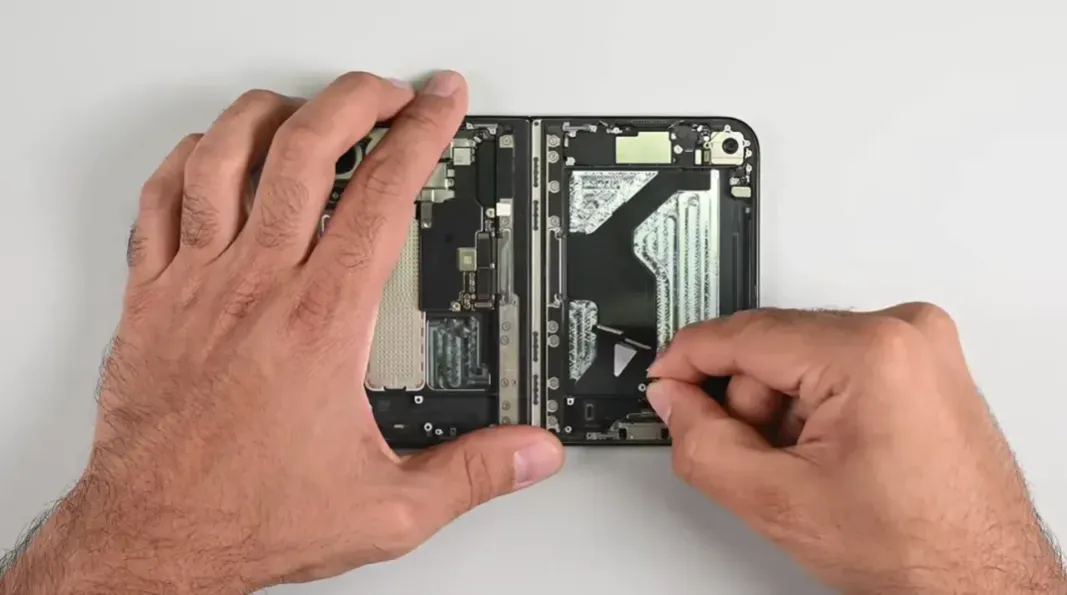
Apple’s first folding iPhone gives repairers easier access to batteries and smaller components, according to iFixit’s October 25, 2026 teardown. The iPhone Duo’s inner screen and hinge still require demanding service work, leaving owners with a more involved repair when those parts are damaged.
The repair-analysis team awarded the Duo its highest foldable repairability rating to date. Its 5/10 score was provisional because it was still waiting for replacement parts when it published the report.
Easier Access Means Fewer Parts at Risk
The Duo’s two battery cells are held with adhesive that releases when electricity is applied. Metal shells around the cells provide additional protection against puncture if mechanical removal becomes necessary.
To replace one of the Duo’s two battery cells, technicians first remove the back glass. Electrical release then lets them separate the cell from the enclosure with less force against the battery.
iFixit removed the Duo’s outer display and the trim around its inner display intact. The outer screen is an entry route for other internal repairs, so preserving it avoids adding a damaged display to the original job. Cameras and charging components also require relatively few other parts to be removed first, reducing the work and opportunities for collateral damage.
Samsung’s Galaxy Z Fold8 presents a harder access problem. In iFixit’s teardown of Samsung’s folding phone, adhesive pull jackets helped release the batteries, but reaching one cell required removing a fragile, strongly glued outer display. The team still bent the cells more than it wanted. The Fold8’s inner-display trim broke apart during removal, whereas the Duo’s survived.
The Folding Screen Still Demands Delicate Work
The inner display and hinge account for iFixit’s biggest repairability deductions. Getting to the hinge requires disturbing the flexible screen and its supports, making contamination or a damaged hinge a substantially different service job from replacing an accessible component.
Replacing the inner display starts with removing the trim and outer display, disconnecting the inner screen and carefully separating its adhesive without damaging nearby cables or the hinge. Reassembly requires clearing old material, replacing adhesive and foam, applying glue and aligning the display and trim.
The glue goes into 21 pockets around the enclosure, and the display must set for one hour before a pressing stage.
A Replaceable Cover Hides the Crease
The screen’s smooth appearance comes partly from its surface. Under a microscope, iFixit found rounded features in the matte, nano-texture cover that scatter reflected light. Removing that cover made the underlying crease visible again.
The cover is a polymer layer above the OLED, the panel that produces the image. Apple supports replacing the cover separately, allowing surface damage to be addressed while retaining the display beneath it. The work requires dedicated fixtures, a roller and precise alignment.
A Possible Source of Screen Stress
iFixit also investigated photographs of damaged screens cited in owners’ reports. The team described people hearing a sound while opening or closing the phone, then seeing lines of damaged pixels. A local electrical connection failure can affect an entire row or column, so a long visible line need not represent an equally long physical crack.
The hinge has to guide several display layers as they slide through the bend. A flexible cable carries power and data between the phone’s two halves, while adjacent supports bear the screen. iFixit combined teardown footage, patents and CT scans of the hinge’s internal structure into a three-dimensional hinge model and compared its geometry with the reported damage locations.
The apparent damage lay near a transition between the cable gap and the central hinge support. In one simulated scenario, a support bar failed to move down far enough as the phone folded. The curved display then contacted the bar, concentrating stress near that location.
The cause of the failures remains unresolved, and the reports provide no representative failure rate.
Powder Reaches the Moving Hinge
In a separate experiment, iFixit exposed the Duo to fluorescent powder, repeatedly folded it and took it apart to trace where particles went. Most powder stopped at adhesive barriers protecting the electronics. Some reached moving hinge parts, and the hinge began to crunch.
The Duo retained less visible powder than the team’s earlier Galaxy Z Fold8 and Google Pixel 11 Pro Fold experiments. Its barriers therefore offered a real improvement in that challenge, even though particles still reached the mechanism that has to move.
iFixit had publicly raised the dust-and-sand concern on September 9, 2026, before publishing its teardown report.
Introducing the duo on a beach is bold for a hinged device. Hopefully Apple has solved the problems other hinged devices have when dust, sand, etc. are present pic.twitter.com/HZYedgTz5H
— iFixit (@iFixit) September 9, 2026
A different experiment by Zack Nelson, who runs the JerryRigEverything testing channel, produced another outcome. In the channel’s reported durability test, introduced dust obstructed the Duo’s hinge enough to prevent full closure. Bending then produced a permanent green line on the inner display; further bending added lines and left the screen unresponsive.
Whether debris contributed to the bending damage remains unknown.
Samsung’s standard Galaxy Z Fold8 had a different reported result: in Nelson’s open, backward-bend test, its body flexed while the inner display remained intact. Its screen withstood that reported stress despite the phone’s difficult repair access.
iFixit still recommends a conventional phone for people who put repairability first.