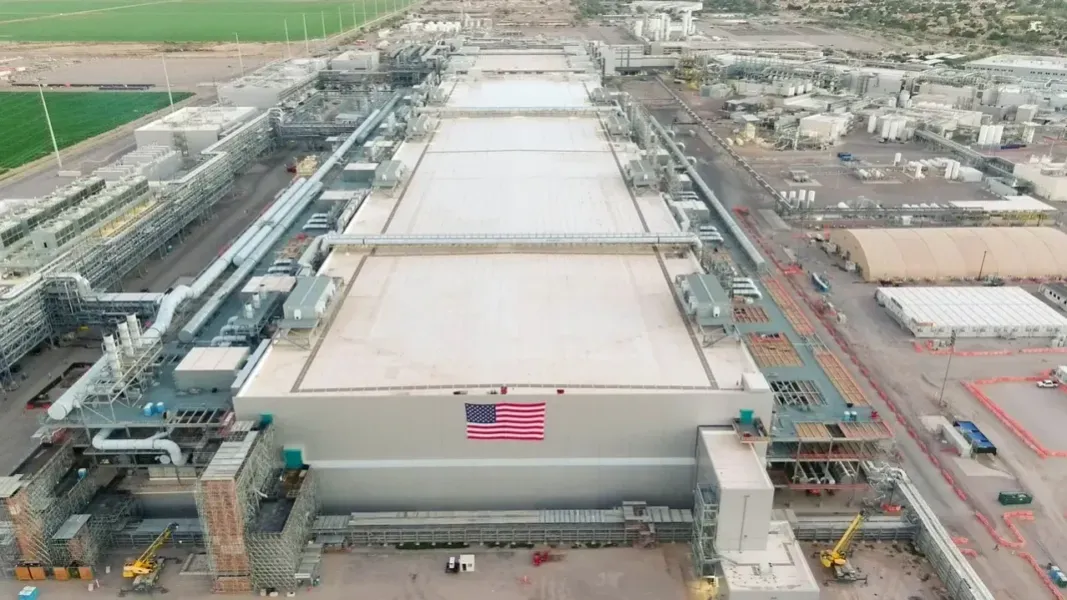
- Factory Expansion: Intel has begun installing tools at Fab 62, a new Arizona chip factory intended to expand its U.S. manufacturing.
- Operations Target: The company expects the factory to begin operations by the end of 2028.
- Tool Spending: Equipping a factory is a major capital commitment under Intel’s policy of tying investment to customer demand.
- Customer Choice: Chip analyst Dan Hutcheson says another manufacturer could give designers more bargaining power over contract chipmaker TSMC.
Intel has started installing chipmaking equipment at Fab 62, a new factory in Chandler, Arizona. Its neighbor Fab 52 was already manufacturing Panther Lake PC processors in October 2025 using Intel’s 18A chipmaking process.
Fab 62 is intended to become the sixth high-volume semiconductor manufacturing facility at Intel’s Ocotillo campus, with operations expected by the end of 2028.
From a Building to a Production Line
In chip lithography, light reproduces a design pattern in a light-sensitive coating on a silicon wafer. Those patterns are used to build the layers of a chip.
At Intel’s Fab 34 in Ireland, the first tool delivered in 2022 was a coating machine called a lithography resist track. It coats wafers before exposure in an extreme ultraviolet scanner.
Chipmakers can build a factory shell and defer purchasing and installing production tools until demand warrants the spending. Equipping the facility is the costliest part of preparation, with individual tools potentially costing hundreds of millions of dollars.
Tools must also be qualified for manufacturing, or verified as ready for production, before they can produce saleable processors. Fab 62’s manufacturing process and wafer capacity remain unspecified in Intel’s update.

Why Intel’s Spending Matters
CEO Lip-Bu Tan tied factory spending to confirmed customer demand in July 2025, after criticizing earlier investment that ran ahead of demand.
Intel’s renewed factory work is an indication of greater confidence in demand under that policy. Intel’s own data-center processors have been seeing increased demand.
Intel uses the 18A process in Arizona to make its own processors. As of October 21, the company had yet to secure a major external customer for that production.
A Second Source for Chip Designers
Mizuho Securities analyst Jordan Klein described intense competition for contract chipmaker TSMC’s production slots. TechInsights analyst Dan Hutcheson explained that a second source could give customers bargaining power over TSMC’s prices.
TSMC had completed construction of its second Arizona factory and started moving in and installing tools by October 15. Intel expects operations at Fab 62 to begin by the end of 2028; TSMC targets volume production at its second Arizona factory in the third quarter of 2027.