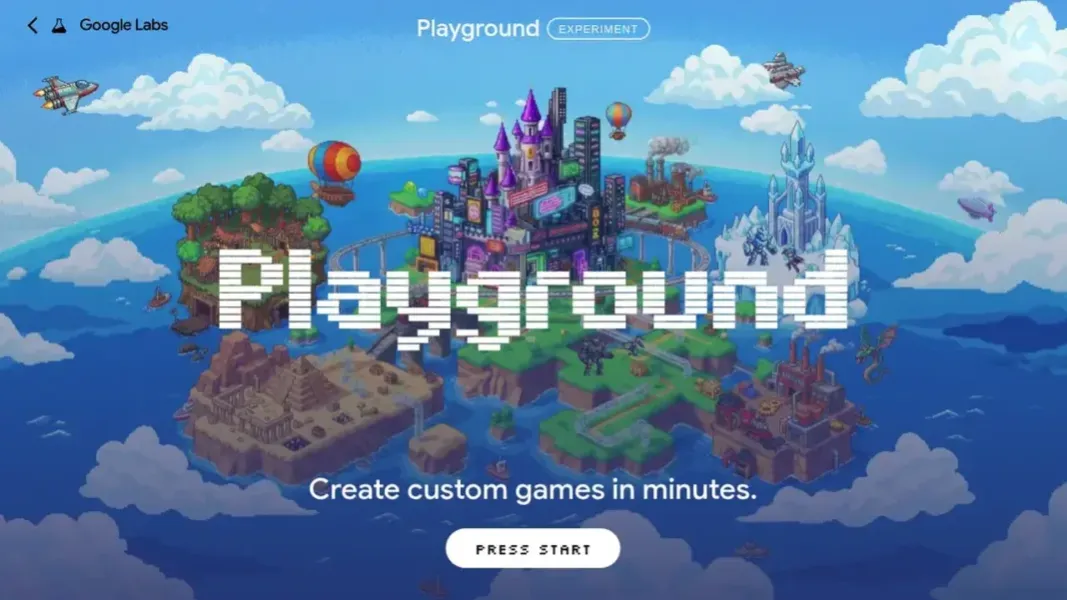
- Game Creation: Google’s Playground lets US adults build browser games with AI prompts, with creation access rolling out by subscription tier.
- Sharing Options: Games can stay creator-only, circulate through links or appear in Playground’s public Explore gallery.
- Source Export: Creators can download a ZIP containing their game’s web code and generated assets.
- Unity Spark: Unity’s planned collaborative game creator is in testing, with a closed beta scheduled later in 2026.
Google has launched Playground, an experimental browser platform that lets people make playable games by describing them and asking for changes. The October 7 rollout covers US users aged 18 and older, with creation access arriving in tiers tied to Google AI subscriptions.
Google and Unity also plan to connect Playground to Unity Spark, a separate game-making environment for people working together with AI assistants. Spark is in testing, with a closed beta scheduled later in 2026.
Prompt, Test and Share
Playground’s creation loop starts with a blank project, a starter prompt or guided support. Creators describe what they want, test the resulting game, then ask for changes to its rules, physics, characters or environment. Coding experience is not required to use that conversational interface.
The creator can choose a genre such as trivia or racing, specify 2D or 3D, and describe the mechanics and visual style. Uploaded images can also become assets matched to the game’s art style.
That workflow differs from the exploration offered by Google’s Project Genie in January. Its users sketched worlds from prompts or images, explored them in sessions limited to 60 seconds and downloaded walkthrough videos. Playground instead lets creators revise game rules and distribute a playable browser game.
Creators control who can reach their game. Drafts and private games are visible only to their creator. An unlisted game can be played by anyone who has its link, while a listed game is public and searchable. Publishing to Explore adds it to a gallery that highlights creations through player ratings and play activity; published games undergo safety screening and can be reported by users.
Playground also offers a source-code ZIP download containing HTML, JavaScript, CSS and generated assets: the web files behind the game. Games can be played on phones and computers, although how well their layouts adapt depends on the creator. Multiplayer is supported in selected genres; platform leaderboards apply to publicly listed single-player games.
Google spokesperson Nia Carter told The Verge that Playground combines the Gemini, Nano Banana and Lyria AI models with a custom system refined through Google’s own games and evaluations.
Spark Adds Collaborative Refinement
Unity Spark is designed to bring Unity’s game engine and artist-created assets into a collaborative browser editor. Several people will be able to work on the same project, each using their own AI assistant, Unity CEO Matt Bromberg told Game File.
In a demonstration given to GamesIndustry.biz, a request for a character’s cape returned options from the Unity Asset Store. A sunrise request produced background choices. The assistant can also suggest creating a tool for switching between lighting presets.
Bromberg argues that polished game-making draws on many crafts, including art, design and programming. His stated aim is to help people with creative ideas build something “worth working on, polishing, and sharing” and keep refining their ideas with artist-made assets.
Spark’s planned editor runs in desktop browsers, while its games can be played in desktop and mobile browsers and published to Playground. At launch, Spark projects will not be downloadable, exportable to the full desktop Unity engine or available to sell, according to GamesIndustry.biz.
Different Routes to Players
Meta is testing a related approach with Horizon Create, a phone app, and Horizon Studio, a browser tool with more detailed editing controls. It has an early-access waitlist and plans to make published games playable and recommendable inside Facebook and Instagram feeds, alongside Horizon. That would put the route to players inside social feeds, rather than just a dedicated game gallery or shared link.
Android Central writer Nicholas Sutrich tried a controlled demonstration at Meta Connect with five people creating and playing in one world. He could resize and reposition objects directly, as well as ask Meta AI to alter them.
Roblox’s Build already provides prompt-based game creation within its app. Its September 11 alpha expansion added Serbia and Singapore to New Zealand, along with desktop access, an asset library and more iterative control. Roblox reported approximately 9,000 published Build games using data through September 1. Its connection to the deeper Roblox Studio editor remains under development; browser play was scheduled for the end of 2026.
Creation Is Metered
Browsing and playing Playground’s catalogue is free. Game generation uses weekly token allowances, a budget for AI creation work, with higher limits for Google One subscribers depending on their plan. Creation access is rolling out by subscription tier, so immediate admission for every free account remains uncertain.
Spark has a separate proposed payment model: a free allowance of credits tied to AI tokens, followed by purchased credits. The full payment terms, including the allowance and rates, remain unfinished.