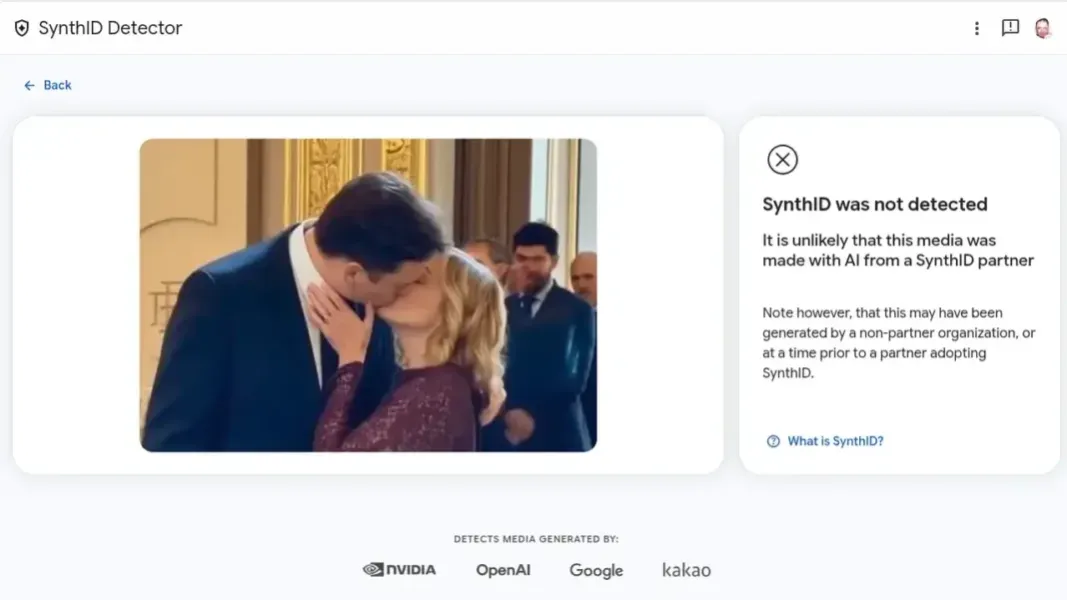
- Public Checks: Google’s SynthID website lets anyone check images, videos and audio for invisible watermarks identifying supported AI-generated or edited media.
- Partner Coverage: It recognizes supported Google, OpenAI, NVIDIA and Kakao watermarks, with Apple detection coming later.
- Missing Marks: An absent watermark leaves a file’s origin unresolved: some AI systems never insert one, and changes can weaken existing marks.
- Daily Limit: Users must sign in and get approximately ten checks a day, according to Ars Technica.
Google has opened its SynthID AI watermark checker to everyone, giving people assessing shared images, videos and audio one website for checking supported media from several AI producers. The service recognizes participating partners’ watermarks alongside Google’s, widening checks beyond the Google-generated content that Google’s Gemini AI app recognizes through its watermark verification.
The standalone detector is available globally in English as of October 7. It follows the restricted SynthID Detector rollout in May 2025, when early testers gained access and journalists, researchers and developers could join a waitlist. The public site supports watermarks from Google, OpenAI, NVIDIA and Kakao; detection of Apple-generated media is forthcoming, with no date specified.
Gemini recognizes Google-origin SynthID watermarks, while also inspecting Content Credentials, records of a file’s origin and editing history. OpenAI’s verifier checks its own provenance signals in images and audio. The new SynthID portal brings participating makers’ distinct watermarks into one destination, reducing the need to choose a maker-specific detector before checking a file.
The service is free and accepts Google, OpenAI or Apple accounts for sign-in. Ars Technica reports a daily quota of approximately ten image, video and audio checks per user. Google engineers told the publication that limiting checks helps prevent people from using repeated results to develop watermark-removal tools.
What a Watermark Result Tells You
SynthID, developed by Google DeepMind, embeds an imperceptible signal directly into generated content. Image and video watermarks reside in the pixels; audio watermarks reside in the waveform. A participating generator supplies the signal, and a matching detector looks for it in an uploaded copy. This gives the person checking a shared file evidence of AI involvement.
A detected watermark can concern either generation or editing. The public website does not distinguish entirely AI-created media from content merely edited with AI. For images, it also lacks the older internal tool’s highlighting of watermarked regions.
An absent mark leaves more possibilities open. A file may come from a producer that uses another labeling system, or a model that inserts no watermark.
Google puts SynthID’s cumulative deployment at more than 180 billion watermarked images and videos, plus audio totaling 240,000 years. Separately, the company says its built-in verification features in Search, Gemini and Chrome handle more than one million requests daily.
Watermarks Can Survive Sharing, Within Limits
In a July test by Ars Technica, reporter Ryan Whitwam checked two images from Google’s Nano Banana Pro image model through Gemini: one fully generated, the other a photograph of his dog edited to make it partly dragon. Both retained detectable SynthID marks after 300 successive rounds of randomized compression and resizing. Cropping those heavily degraded images by 20 percent then made the marks undetectable.
Coverage also depends on who makes the file. Adam Rose, a fellow and senior advisor at the provenance-focused Starling Lab, told Ars that people can run their own models on their own computers. Those independently generated outputs can bypass the cooperating providers that insert watermarks in the first place.
Signed History Adds Context a Watermark Cannot Supply
Content Credentials, defined by the C2PA standard, offer a complementary form of provenance. A creation or editing tool records information about a file’s origin, modifications and use of AI, then digitally signs that record. A compatible reader can check who signed it and whether the record and its connection to the media remain intact. When the signer is trusted, this gives reviewers a documented history to assess alongside the content.
A watermark can preserve an AI-origin signal within the media; a credential can describe how it was made or changed. OpenAI combines C2PA metadata and SynthID in its verifier, and explains that the embedded watermark can preserve a signal when metadata is lost. The C2PA standard also supports recovering remotely stored credentials through watermark or fingerprint links after embedded records are removed.
Whether the depicted scene or claim is accurate still requires judgment beyond the file’s signed record.