- Model Launch: Anthropic released Claude Sonnet 5.5, an AI model for coding that it says generates text faster and costs less on some tasks.
- Token Prices: Sonnet 5.5 keeps Sonnet 5’s developer rates: $2 per million text units supplied and $10 per million generated.
- Task Costs: Anthropic claims up to 30% lower costs in its tests; Artificial Analysis measured higher task costs than Sonnet 5 at maximum effort.
- Cyber Access: Filters may reject benign requests; some cyber blocks trigger Sonnet 5 fallback in Anthropic apps, while API developers must opt in.
Anthropic has released Claude Sonnet 5.5, an AI model for coding and multistep work, and says some developer tasks cost less than on Sonnet 5 at unchanged rates for the text it processes and generates. A task may involve several model requests and tool calls, so its bill can change with the amount of text consumed even when the rate does not.
Why the Same Token Rate Can Produce a Smaller Bill
The standard API rate is $2 for every million input tokens and $10 for every million output tokens, the same as Sonnet 5. Tokens are the pieces of text the service counts for billing: an application’s instructions and other context go in, while answers and internal reasoning add output tokens.
Sonnet 5 already supported multistep agents that plan, use browsers or terminals, and return to a task after a tool responds. Each step can add model requests and text to the bill. Anthropic says Sonnet 5.5 generally uses fewer tokens and needs fewer tool calls on some tasks. Its up-to-30% lower cost per task is a company test result against Sonnet 5, with no published task mix or distribution that would turn it into a general customer saving.
Sonnet 5.5 uses adaptive reasoning by default, with Medium effort in Claude apps and Claude Code and High effort through the Claude Platform API. A lower between_tools effort setting can reduce how much the model reasons before using a tool, although quality can change with the setting. Reasoning tokens are billed as output. Anthropic separately says Sonnet 5.5 generates output more than 30% faster than Sonnet 5.
A Coding Gain Under Defined Test Conditions
In Anthropic’s Terminal-Bench 4.0 comparison, Sonnet 5.5 scored 70.6% against a 10.3% Sonnet 5 figure. The benchmark owner calls this a task-resolution rate: its checks judge whether attempts solve command-line tasks.
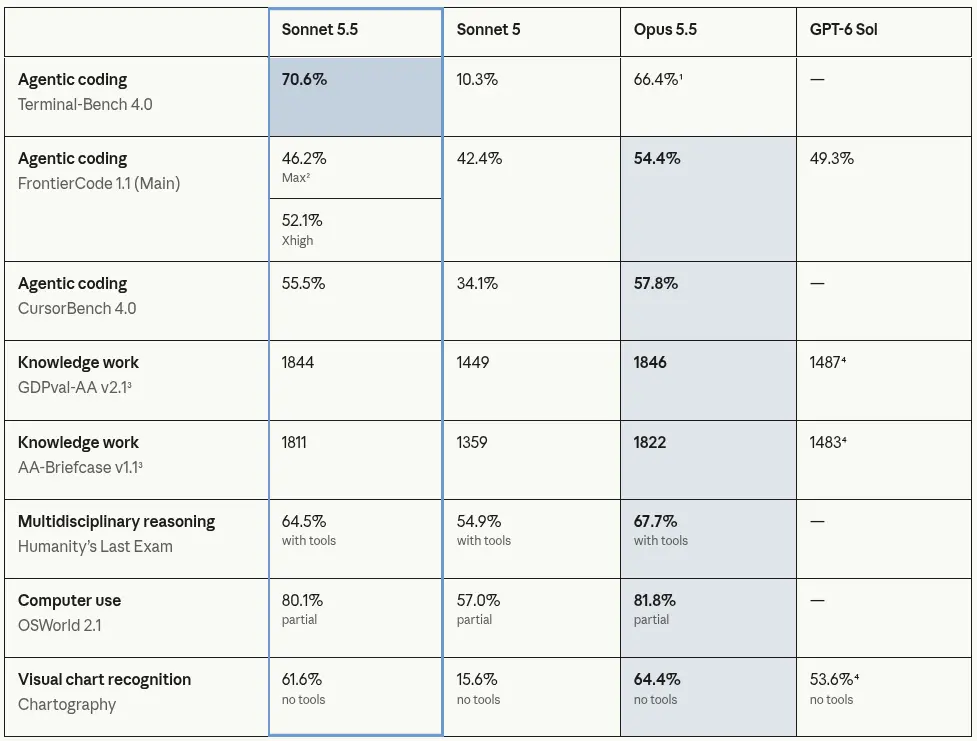
Anthropic’s system card says the new model ran through its Claude Code assistant without internet access at maximum effort, with five trials on each of 66 tasks. The company does not state Sonnet 5’s effort setting for the launch-table figure.

Access and Cybersecurity Boundaries
The release makes Sonnet 5.5 available in Anthropic’s Claude products and developer platform and says it is offered through AWS, Google Cloud and Azure. Google Cloud lists a September 28 release date and general availability through US, European and global endpoints.
The new model has stronger cybersecurity capabilities than Sonnet 5, and Anthropic has tightened safeguards that Sonnet 5 already had. Its system card says ordinary source-code vulnerability discovery remains permitted, while compiled-binary vulnerability discovery is blocked at general access. Some benign security requests may be refused. For some blocked cyber requests, Anthropic’s apps fall back to Sonnet 5; API developers must enable automatic fallback. That can change which model actually answers a task, and wider access for verified defensive researchers remains a future plan.
Artificial Analysis Finds a Different Cost per Task
Artificial Analysis tested the new model at maximum effort with its default safety fallback. On its Intelligence Index, which combines ten evaluations, Sonnet 5.5 scored 56 against Sonnet 5’s 38. Its weighted cost per benchmark task was $7.60, however, versus $5.09 for Sonnet 5. Higher-tier Opus 5.5 scored 58 at $5.98 under its listed maximum-effort setting, a slightly higher Index score and lower measured task cost than Sonnet 5.5 in the same suite.

Artificial Analysis counts input, cached, reasoning and answer tokens in that benchmark cost. Its task mix and maximum-effort setting differ from Anthropic’s undisclosed sample, and its figure is cost per benchmark task rather than cost per successful completion. On that independent workload, Sonnet 5.5 scored higher than its predecessor yet cost more per task than either Sonnet 5 or Opus 5.5.