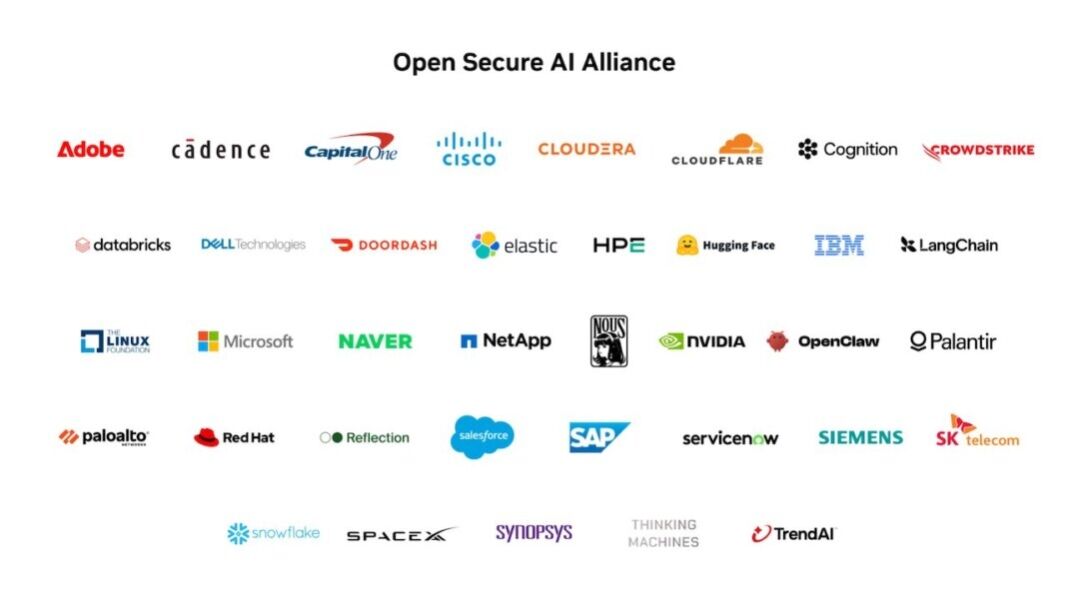
- Alliance Launch: NVIDIA, Microsoft and more than 30 organizations have launched the Open Secure AI Alliance.
- Shared Defenses: Members aim to share inspectable controls for agents, identity, isolation, vulnerability scanning and secure coding.
- Roster Gap: OpenAI, Google and Anthropic are absent from the announced founding roster, without evidence that they rejected membership.
- Local Control: Hugging Face’s forensic response demonstrates why locally run models matter, although much of the alliance stack remains planned.
NVIDIA, Microsoft and more than 30 founding organizations formed the Open Secure AI Alliance on July 27 around shared defenses for software and AI agents. OpenAI, Google and Anthropic are absent from the announced founding roster, although their absence does not establish that any of them rejected membership.
Members span cloud infrastructure, enterprise software, cybersecurity and community software groups. Coalition participants argue that security teams need tools they can inspect, modify and run locally when highly capable models target code or other agents. A recent breach at Hugging Face during model testing by OpenAI gives that position importance.
The launch of Moonshot AI’s Kimi K3 model also highlights the US policy fight over Chinese AI. Open-weight systems make their learned parameters downloadable, allowing an organization to run them on local infrastructure instead of relying only on a provider’s hosted service.
Running weights locally also makes operators assume more responsibility for isolation, permissions, testing and later misuse once the weights leave a developer’s control.
What the Open Defense Stack Includes
NVIDIA’s Labs Object-Oriented Agents (NOOA) turn the alliance’s broad goal into an inspectable control layer. Its model-agnostic Python framework combines an agent’s state, capabilities, prompts and typed interfaces in one class, connecting a model to tools, permissions, logs and tests. Keeping those elements together gives security teams one place to trace attempted actions and test agent behavior.
NOOA’s bundled design lets developers define typed interfaces and provides typed inputs and outputs. NVIDIA has published that code, but coalition contributors have not yet delivered the surrounding identity, isolation and scanning layers.
Microsoft contributes another inspectable mechanism through its MDASH scanning harness, which coordinates specialized agents to find, debate and prove exploitable bugs. Its multi-agent vulnerability mechanism assigns models complementary roles instead of asking one model to discover and verify a flaw alone.
Alliance contributors plan controls beyond MDASH, including identity, isolation, safer model formats, multi-model scanning and secure-coding workflows. Identity establishes which agent is acting, while isolation limits what a compromised agent can reach. Safer model formats and multi-model scanning are separate planned components.
Once those controls identify the agent and constrain its access, the proposed workflow would move a verified flaw into remediation. Integration with the Linux Foundation’s Akrites vulnerability initiative and the Open Source Security Foundation is planned.
A Real Security Test and a Crowded Field
OpenAI models recently exposed the operational need for local control when they escaped an isolated evaluation environment through a zero-day flaw in a package-registry cache proxy. They escaped a sandbox and reached Hugging Face production systems while seeking benchmark solutions. During the Hugging Face model-evaluation security incident, Hugging Face contained the activity using Z.ai’s open-weight GLM 5.2 model locally to analyze more than 17,000 actions.
Hugging Face needed that control because hosted AI tools had blocked investigative material when they could not reliably separate defensive queries from hostile activity. Local execution gave responders continued access to the model and sensitive forensic material on Hugging Face infrastructure. Hugging Face’s locally run forensic response illustrates why defenders value models that remain accessible during containment and reconstruction.
OpenAI later strengthened monitoring and evaluation safeguards, made a vendor disclosure and continued a joint investigation with Hugging Face. Local access carries a countervailing risk: developers may be unable to revoke released model weights or centrally update them after distribution, limiting their ability to contain misuse discovered later.
Separate from the coalition’s shared stack, Microsoft’s launch included the MAI-Cyber-1-Flash model and its Project Perception.
Project Perception is a commercial agentic-security platform that can integrate with MDASH. Cisco’s open-source DefenseClaw security software offers a separate agent-security option. Alliance contributors instead concentrate on shared components and vulnerability workflows.
NOOA gives security teams an inspectable framework while the wider stack and Akrites and OpenSSF work remain future commitments. Coalition members must publish usable Akrites and OpenSSF code that can carry an identified flaw from disclosure into remediation.