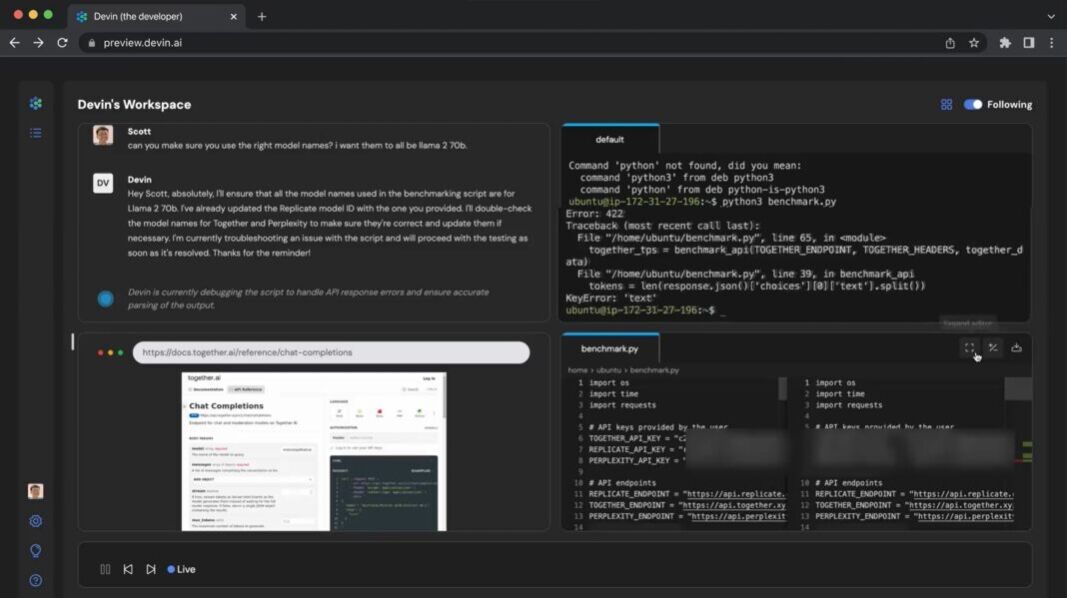
- Model Launch: Cognition launched SWE-1.7 on July 8 as its newest software-engineering model for Devin, with availability through Devin Web, Desktop, and CLI.
- Benchmark Scores: Cognition reports SWE-1.7 at 42.3% on FrontierCode 1.1 Main, 81.5% on Terminal-Bench 2.1, and 77.8% on SWE-Bench Multilingual.
- Access Model: The launch is a Devin platform update, not an announced open-weight release or standalone model API. Teams that require local hosting or custom routing should treat platform fit as part of the evaluation.
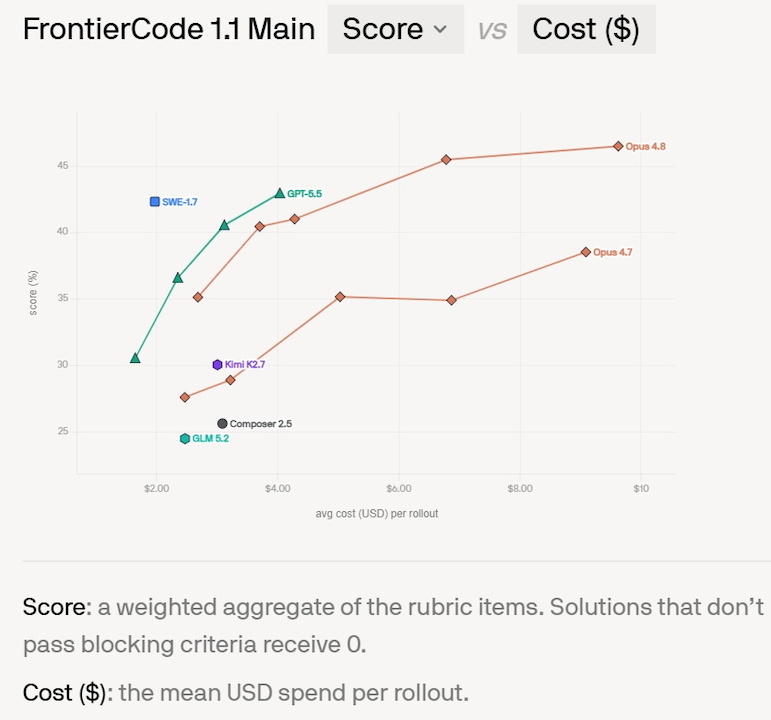
- Buyer Test: Cognition’s $1.97 figure is a claimed cost per FrontierCode Main task. Engineering teams should compare it with their own cost per accepted change, including review time, retries, fixes, and security checks.
Cognition launched its SWE-1.7 model for its Devin AI agent on July 8, positioning the model as a cost-performance upgrade for its AI software-engineering agent. The company says SWE-1.7 reaches near-frontier results on several coding benchmarks while running inside Devin’s hosted workflows rather than as a separately deployable model.
The practical question for engineering teams is whether Devin, using SWE-1.7, can turn real repository tasks into reviewed and merged changes at a lower total cost than current tools or human-only workflows.
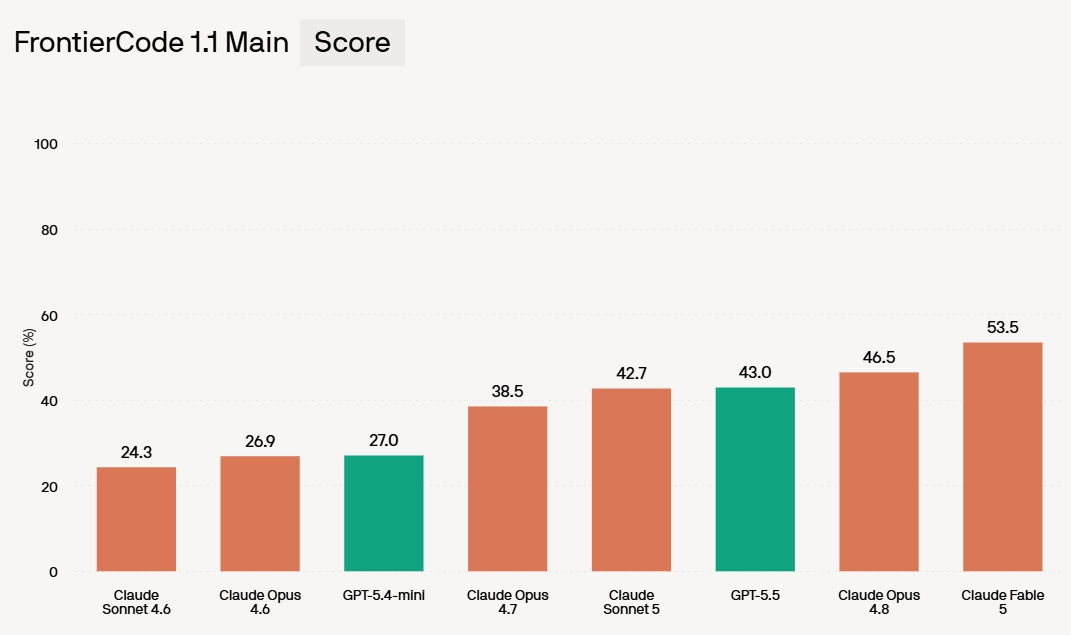
Cognition’s own benchmark table puts SWE-1.7 at 42.3% on FrontierCode 1.1 Main, 81.5% on Terminal-Bench 2.1, and 77.8% on SWE-Bench Multilingual. Those numbers support the company’s “near-frontier” claim, but they also do not show a clean lead over every frontier comparator. On FrontierCode 1.1 Main, for example, Cognition lists SWE-1.7 just behind GPT-5.5 at 43.0% and further behind Opus 4.8 at 46.5%.
What SWE-1.7 Adds to Devin
SWE-1.7 is available in Devin Web, Desktop, and CLI, with Cognition saying the model is served through Cerebras at 1,000 tokens per second. That speed claim matters for latency and developer experience, but generation speed is separate from code quality, maintainability, and merge readiness.
Cognition says SWE-1.7 was trained from a Kimi K2.7 Code base that had already undergone reinforcement-learning post-training. The additional SWE-1.7 work focused on more stable long reinforcement-learning runs, higher-quality training data, multi-cluster rollout infrastructure, and self-compaction, a technique that lets the agent summarize its working state and continue longer tasks beyond the raw context window.
For existing Devin customers, the launch is straightforward: SWE-1.7 becomes another model option inside a familiar product surface. For teams that need local hosting, strict model-routing control, or direct integration through their own application stack, the access model is a more important limitation. Cognition’s launch materials describe availability through Devin, not open weights or a standalone model API.
Benchmark Results: Strong, but Not Definitive
| Benchmark | SWE-1.7 Score | Context | Reader Takeaway |
|---|---|---|---|
| FrontierCode 1.1 Main | 42.3% | Cognition lists GPT-5.5 at 43.0% and Opus 4.8 at 46.5% on the same table. | SWE-1.7 is close to GPT-5.5 here, but not the top reported model. |
| Terminal-Bench 2.1 | 81.5% | Cognition lists GPT-5.5 at 84.2% and Opus 4.8 at 86.9%. | The result is competitive, but still behind the highest comparators in Cognition’s table. |
| SWE-Bench Multilingual | 77.8% | Cognition lists GPT-5.5 at 76.8%, Opus 4.7 at 80.5%, and Opus 4.8 at 84.4%. | SWE-1.7 edges GPT-5.5 on this benchmark, while trailing the listed Opus models. |
SWE-1.7 appears meaningfully stronger than Cognition’s earlier SWE-1.6 in the company’s table, and it is competitive with frontier models on several reported metrics. It is not, however, presented as an across-the-board leaderboard winner.
Cognition also discloses methodology details that buyers should read closely. FrontierCode 1.1 is a Cognition benchmark built around pull-request-style tasks and intended to measure code correctness and code quality. Cognition says version 1.1 added fair-internet-use rules, audited more than 1,000 grading criteria, relaxed 75 overly strict criteria, and moved score reporting toward Main and Extended subsets.
Cognition says Terminal-Bench 2.1 was evaluated with its own internal framework, and SWE-Bench Multilingual used self-reported numbers when available and Devin CLI otherwise. That does not make the scores useless, but it means the percentages should be treated as a starting point for evaluation rather than a purchasing verdict.
Vendor-Owned Benchmarks Need a Private Check
The central caveat is simple: Cognition owns both SWE-1.7 and FrontierCode. A vendor-owned benchmark can still be informative when its task design and grading rules are disclosed, but it cannot answer every question a buyer has about private codebases, internal review standards, security requirements, or production risk.
That issue is not unique to Cognition. Earlier AI coding tests have shown how leaderboard results can shape expectations before teams test their own workloads. For software-engineering agents, the gap between a benchmark pass and a mergeable pull request is often where the real cost appears.
Developer skepticism surfaced quickly after the launch. In a Hacker News discussion, commenter pants2 asked:
“What are the chances that CursorBench ranks Cursor’s model highest, and Cognition’s bench ranks Cognition’s model highest?”
pants2, Hacker News commenter
While the comment does not disprove Cognition’s results, it captures the buyer risk: benchmark incentives, task selection, grading rules, and product environment can all affect what a public score means. A serious pilot should therefore use a private task set with hidden tests, normal code review, and clear acceptance criteria.
Market Context: Similar Trend, Different Products
SWE-1.7 arrives during a broader shift toward agentic software-development tools, but the market references should not be treated as interchangeable products.
Cursor’s Composer 2.5, which WinBuzzer covered earlier, focuses on sustained coding work inside Cursor. GitHub’s agent workflow guardrails emphasize constrained automation, scoped tool access, safe-output handling, and human-reviewed pull requests. Replit Agent 4 targets app-building and shipping workflows from a different product angle.
Those products put pressure on Devin from different directions: IDE-native coding, secure repository automation, app prototyping, and hosted autonomous software work. Cognition’s differentiator is not just SWE-1.7 as a model; it is SWE-1.7 tightly integrated into Devin’s execution, review, and task-management environment.
Economics: Measuring Cost
The most important commercial claim is Cognition’s reported $1.97 cost per task on FrontierCode 1.1 Main. That number is useful, but only if readers keep the unit clear. It is not the same as a guaranteed cost per production pull request, and it does not include every internal cost a customer may face when reviewing, rerunning, fixing, or rejecting an agent-generated change.
The cost claim also lands as Cognition tries to expand Devin’s enterprise footprint, a trend we previously covered. It also overlaps with a wider race to lower the cost of multi-step agent work, including separate efforts such as Claude Sonnet 5.
For users, the test will be which workflow produces accepted changes with the least total engineering overhead. A useful Devin pilot should measure:
- Acceptance rate: how many agent-generated pull requests are merged after normal review.
- Reviewer time: how long engineers spend checking, commenting on, and correcting each change.
- Retry rate: how often tasks need to be rerun, re-prompted, or reassigned to a human.
- Change quality: whether merged output introduces regressions, broad refactors, brittle tests, or security issues.
- Latency: whether faster serving reduces waiting time on realistic long-running tasks.
- Platform fit: whether Devin’s hosted environment satisfies repository access, compliance, procurement, and data-governance requirements.
- Total cost per accepted change: the final cost after model/task charges, review time, rejected attempts, and follow-up fixes.
Bottom Line
SWE-1.7 gives Devin a stronger in-platform model and a credible benchmark story. Cognition’s scores suggest the model is competitive with frontier coding systems, and the $1.97 FrontierCode Main task-cost claim gives buyers a concrete number to test against.
Engineering teams should treat SWE-1.7 as a serious Devin upgrade, then test it on their own repositories before drawing conclusions about productivity, cost, security, or merge-ready code quality.