- Gap Map Launch: Current AI has introduced Open Source AI Gap Map v0.1 as a living map of open source artificial intelligence projects.
- Scored Subset: The map surveys more than 24,626 projects but details 421 products and leaves 24,400 artifacts unscored.
- Evidence Rules: Discovery and scoring remain separate, so entries need research and citations before they receive openness, adoption, and capability grades.
- Reusable Data: The public, MIT-licensed repository gives researchers source data, CSV access, and contribution rules for checking future releases.
Current AI, a nonprofit public-interest AI project, has introduced the Open Source AI Gap Map v0.1 on July 1 as a living map of open source AI projects. Gap Map is a dataset and measurement layer, not a new model or a closed-versus-open leaderboard.
The AI Gap Map give researchers, builders, and policymakers a comparison tool to evaluate capabilities of open-source AI models and tools. Gap Map surveys more than 24,626 projects and details 421 products and 24,400 unscored artifacts, leaving much of the long tail as candidates until research and citations turn them into scored entries.
Founded at the AI Action Summit in Paris in February 2025, Current AI brings together governments, philanthropists, researchers, grassroots builders, and industry leaders around public-interest AI. More than $400 million has been committed toward a five-year mobilization target of $2.5 billion, giving the map institutional support beyond a volunteer catalog.
What Gap Map Measures
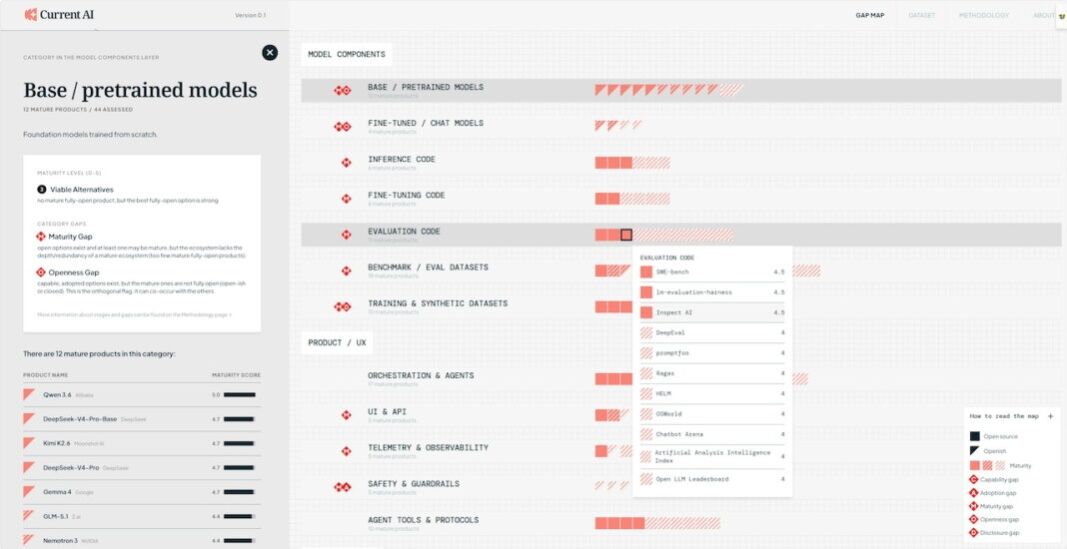
Inside the map, open source AI becomes a stack of components needed to build and run AI systems with inspectable or reusable parts. Gap Map v0.1 details 421 products in depth. The methodology covers software, model, dataset, and hardware counts: 266 software tools and libraries, 85 models, 50 datasets, and 20 hardware projects from 228 organizations.
The first release organizes that scored subset into 14 categories across model components, product and user experience, and infrastructure. Gap Map separates discovery from scoring: discovery identifies candidate products and artifacts, while scoring enriches a curated subset. Official methodology begins with approximately 24,821 candidate products, including 15,375 GitHub repositories, 6,428 models and datasets, and 2,823 package entries.
Every scored product receives openness, adoption, and capability grades, with openness functioning as a grade for how available and transparent the model or component is.
Scored entries must be backed by evidence instead of estimates. Each scored value records supporting evidence, and the scored set includes 1,606 primary citations across 275 distinct source domains. Products that cannot be verified against primary evidence stay outside the scored set.
Why the Dataset Is Reusable
Its public, MIT-licensed repository uses a permissive open source license that generally allows reuse with attribution. Curated YAML data sits alongside notebooks, schemas, and scripts, giving outside researchers a way to inspect the inputs behind the published map rather than relying only on the visual interface.
Builders can also use a spreadsheet-style comma-separated values file covering 16,185 GitHub repositories, and the data can be explored through Datasette Lite, a browser-based CSV viewer. Contribution rules require every score to cite a primary source and block hand edits to generated files, making evidence quality part of the workflow rather than a note added after publication. Repository access turns Gap Map into a reusable data source rather than a static web page.
Where Gap Map Fits in AI Measurement
Gap Map focuses on what is needed to build a fully open source AI system and does not compare closed and open AI ecosystems. Open source AI was already large enough to strain simple cataloging in 2025, when AI activity on Hugging Face grew with 13 million users, more than 2 million public models, and more than 500,000 public datasets.
Stanford HAI’s AI Index tracks and visualizes AI data for policymakers, researchers, executives, journalists, and the public. Artificial Analysis offers independent leaderboards for models, agents, media, hardware, and providers, including openness evaluations. Adjacent resources measure broad AI activity or benchmark performance; The AI Gap Map’s narrower job is to show which open source AI building blocks have enough evidence to be scored.