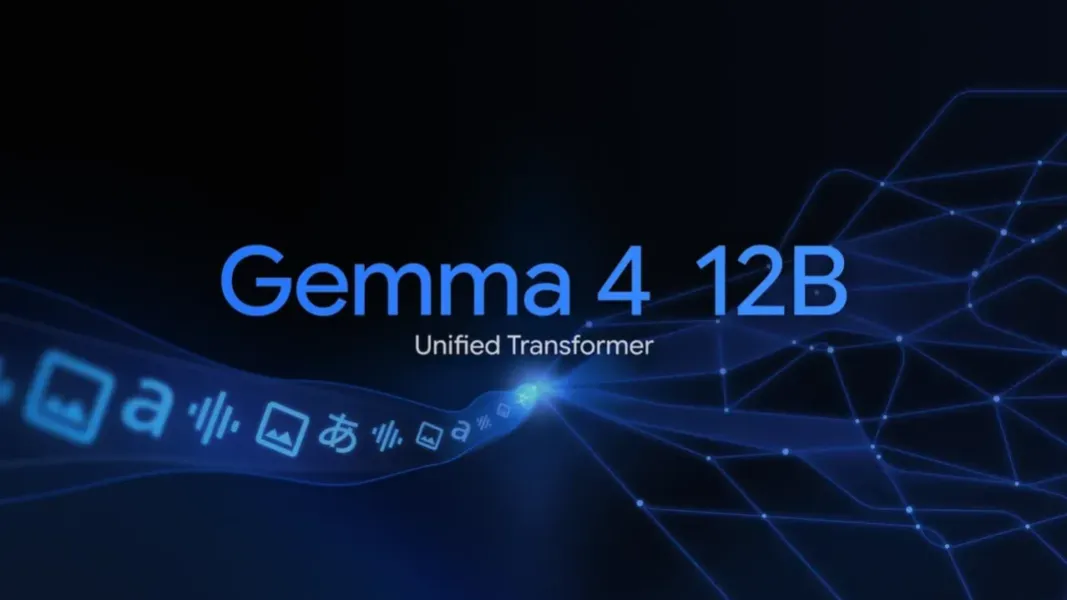
- Model Launch: Google this week released Gemma 4 12B Unified for local agent work on laptops.
- Laptop Threshold: Gemma 4 12B can run with 16GB of VRAM or shared CPU/GPU memory.
- Architecture: The model routes audio and image inputs into the language-model backbone.
- Validation Gap: Independent laptop benchmarks still need to test latency, memory use, and multimodal accuracy.
Google has released Gemma 4 12B Unified for local agent work on laptops. The mid-sized multimodal AI model targets workflows that combine speech, screenshots, code, and tool calls without sending every request to cloud infrastructure.
Hardware access is the clearest stake for developers. Google positions the 12B model for consumer-laptop use rather than dedicated workstations. The historical Gemma 4 family has already established a diverse open-model line, and Google says Gemma downloads have now passed 150 million.
AI based laptop workloads will reveal whether mixed audio, image, code, and tool sessions hold up outside Google’s launch material for Gemma 4 12B Unified.
Encoder-Free Architecture Targets Local Agents
Gemma 4 12B uses a unified encoder-free architecture that sends image and audio inputs into the language-model backbone rather than through separate multimodal encoders. In plain terms, fewer front-end components process different media before the language model reasons over them.
Gemma 4 12B can run locally with 16GB of VRAM or shared CPU/GPU memory. Extra encoders can add memory pressure and delay on laptop-class hardware. A local assistant that listens to speech, reads a screenshot, writes code, and calls a tool needs those inputs to fit inside the same constrained device budget.
Raw 16 kHz audio is cut into 40 ms frames and projected into the language-model input space. A 35-million-parameter vision embedder replaces the 27 vision transformer layers used in other medium-sized Gemma 4 models.
Local serving turns the architecture into a developer workflow. Gemma 4 12B can run through LiteRT-LM local serving as an OpenAI-compatible API server for Continue, Aider, OpenClaw, Hermes, and OpenCode, letting existing coding assistants test the model without a separate hosted demo.
Google also pairs the launch with macOS desktop app support through Google AI Edge Gallery and Google AI Edge Eloquent. On-device agent tests will need to show whether one laptop can sustain voice input, screenshot reasoning, code edits, and tool calls without exhausting shared CPU and GPU memory.

Gemma 4 Expands Its Local Lineup
Gemma 4 12B sits between Google’s edge-friendly E4B option and its 26B Mixture of Experts model. The Gemma 4 family arrived in March and latency-focused Multi-Token Prediction (MTP) variants followed in April, covering E2B, E4B, 31B, and 26B A4B sizes.
Gemma 4 as an open-model family derived from Gemini 3 research, with 12B, 26B, and 31B sizes for personal-computer-class reasoning, coding assistants, and agentic workflows. Release data also lists text, audio, and image input with a context window of up to 256K tokens, tying the 12B model to long-context local work rather than short prompt demos alone.
Gemma 3n previously brought multimodal capabilities directly to consumer devices, and Gemma 4 12B raises that on-device ambition with a larger model and direct audio input.
Multi-Token Prediction adds another latency lever. Drafter components predict upcoming tokens so the main model can verify more than one token at a time, which can reduce generation delay when the draft path is accurate enough.
Nvidia’s Nemotron 3 Nano Omni, Z.ai’s GLM-4.6V, and OpenAI’s gpt-oss point to the same open-weight or local-capable multimodal audience. Meaningful comparisons will require shared prompts, tools, and laptop configurations, not only product specifications.
What Developers Should Watch Next
Developers can use weights and runtimes through Hugging Face, Kaggle, Ollama, LM Studio, Google AI Edge Gallery, and Docker to compare the model with smaller Gemma variants or larger multimodal alternatives.
Local execution could reduce reliance on cloud inference for edge AI applications only if users see practical latency, memory use, and multimodal accuracy on the laptop hardware Google is targeting. Benchmarks should track prompts, peak memory, audio-image accuracy, and tool-call reliability rather than a single headline score.