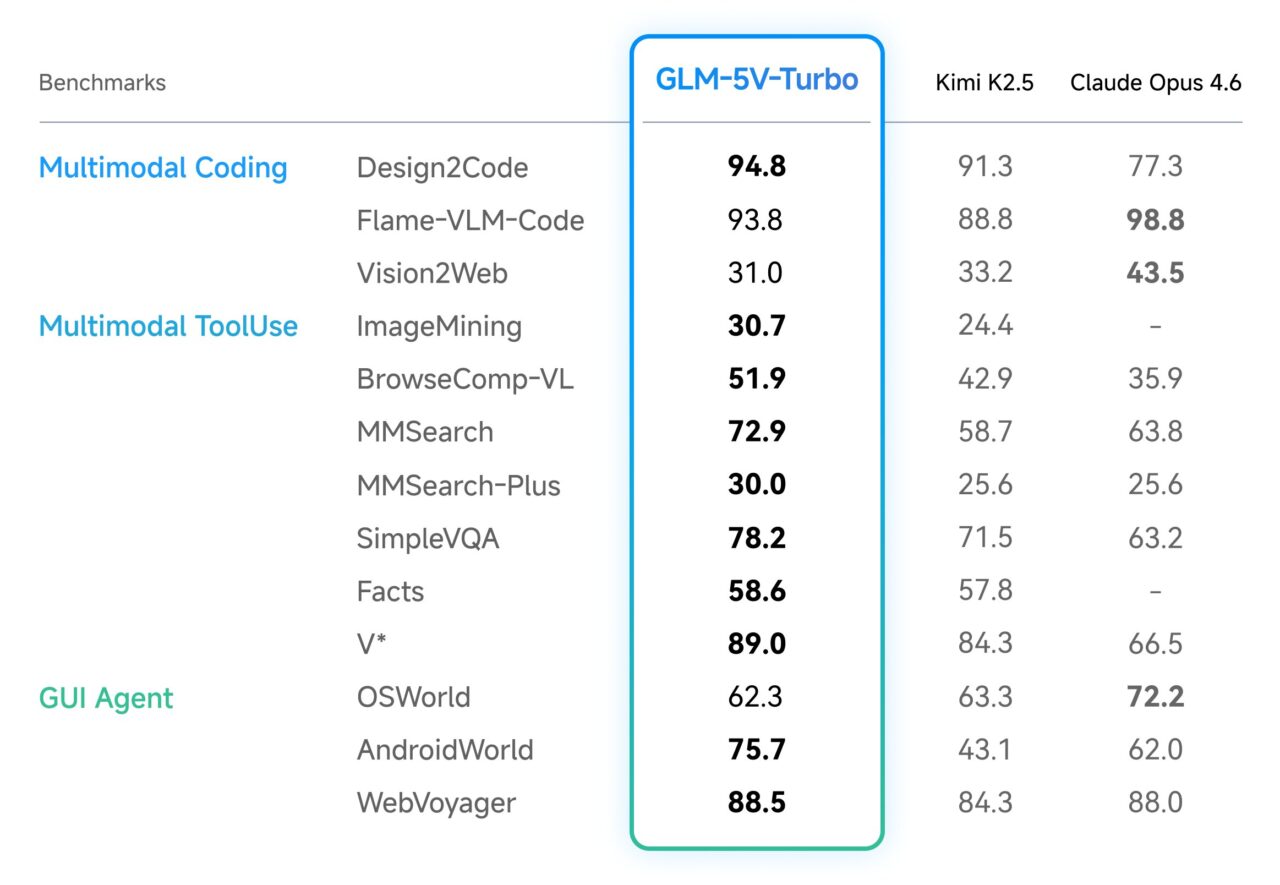
- New Model: Zhipu AI (Z.ai) released GLM-5V-Turbo, a multimodal model combining native vision understanding with code generation for agentic workflows.
- Benchmark Performance: GLM-5 outperforms Claude Opus 4.5 on agentic browsing benchmarks like BrowseComp while trailing by 3.1 points on SWE-bench coding tasks.
- Technical Scale: The model scales to 744 billion parameters in a Mixture-of-Experts architecture with 40 billion active per token, trained on 28.5 trillion tokens.
- Market Context: The release arrives amid a wave of competitive Chinese AI models as Chinese token share surpassed U.S. models on OpenRouter in early February.
Zhipu AI is closing the gap with Western frontier models. On April 1, the Tsinghua University spinoff released GLM-5V-Turbo, a multimodal model combining native vision understanding with code generation that targets agentic software engineering workflows. It outperforms Claude Opus 4.5 on agentic browsing benchmarks while trailing narrowly on pure coding tasks.
GLM-5V-Turbo builds on GLM-5, which scales to 744B parameters in a Mixture-of-Experts architecture with 40 billion active per token, trained on 28.5 trillion tokens. By natively fusing visual perception with code execution, the model addresses a gap in existing vision-language models that describe images fluently but struggle to translate what they see into working software.
Zhipu optimized GLM-5V-Turbo specifically for OpenClaw, the agentic harness framework that coordinates AI agent behavior by decomposing goals into subtasks and has become a focal point of China’s AI development boom.
Founded in 2019, Zhipu AI rebranded internationally as Z.ai in July 2025 and listed on the Hong Kong Stock Exchange in January 2026, raising a substantial sum in its IPO and cementing its position as one of China’s leading large language model companies. According to Chronicle data, the company has attracted attention from both competitors and investors: OpenAI named Zhipu as a global competitor, JPMorgan issued favorable research assessments citing improving commercial prospects, and Zhipu’s stock has surged notably in recent weeks to a market cap of roughly $19 billion.
Despite being placed on the U.S. Commerce Department Entity List in January 2025 citing national security concerns, neither its Hong Kong IPO nor its open-source distribution activities have been materially restricted.
GLM-5’s Technical Edge
GLM-5 represents a generational leap from the GLM-4.5 agentic AI model, which launched in July 2025 with a mixture-of-experts design. Zhipu’s technical documentation shows GLM-4.5 used a 32-billion active parameter subset from a larger total parameter count and trained on 15 trillion tokens. Zhipu roughly doubled both parameter count and training data for GLM-5, pushing its flagship into competitive range with proprietary Western systems.
A central efficiency innovation involves adopting DeepSeek Sparse Attention combined with a novel asynchronous RL infrastructure called “slime” that decouples sample generation from gradient updates. Conventional reinforcement learning pipelines run synchronously, each training step blocked until the previous generation completes. Slime allows both processes to proceed independently, boosting throughput across the entire RL pipeline and letting Zhipu scale post-training while keeping compute costs manageable, a competitive advantage as RL-based post-training becomes standard across frontier labs.
Context capacity expands substantially from the previous generation. Where GLM-4.5 supported a 128,000-token context window, GLM-5 extends this to 200,000 tokens for tool-augmented tasks, with up to 131,072 tokens of output generation available for extended reasoning chains. For agentic workflows involving documentation review, web browsing, and multi-file code changes in a single session, the expanded context is a prerequisite rather than a luxury.
More than 184 authors contributed to the paper titled “GLM-5: from Vibe Coding to Agentic Engineering”. The title reflects a broader industry shift away from simple code completion toward models that can autonomously plan, execute, and debug across entire software projects. According to Zhipu’s HuggingFace model card, scaling to 40 billion active parameters enables longer agentic sessions where the model must track tool outputs and intermediate reasoning across extended interactions, a key requirement for complex, multi-step software engineering workflows.
Benchmark Results
On SWE-bench Verified, GLM-5 scores 77.8, trailing Claude Opus 4.5 at 80.9 and GPT-5.2 at 80.0 but surpassing DeepSeek-V3.2 at 73.1 and Kimi K2.5 at 76.8. On Terminal-Bench 2.0, which measures autonomous terminal navigation and command execution, it scores 56.2 (or 60.7 with the Terminus 2 executor), compared to Claude Opus 4.5 at 59.3 and Gemini 3 Pro at 54.2. Across traditional software engineering tasks, GLM-5 occupies a narrow band below the two proprietary leaders while maintaining a clear lead over open-source competitors.
Agentic benchmarks tell a different story. GLM-5 scores 62.0 on BrowseComp, compared to Claude Opus 4.5 at 37.0, demonstrating a strong advantage in autonomous website navigation and information extraction. With context management enabled, the BrowseComp score rises to 75.9 against Claude Opus 4.5 at 67.8, widening the gap in long-session agentic scenarios. On MCP-Atlas, which evaluates tool-calling proficiency through standardized Model Context Protocol tasks, GLM-5 reaches 67.8 versus Claude’s 65.2 and Gemini 3 Pro’s 66.6. On CyberGym, it scores 43.2 against Claude Opus 4.5 at 50.6, though far exceeding DeepSeek-V3.2 at 17.3.
For developers choosing between GLM-5 and proprietary alternatives, the benchmark picture is nuanced. Trailing Claude Opus 4.5 by 3.1 points on SWE-bench means GLM-5 is not yet a full drop-in replacement for complex multi-file engineering. Its dominant BrowseComp and MCP-Atlas scores suggest that for agentic applications requiring autonomous browsing and multi-step tool coordination, GLM-5 may offer stronger practical performance at a fraction of the cost. The open-source release on HuggingFace lowers the barrier further, allowing developers to self-host and tune the model without API dependency.
China’s Agentic AI Boom
GLM-5V-Turbo arrives amid a wave of strong 2026 Chinese AI model releases alongside Kimi 2.5 and Minimax M2.5. Chinese AI models surpassed U.S. models in token share among the top nine models on OpenRouter in early February, a shift reflecting growing developer adoption beyond China’s domestic market.
OpenClaw, created by Austrian programmer Peter Steinberger and released on GitHub in November 2025, lets users create personal AI agents accessible via WhatsApp, Telegram, and Discord. GLM models are already integrated as options in platforms like Tencent’s WorkBuddy, and Nvidia entered the ecosystem with NemoClaw for deploying OpenClaw with built-in security settings. Major Chinese cloud providers including Alibaba, Tencent, ByteDance, and Baidu have each released their own OpenClaw variants, accelerating ecosystem adoption well beyond developer-only tooling.
Cost-effective Chinese models have found a receptive market in this ecosystem. “Good enough and cheap is sometimes the right tool to pull out of the toolbox,” Jeff Walters, head of BCG’s Asia-Pacific tech practice, noted in Fortune. However, Jan Wuppermann of NTT Data cautioned that hidden costs such as security breaches and added complexity often go unmeasured, showing up instead as extra headcount or longer time-to-market. For enterprises weighing GLM-5V-Turbo against proprietary alternatives, the choice depends on whether their agentic use case prioritizes raw engineering capability or cost-efficient autonomous browsing and tool coordination.
GLM-5 has accumulated over 217,000 downloads on HuggingFace, per Zhipu’s model page, giving developers worldwide direct access to model weights and the ability to fine-tune for specific use cases. While the Entity List designation has not blocked the Hong Kong IPO or this open-source distribution, it may limit adoption among U.S. government contractors and defense-adjacent firms. The HuggingFace channel bypasses traditional commercial licensing restrictions entirely.
CEO Zhang Peng articulated Zhipu’s broader strategy in February 2026: “Unlike OpenAI’s closed system, we adopt an open strategy to advance science and technology.” As China Telecom chief scientist Bi Qi observed, Chinese companies’ open-source positioning as challengers has the potential to exert real commercial impact on Western leaders.
With Chinese cloud providers racing to adopt OpenClaw and JPMorgan analysts issuing favorable assessments, GLM-5V-Turbo’s release positions Zhipu to capture agentic AI demand in markets where open-source access and low cost outweigh marginal benchmark differences against proprietary rivals. Z.ai’s frequent release cadence, including GLM-4.7 claiming GPT-5.1 parity for coding agents just months prior, underscores a strategy of rapid iteration designed to capture developer mindshare across global markets.