- New Release: Anthropic launched Claude Opus 4.6 with improved coding capabilities and a 1 million token context window.
- Benchmark Performance: The model achieved the highest score on Terminal-Bench 2.0 and leads all frontier models on Humanity’s Last Exam.
- Enterprise Deployment: Rakuten deployed the model to autonomously manage a 50-person organization, closing 13 issues in one day.
- Key Capabilities: The model sustains agentic tasks for longer periods and can multitask autonomously within Anthropic’s Cowork platform.
Anthropic launched Claude Opus 4.6 on Thursday, upgrading its flagship model with improved coding capabilities and a 1 million token context window. The company is upgrading its smartest model. Claude Opus 4.6 improves on its predecessor’s coding skills while claiming top-tier results on several industry benchmarks.
The release marks the latest evolution in Anthropic’s Opus line of high-performance language models, building on the previous Opus 4.5 model. Each iteration has focused on expanding the range of tasks AI systems can handle autonomously. Opus 4.6 continues this trajectory, emphasizing longer task execution and improved reliability across complex workflows.
Core Technical Improvements
Building on this foundation of autonomous capability, the latest iteration introduces meaningful upgrades to how Claude handles complex development tasks. Opus 4.6 plans more carefully than its predecessor, resulting in more reliable execution of multi-step operations. This careful planning manifests in fewer errors during extended coding sessions and more consistent output quality across lengthy interactions.
The model now sustains agentic tasks for longer periods, enabling it to complete complex workflows that require sustained attention. Unlike earlier versions that might lose focus or context during extended sessions, Opus 4.6 maintains coherence across thousands of lines of code and multiple file changes. This sustained attention proves valuable for refactoring large codebases, implementing multi-file features, or debugging complex systems.
Developers working with extensive codebases will find Opus 4.6 can operate more reliably in larger codebases, maintaining context across thousands of files. The model also demonstrates better code review and debugging skills to catch its own mistakes, reducing the need for human oversight during iterative development cycles.
Beyond coding enhancements, Opus 4.6 features a 1M token context window in beta, a first for Opus-class models. This expansion allows the model to process approximately 750,000 words in a single context, opening possibilities for analyzing entire codebases or lengthy legal documents without chunking.
The combination of extended context window and sustained agentic execution creates a capability stack that addresses a fundamental limitation in AI-assisted development. Previous systems could either handle large amounts of information or maintain focus over long tasks, but rarely both simultaneously. This convergence positions Opus 4.6 to handle enterprise-scale refactoring projects that would have required human project managers to coordinate across multiple AI sessions.
Enterprise Applications
These technical advances translate directly into practical applications beyond software development. Opus 4.6 can run financial analyses and handle complex research tasks, processing large datasets and generating insights. Financial analysts can feed the model entire quarterly reports, receiving synthesized summaries and trend identification.
Users can leverage the model to use and create documents, spreadsheets, and presentations, streamlining content creation workflows. The ability to work across document formats means Opus 4.6 can draft a report, populate supporting data in spreadsheets, and create presentation slides while maintaining consistency across materials.
Within Cowork, Anthropic’s collaborative platform, Opus 4.6 can multitask autonomously, managing multiple workstreams simultaneously without constant user prompting. Rather than requiring step-by-step instructions for each subtask, Opus 4.6 can receive a high-level goal and break it into actionable components.
Expanding into autonomous multitasking signals Anthropic’s strategic bet on AI systems as independent contributors rather than assisted tools. For enterprise teams, this shifts the interaction model from micromanaging AI outputs to setting objectives and reviewing completed work. This shift extends productivity implications beyond speed gains to fundamental restructuring of how knowledge work gets distributed between humans and AI systems.
Benchmark Performance
Translating these capabilities into measurable performance, Anthropic’s claims receive support from several standardized evaluations.
The model’s performance shows top-tier results on several coding benchmarks like Terminal-bench, including achieving the highest score on Terminal-Bench 2.0 agentic coding evaluation. This benchmark tests AI systems on real-world terminal-based programming tasks, measuring their ability to navigate codebases, execute commands, and solve problems in realistic development environments.
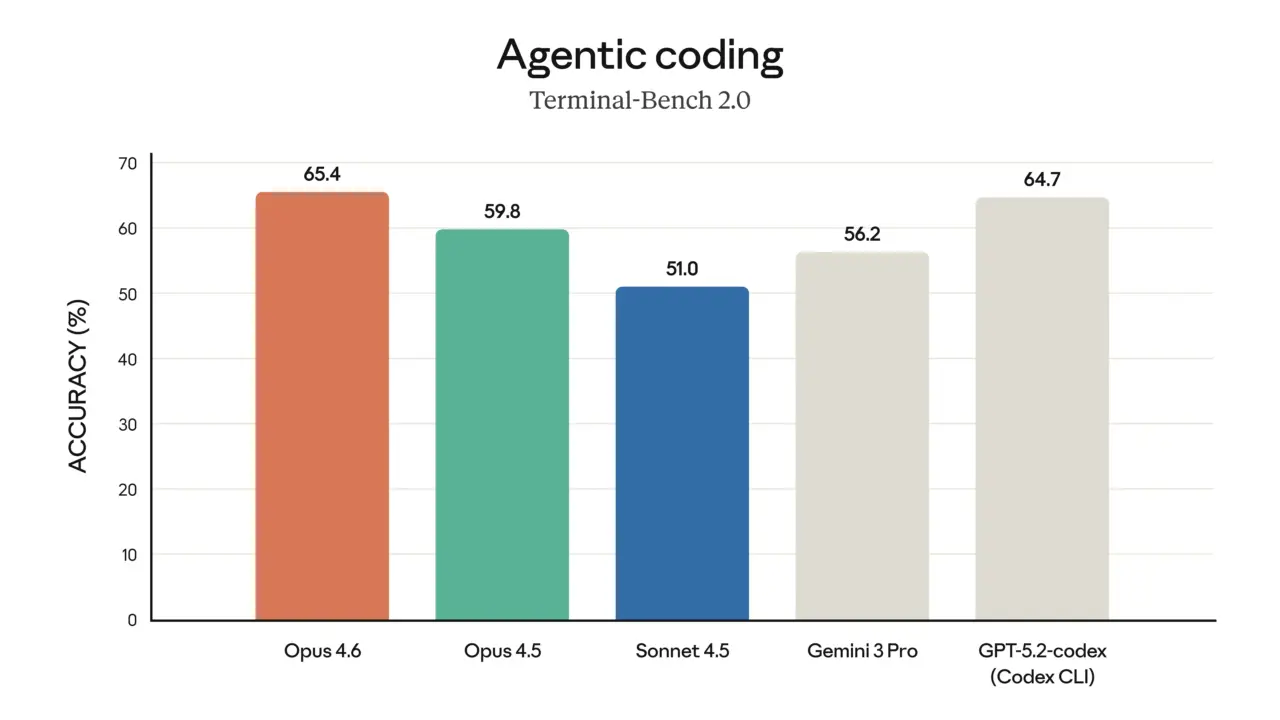
Opus 4.6 also leads all other frontier models on Humanity’s Last Exam, a complex multidisciplinary reasoning test designed to assess capabilities across mathematics, science, and humanities. Leading this diverse evaluation indicates breadth of knowledge beyond narrow technical domains.

The GDPval-AA evaluation, which measures performance on economically valuable knowledge work tasks in finance, legal, and other domains, provides additional validation of practical utility. Unlike academic benchmarks that may not reflect real-world applications, GDPval-AA focuses on tasks with measurable economic value, such as contract analysis and financial modeling.

In specialized domains, Claude Opus 4.6 achieved 90.2% on BigLaw Bench, the highest score of any Claude model on this legal reasoning benchmark. Security testing showed the model outperformed Claude 4.5 in 38 of 40 cybersecurity investigation tests, demonstrating improved capabilities for threat analysis and vulnerability assessment.
Breadth of benchmark leadership across coding, reasoning, legal analysis, and security testing indicates Anthropic’s development focus on versatility rather than narrow optimization. While competitors may lead individual benchmarks, Opus 4.6’s consistent top-tier performance across diverse evaluation types suggests a more generalizable capability architecture.
This positions the model advantageously for enterprise deployments where tasks rarely fit neatly into single-domain categories.
Enterprise Validation
Beyond benchmark scores, real-world deployments provide concrete metrics supporting Anthropic’s claims. Rakuten deployed Claude Opus 4.6 to autonomously manage a 50-person organization across 6 repositories, closing 13 issues and assigning 12 in one day.
“Claude Opus 4.6 autonomously closed 13 issues and assigned 12 issues to the right team members in a single day, managing a ~50-person organization across 6 repositories.”
Rakuten representative, Early Access Partner (via Anthropic)
The claim of autonomously managing a 50-person organization represents one of the more ambitious AI deployment scenarios publicly disclosed. If these results prove reproducible at scale, AI systems may soon handle coordination tasks previously requiring human managers.
Box reported similar improvements, with their evaluation showing Claude Opus 4.6 delivered 10% performance improvement over baseline measurements. These results suggest the benchmark gains translate into measurable productivity increases in production environments.
A 10% improvement in AI-assisted workflows compounds over time, potentially yielding substantial efficiency gains for enterprises adopting the technology.
The Rakuten and Box deployments reveal a pattern where enterprises deploy Opus 4.6 for fundamentally different use cases, such as organizational coordination versus workflow optimization, yet both report meaningful efficiency gains.
This versatility in enterprise application suggests the model’s architecture supports diverse deployment patterns without extensive customization, therefore reducing the barrier to adoption for organizations evaluating AI integration.
Partner Perspectives
Early access partners provided additional validation across different use cases. Notion emphasized the model follows through on complicated requests, breaking them into concrete steps, executing, and producing polished work even when the task is ambitious.
Cognition noted the model reasons through complex problems at a level not seen before, considering edge cases other models miss. Thomson Reuters highlighted the model’s meaningful leap in long-context performance and consistency with large information bodies. For research-intensive industries, this capability reduces the time spent manually cross-referencing documents and synthesizing information from multiple sources.
Lovable described the model as an uplift in design quality that works beautifully with design systems. The convergence of partner feedback around reliability, edge-case handling, and autonomous execution indicates Anthropic has addressed pain points that previously limited AI adoption in production environments.
This alignment between technical capabilities and business requirements therefore strengthens the model’s competitive positioning against alternatives that may require more hands-on management.
Conclusion
Claude Opus 4.6 represents Anthropic’s attempt to combine enhanced coding capabilities with expanded context window capacity. The model demonstrates top-tier performance across multiple benchmarks while showing measurable productivity gains in enterprise deployments.
The window for competitive advantage through AI adoption is narrowing rapidly. Rakuten’s experience managing a 50-person organization demonstrates these systems can independently coordinate human teams at scale, while Box’s 10% productivity improvement shows these gains compound meaningfully over time.
For the developers, analysts, and knowledge workers whose daily workflows will be reshaped by these tools, the question is no longer whether AI will transform their work, but which organizations will adapt quickly enough to define the new standards rather than struggle to meet them.
Anthropic has placed its bet on autonomy, and now enterprises must decide how much control they are willing to delegate before their competitors make that choice for them.